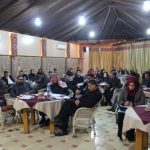
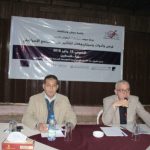
Session: «The solutions Israel puts forward for the Palestinian question»
Writers, analysts and Israel-affairs specialists in Gaza discussed a position paper on «The solutions being proposed and scenarios for influencing Israeli public opinion», by Antoine Shalhat, director of the Israeli Scene unit at MADAR.
- Date
- 2018-01-21
A number of writers, analysts, and specialists in the Israeli affair in the Gaza Strip discussed a position paper on “The proposed solutions and the scenarios of influencing Israeli public opinion”, by Mr Antoine Shalhat, the researcher in Israeli affairs and director of the “Israeli Scene” unit and the translation unit at the “Madar” centre.
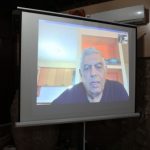
The paper's author, Mr Antoine Shalhat, was hosted via Skype from the city of Acre to present and discuss what the paper raised, and Mr Akram Atallah, the writer specialised in the Israeli affair, presented a commentary on what it contained, with the goal of enriching it and setting observations on the most prominent of what the paper took up.
The session was opened by Omar Shaban, director of the “Pal-Think” for Strategic Studies institution, welcoming the attendees and the participants.
Shaban said: “Pal-Think strives to shed light on essential issues that concern the Palestinian cause, through contact and communication with the thinkers and writers to exchange knowledge, in an endeavour to enrich Palestinian thought and build the Palestinian strategy”.
Omar Shaban praised the research paper, which aims at reading and analysing the Israeli debate around the options of settlement with the Palestinians and the extent of its influence on public opinion.
In his turn, the researcher Antoine Shalhat reviewed the axes of his paper, which focuses, exclusively, on the scenarios of influencing Israeli public opinion and understanding the general directions in Israel regarding the options of the political settlement.
Shalhat said: “This paper was prepared after Trump's declaration of Jerusalem as Israel's capital, and the paper's subject was the scenarios and solutions raised within the Israeli political and intellectual arena.
He added that the paper set out by reading the latest developments published and written in the state of the Israeli occupation, setting out on the occasion of the passage of half a century since the occupation of '67, which represents a turning point in the history of the Palestinian-Israeli conflict.
The paper points to four options raised in the circles of Israeli public opinion and the circles of the Israeli forces: the first is the option of two states for two peoples; the second option is the option of one state with Israeli sovereignty over Judea and Samaria; the third is keeping the existing situation, which is the option the current Israeli government adopts; as for the fourth option, it is an option as it is circulated, “one homeland for two peoples” — an unconventional option confined to a specific category.
The researcher reviewed in the paper the Israeli debate around the settlement options regarding the Palestinian political entity, deficient in sovereignty and geographically dismembered, in addition to the annexation project for areas of the territories occupied in '67.
Shalhat continued regarding the settlement enterprise and Netanyahu's statements on the end of the policy of evacuating settlements, pointing in the paper to the subject of Jerusalem and the Israeli consensus on keeping Jerusalem unified under Israeli control.
In his turn, Mr Akram Atallah, the writer specialised in the Israeli affair, commented on what the paper took up, saying: “The paper carries valuable information and points to an important issue for studying the debate underway in Israel and the coming solutions regarding the political settlement”.
Atallah said: “Israel no longer has a horizon for dealing with any solutions, in light of the phenomenon of the control of the nationalist and religious rightists — a unique phenomenon, and there is an overlap between the two”.
Atallah pointed out that the paper reviewed what is raised in Israel, and we need how we can work to reach the settlement.
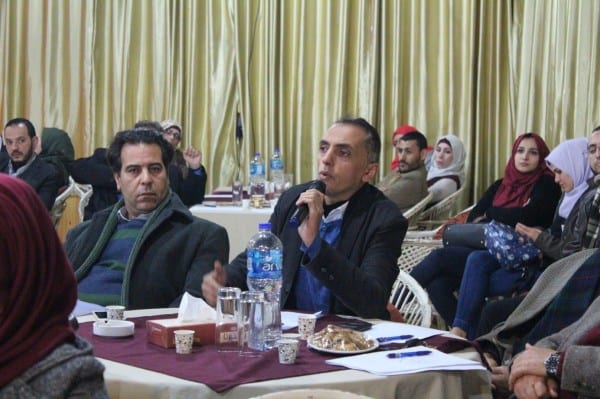
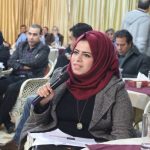
The participants affirmed in their interventions the importance of the paper and what it presented of the debate inside the occupation state around the subject of the political settlement and the proposed solutions, and the analysis of the scenarios of influencing Israeli public opinion, while raising some observations and questions about what the paper contained.
It is recalled that this session comes within the project “Building the strategic capacities of the official and civil institutions in Palestine”, organised by the “Pal-Think” for Strategic Studies institution in cooperation with the Palestinian centre for Israeli studies “Madar” and the Palestine Strategy Group.