Pal-Think discusses a paper on COVID-19's effects on Gaza's economy
Pal-Think held a Zoom discussion of the research paper «The corona crisis's effect on Gaza's economic sector», with deputy economy minister Dr. Rushdi Wadi and garment-industries union head Tayseer Al-Ostaz participating.
- Date
- 2021-01-02
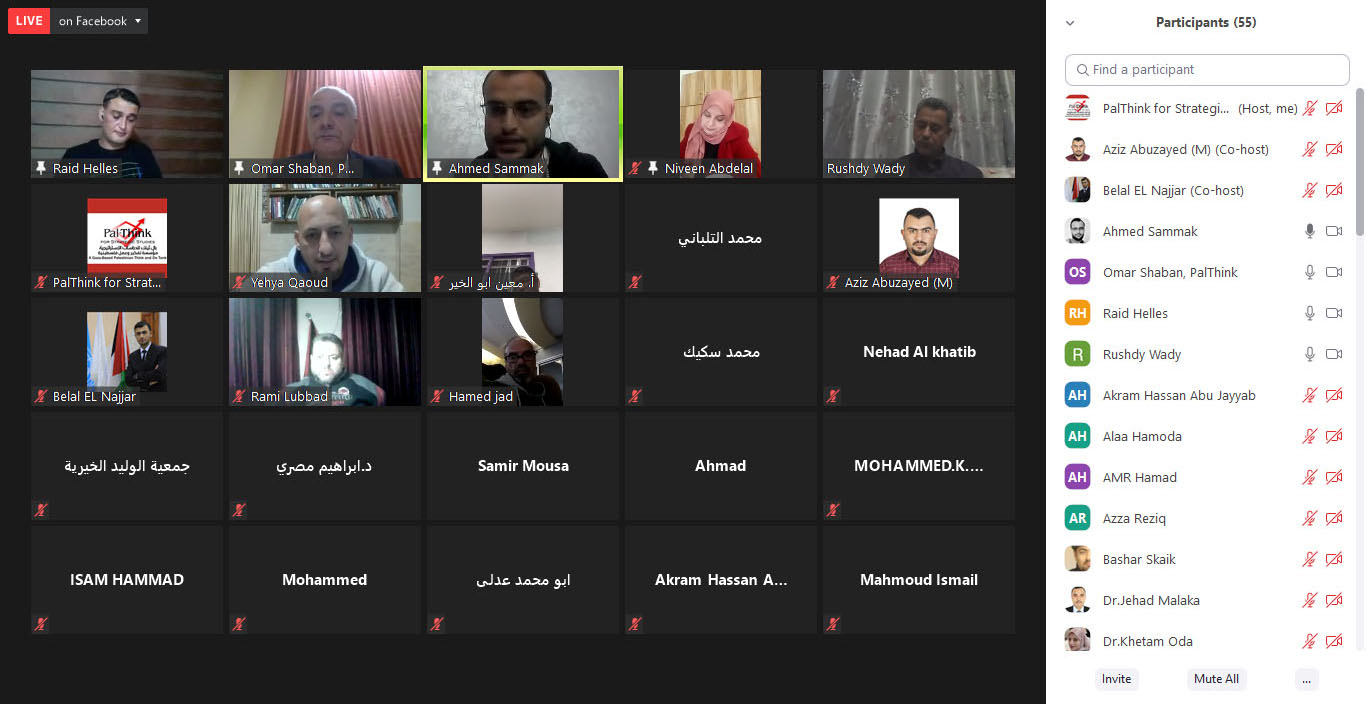
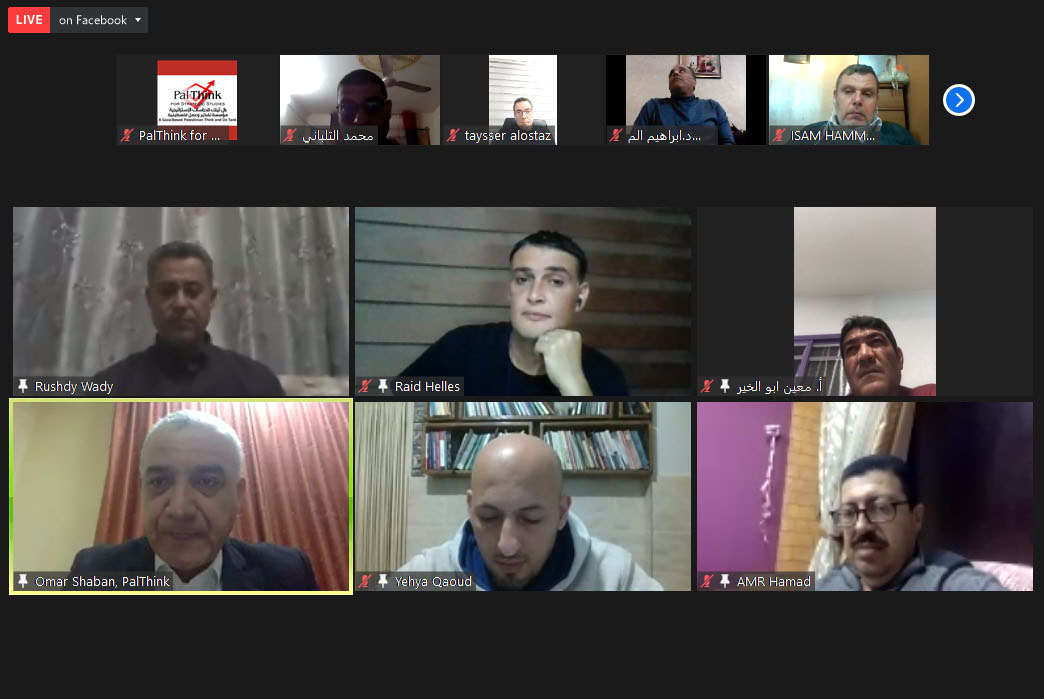
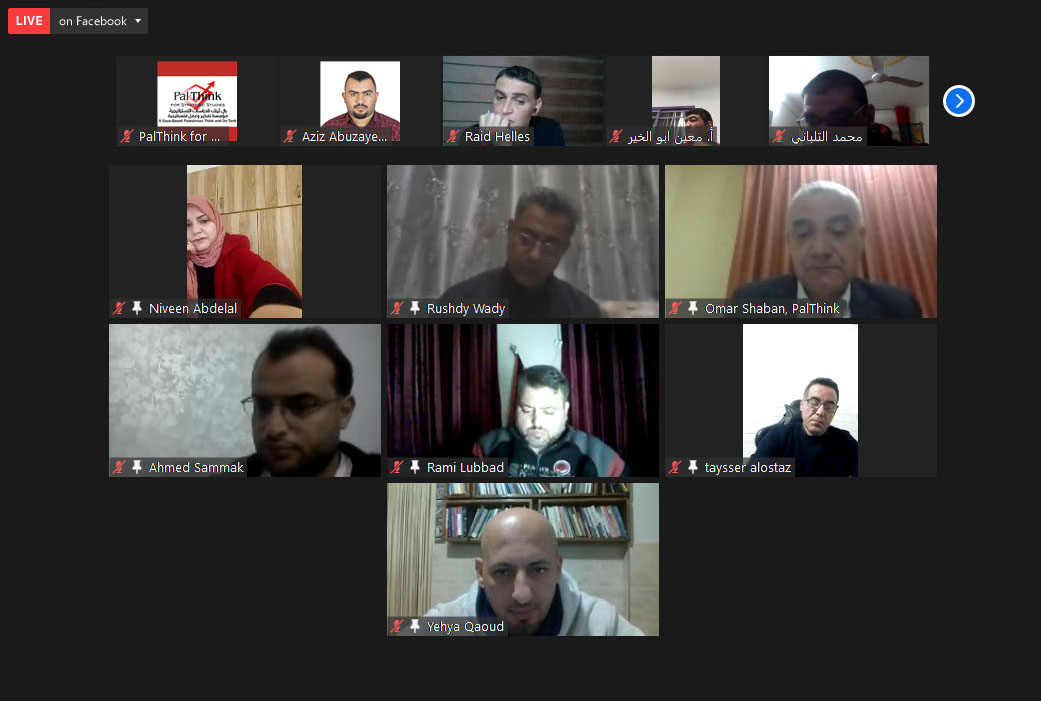
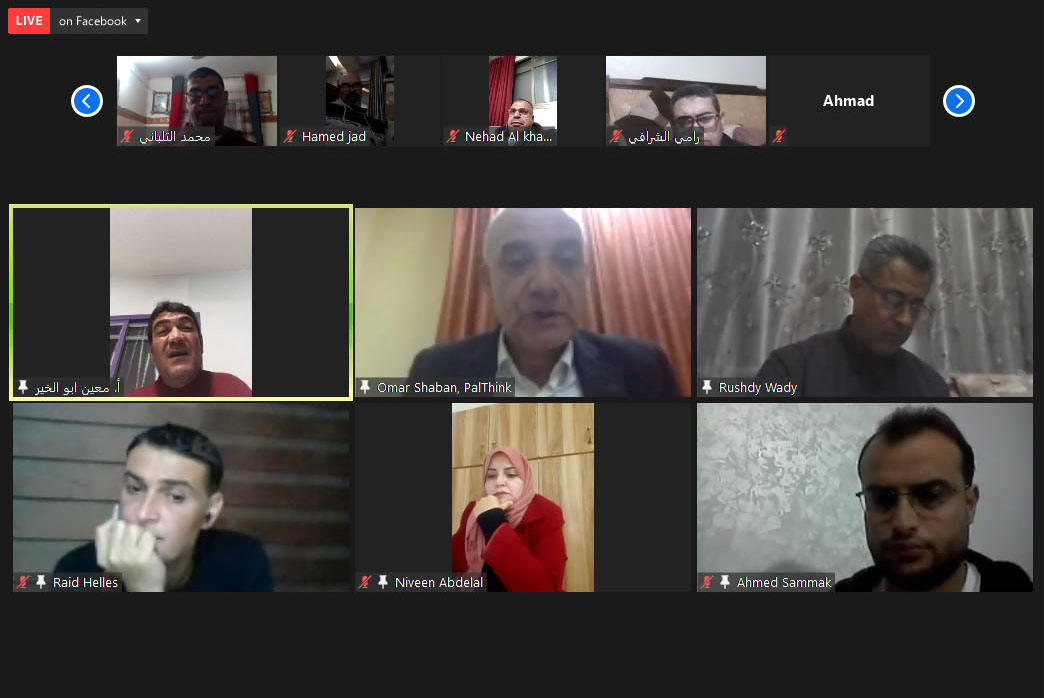
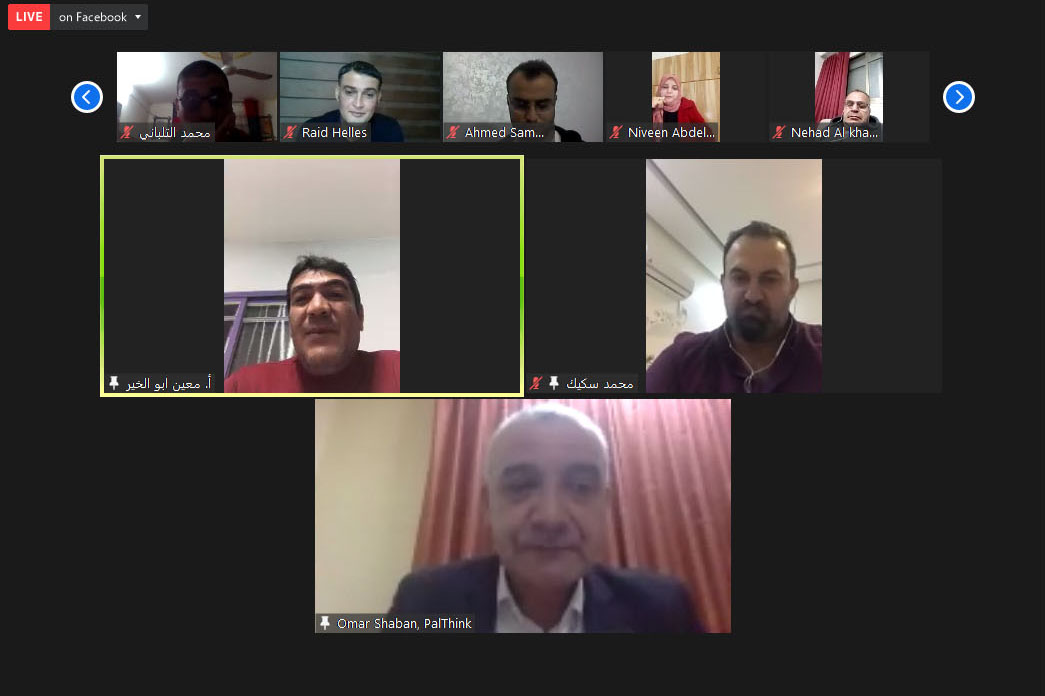
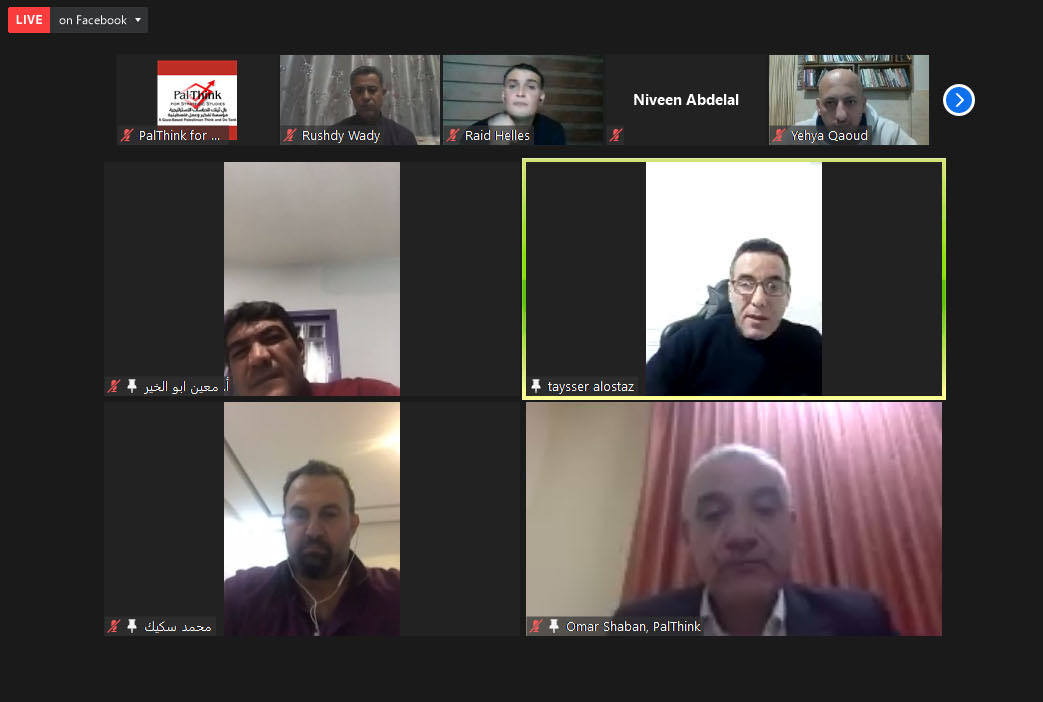
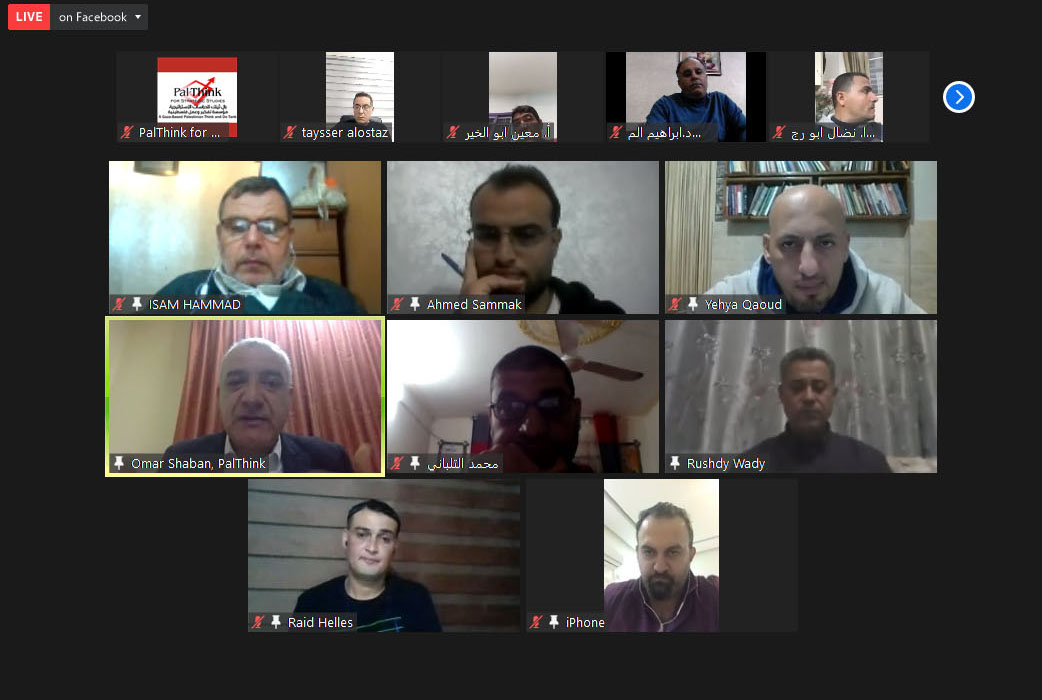
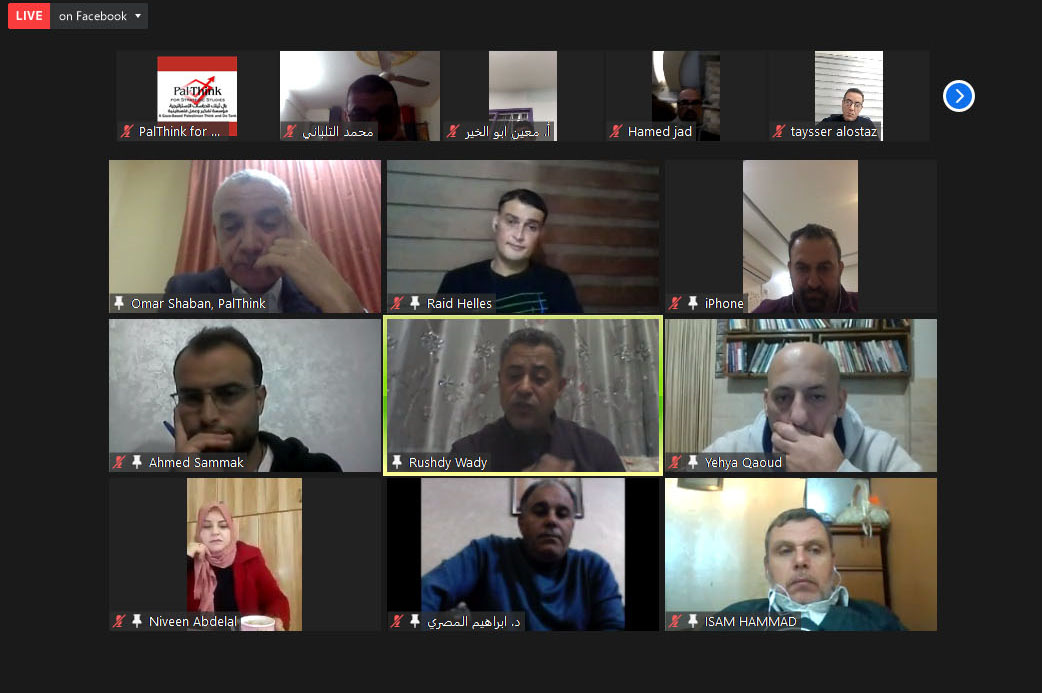
Pal-Think for Strategic Studies organised a discussion session via the Zoom programme to discuss a research paper titled “The effect of the corona crisis on the economic sector in the Gaza Strip”, with the participation of the undersecretary of the Ministry of Economy in Gaza, Dr Roshdi Wadi; the head of the clothing-industries union, Mr Tayseer al-Ostaz; the director of the Palestinian body for restaurants, hotels, and tourism services, Mr Moeen Abu al-Khair; the director of the Palestine Trade Centre PalTrade, Mr Mohammed Skaik; the deputy of the contractors' union, Mr Osama Kuhail; and an assembly of researchers and representatives of civil society organisations.
The session was opened by the institution's director, Mr Omar Shaban, welcoming the attendees, and he said: “Pal-Think is an independent, non-profit civil institution aiming to reach the truth and present it, with a long record in communal reconciliation — it produced the reconciliation paper in partnership with the Swiss Representative Office, which treats the employees file. Pal-Think works to bring in new young competencies and give them opportunities to present themselves. And it strengthens sober, neutral, balanced scientific research.” He pointed out that the Palestinian private sector — which forms the locomotive of economic development and has a great role in creating work opportunities and in achieving development — has been living continuous crises since the beginning of the blockade and the division, and the corona crisis came to pour oil on the fire. Shaban reported that although the private sector has been subjected to multiple crises, some tied to internal factors and some tied to international circumstances such as the scarcity of international funding, the blockade, and the prevention of the entry of some goods and of export, and some economic sectors were damaged because of the corona crisis — yet some other sectors benefited, and this is an indicator of the economic sector's capacity to adapt and benefit from crises.
For his part, the undersecretary of the Ministry of National Economy, Dr Roshdi Wadi, thanked “Pal-Think” for the encounter and praised the research paper, then said: “Our economy, before the corona crisis, was a fragile and weak economy. We are in a true crisis in all its dimensions, and the current situation needs planning teams. The economy was not the true priority during the coronavirus pandemic in the Gaza Strip; despite that, four months ago we founded what is called the government economic council, in which are the Ministries of Finance and Agriculture and experts from every vital sector.” He pointed out that they restored the policies committee (the former Ministry of Planning) for all the ministries.
For his part, the researcher Dr Raed Hilles spoke of the paper, which took up the effect of the corona crisis on the Gaza Strip, which lives difficult economic circumstances embodied in the repercussions of the tightened Israeli blockade — not to mention the negative effects of the Palestinian division, which affected the Strip's share of the budget and the humanitarian help, and the aggravation of the tightened precautionary measures that affect the economic reality negatively, indeed threaten it with collapse.
The assistant researcher Ahmed al-Sammak reviewed the economic sectors damaged by the corona crisis, namely: the tourism sector, the industrial sector, the agricultural sector, the construction sector, the transport sector, the commercial sector, and the information-technology sector.
As for the assistant researcher Nevin Abdel Aal, she spoke of the economic sectors that benefited from the corona crisis, namely: the clothing and textile industry sector, the food-industries sector, and the sector of chemical industries and medicine-making.
The paper concluded with recommendations, namely: balancing between the health side and the economic side through coexisting with the crisis and practising economic activity gradually and tangibly; providing economic and social protection for the harmed; and developing the economic sectors and achieving the elements of sustainability through setting government plans that take account of the crisis's repercussions.
For his part, the head of the clothing-industries union, Tayseer al-Ostaz, commented by saying: “We benefited from the corona crisis through export, and most of the exports were protective clothing and masks for the West Bank.” He pointed out that there are 50 sewing factories in the Gaza Strip that were damaged because of the closure of the schools, and because of the imported clothes owing to some merchants' non-adherence to the government policies.
In a connected context, the director of the Palestinian body for restaurants, hotels, and tourism services, Mr Moeen Abu al-Khair, pointed out that the tourism economy is the second economy worldwide after the technology and communications sector. The volume of investment in the tourism sector in the world is close to a trillion dollars; in Palestine the volume of investment in the tourism sector reaches 13 billion and 800 million dollars, while in the Gaza Strip investment in the tourism sector reaches close to a billion dollars, divided into hotels, restaurants, cafés, and wedding halls. Mr Moeen Abu al-Khair made clear that the most important impediments are: the Israeli blockade, the closure of the crossings, and the Palestinian division — and the coronavirus pandemic came to strike the internal tourism on which the tourism sector in the Gaza Strip relies. He likewise demanded tax exemptions from the government and intervention from the international community.
For his part, the director of the Palestine Trade Centre PalTrade, Mr Mohammed Skaik, pointed out that the commercial sector in the Gaza Strip is affected by the corona crisis because of the weakness of purchasing power, which formed a crisis in providing cash liquidity — because of the impediments the Israeli side places, and the impossibility of building a strong economy without export. He said: “Civil society institutions and the government must discuss with the funder and convert the funding's goal from relief to development. And the most important thing is the employment funds. And there must be coordination between the experts and the private and government sector.”
Returning to the undersecretary of the Ministry of Economy, who spoke of his ministry's role during the crisis, and said: “I want to point out that our capabilities as a government are very, very weak, and were it not for the relief organisations and the work-for-money projects, matters would have been more complicated and difficult. But the crisis was greater than us and our capabilities.” He pointed out that the private sector's losses were estimated at 61 million dollars during the month of March 2020, in addition to 114 thousand workers who became unemployed; and with the end of 2020 the losses approached a billion dollars. Dr Roshdi Wadi said: “As for the government's interventions: it built the field hospital at a value of 170 thousand dollars; 100 thousand dollars and 95 thousand shekels were disbursed to the Ministry of Interior to cover its expenses and the expenses of the quarantine; emergency financial advances were disbursed to the Ministry of Social Development at a value of 400 thousand shekels; a million shekels were disbursed to the municipalities; and compensation was presented to the harmed of the agricultural sector at a value of a million dollars, because there was fear of a shortage of the goods stock in the Gaza Strip.”
The undersecretary of the Ministry of National Economy in Gaza added: “The government's revenues in Gaza rest on the fuel and tobacco tax. The fuel-tax revenues fell by 2 million shekels monthly, because of the stoppage of the universities and of movement generally. And the value-added fell by close to 2 and a half million dollars monthly, in addition to the fall of the ministries' revenues.”
As for the interventions to ease the economic effects of the corona crisis, Dr Roshdi Wadi said: “We presented a 50% exemption on the industrial city, and carried out a package of complete and partial exemptions in several ministries.” He pointed out that a plan was set with the clothing-industries union on the import of clothes. As for the subject of exports, it is the subject of most attention, and we exempted the exporters from taxes. And we have a decision not to close export in any case whatsoever, even at the expense of the rise of local prices. And among the plans is that part of the budget goes to investment in small projects, and we give priority to remote work.” He concluded by saying: “The Ministry of Health prefers the complete closure to face Corona; as for us, we wanted to lift the ban completely — but in the end we reached a balance with the Ministry of Health and agreed on the partial closure.”