Pal-Think holds a dialogue with Oraib Al-Rantawi on the Palestinian situation and the region
In a Pal-Think dialogue, Oraib Al-Rantawi argued the Palestinian division is destroying the cause and opening the door wide to regional interference — four regional axes shape the Palestinian situation, and the deal of the century threatens Palestine first and Jordan second.
- Date
- 2019-09-19
- The Palestinian division is destructive to the Palestinian cause and has opened the field wide to the region's interventions.
- Four axes in the region affect the Palestinian situation.
- The deal of the century threatens Palestine first and Jordan second.
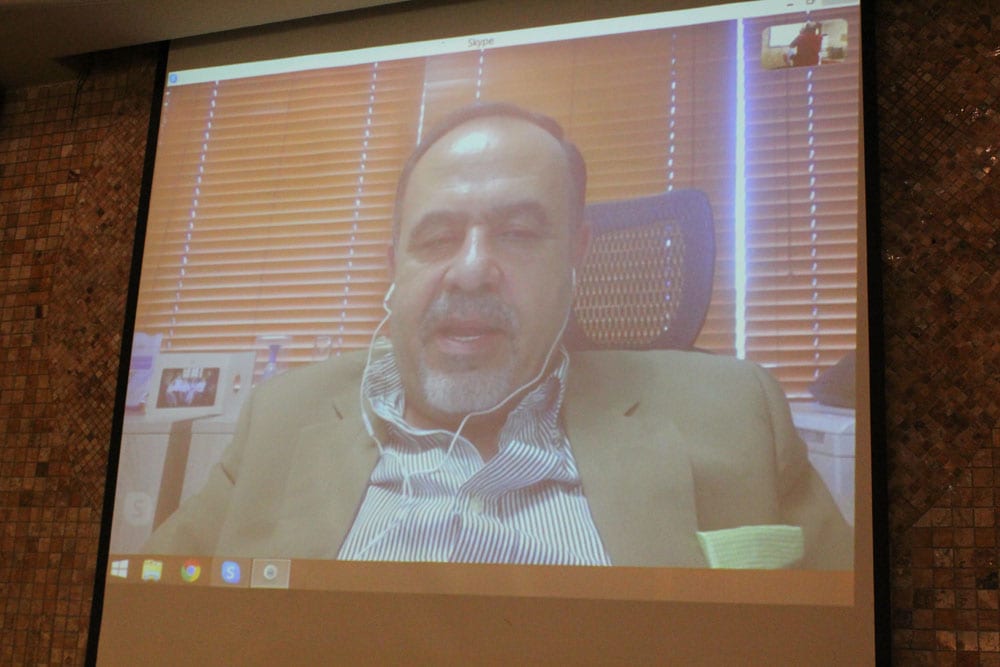
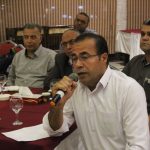
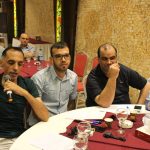
Gaza – In pursuit of the philosophy of Pal-Think for Strategic Studies in deepening constructive discussion and thought and raising the issues that concern the Palestinian affair at the regional and international level, Pal-Think for Strategic Studies organised a dialogue meeting on the Palestinian situation and the region, and hosted via Skype from Jordan the writer and political analyst Dr Oraib al-Rantawi, director of the al-Quds Centre for Studies, with the attendance of a gathering of writers, researchers, academics, businessmen, and representatives of the Palestinian organisations.
Mr Omar Shaban, director of Pal-Think for Strategic Studies, opened the session by welcoming the attendees and thanking them for the valuable participation enriching the discussion; he also introduced Dr Oraib and thanked him for his research paper, which he reviewed and discussed during the meeting.
Al-Rantawi began his talk with the point that the year 1979 was a decisive year that shaped the region's features and axes: this year witnessed the exit of Egypt, the greatest Arab power, from the Arab-Israeli conflict with the signing of the Camp David agreement, and the victory of the Islamic revolution in Iran and the removal of the Shah, ally of Israel and the United States, for Iran to become a regional player whose rise re-sorted the regional axes. This year also witnessed the appearance of what is known as jihadi Salafism and its active role in the region, beginning with the conciliation with the United States and the appearance of Afghan jihadi Salafism, and its exploitation to confront the Shia after the revolution's victory in Iran; this year also witnessed the military coup in Pakistan and the rise of the symbols of jihadi Salafism in it and the rise of the level of confrontation with India.
Al-Rantawi also reviewed the developments subsequent to this year, from the Iraqi-Iranian war and the installing of Iraq to confront Iran; he also took up King Fahd's peace initiative, which the Palestinians rejected, for there to begin, a year after it, the war of destroying Beirut and expelling the Palestine Liberation Organisation, for the initiative to be presented again at the Fez summit in 1982.
Al-Rantawi also took up the peak of the rise of Salafism and terrorism in the events of 11 September 2001, most of whose accused were Saudi citizens, and the escalation of the discourse against terrorism and the Muslims. This stage also witnessed the proposal of the Arab peace initiative at the Beirut summit of 2002, and the insistence of the Lebanese president Emile Lahoud on adding the refugees item to the initiative, motivated by the depth of their cause and its effect on the Lebanese arena.
This period also witnessed the presentation of Afghanistan and Iraq as an unexpected gift to Iran after their invasion by the United States, for Iraq to turn from a dam into a bridge for Iran; and this stage began witnessing the policy of getting rid of the jihadi Salafism hostile to the traditional Islamic groups and the Shia, to Iran's benefit.
All these developments affected the cause of Palestine: that period witnessed the victory of the Hamas movement in the Palestinian general elections, and witnessed the re-raising of the theory of the Shia god and the Iranian rebellion, and the restoration of standing to jihadi Salafism to confront the Shia.
Al-Rantawi also reviewed the developments of the Arab Spring in 2010: the states of moderation looked at the Arab Spring as a danger and the counter-revolution began. The Iran axis saw in the Arab Spring a victory, until the Arab Spring reached Syria, whereupon it turned into a conspiracy in this axis's view.
Al-Rantawi sees that this period witnessed a repositioning of the axes, which he divided into four axes:
1- The Gulf axis, which sees in Iran a great danger, which has led to a Gulf-Israeli rapprochement and American cooperation — and naturally the price of this rapprochement and cooperation will be paid from the Palestinians' pocket; indeed the deal of the century was cooked in some Gulf capitals. This axis maintains lukewarm relations with the Palestinian Authority, with the exception of Saudi Arabia, and it is also hostile to the current of political Islam and the Hamas movement.
2- The Jordanian-Egyptian axis, which is counted among the states of Arab moderation and has peace relations with Israel, and knows that it will pay, at some moment, the price of the deal of the century — especially Jordan. It has excellent relations with the Palestinian Authority and a relation of necessity and fait accompli with Hamas.
3- The Qatari-Turkish axis, which has advanced relations with Israel and with political Islam, and also has natural relations with the Palestinian Authority and the Hamas movement, and takes upon itself the political rehabilitation of the Hamas movement.
4- The axis of resistance and defiance — this axis does not adopt ideas about the Palestinian state; its relations are lukewarm with the Palestinian Authority, and changeable with the Hamas movement, which betrayed this axis with its position on Syria, and Iran is now making attempts to restore the relation between Hamas and the Syrian regime.
Al-Rantawi sees that these axes are not fixed, and are subject to political changes and fluctuation in positions. He mentioned that the increasing influence of the regional powers such as Turkey, Iran, Qatar, and others is a result of the gradual withdrawal of the great powers such as the United States from the Middle East. He sees that the Palestinian division has harmed the Palestinian cause when the Palestinian forces came to seek the aid of these axes against one another at home and abroad.
It falls upon the Palestinians how to benefit from an expected disintegration of these axes, and how they can be employed, without positioning oneself within them, in the service of the Palestinian cause — in light of the fraying of the Saudi-Emirati axis after the entanglement in the Yemen war, the return of the Qatari-Iranian and Turkish-Iranian relations, with the return of the Arab Spring wave in Sudan and Algeria and the possibility of the outbreak of a third wave of the Arab Spring in some Arab states. Al-Rantawi sees the probability of the appearance of new influential powers in the region that must be followed and positive relations built with them to strengthen the Palestinian position on the international arena, and especially in the United Nations, where the State of Palestine has begun losing many of its supporters in South America and Africa. Among those rising powers he mentioned the state of Ethiopia.
Al-Rantawi sees that no one has a conception for the impasse of the Palestinian division, and sees that the Palestinian situation has entered a stage of political wandering among the elites and public opinion, and what is required is re-agreeing on the definition of the national project and specifying its suitable instruments, the necessity of rejuvenating the Palestinian frameworks, and re-searching for new formulas for the internal Palestinian relation in light of the failure to end the division. And openness to the Arab peoples — this card that Palestine lost when it dealt with itself as if it were a state facing a state, and not a liberation movement striving to obtain a state.
The meeting concluded with a round of interventions and questions from the attendees, the most prominent of which was al-Rantawi's affirmation of the necessity of renewing the aged leaderships to represent the “young” Palestinian people, brimming with youthful competences, in reply to a question from one of the attendees about the practical steps that can be adopted in order to improve the reality. Al-Rantawi also answered another question — that he had spoken of the Arab picture as if it had a negative role and were an “object acted upon” — by saying that the Arab states interact with the reality imposed upon them and the variables that arise in their surroundings without bringing about an effective change springing from an Arab will, and he stressed the necessity of entering a different stage in which the Arabs stand in the position of the “actor”, not the “acted upon”. The discussion round was followed by thanking the attendees for their listening and participation, and thanking Dr Oraib al-Rantawi for his enriching and affecting discussion.