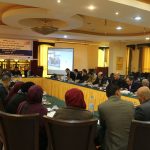
A session on neoliberalism and its effect on Israeli policies
Writers, analysts and Israel-affairs specialists in Gaza discussed a position paper on «Neoliberalism and the rise of new forces in Israel and their effect on Israeli policies», by researcher Khaled Anabtawi, hosted by Skype.
- Date
- 2018-02-07
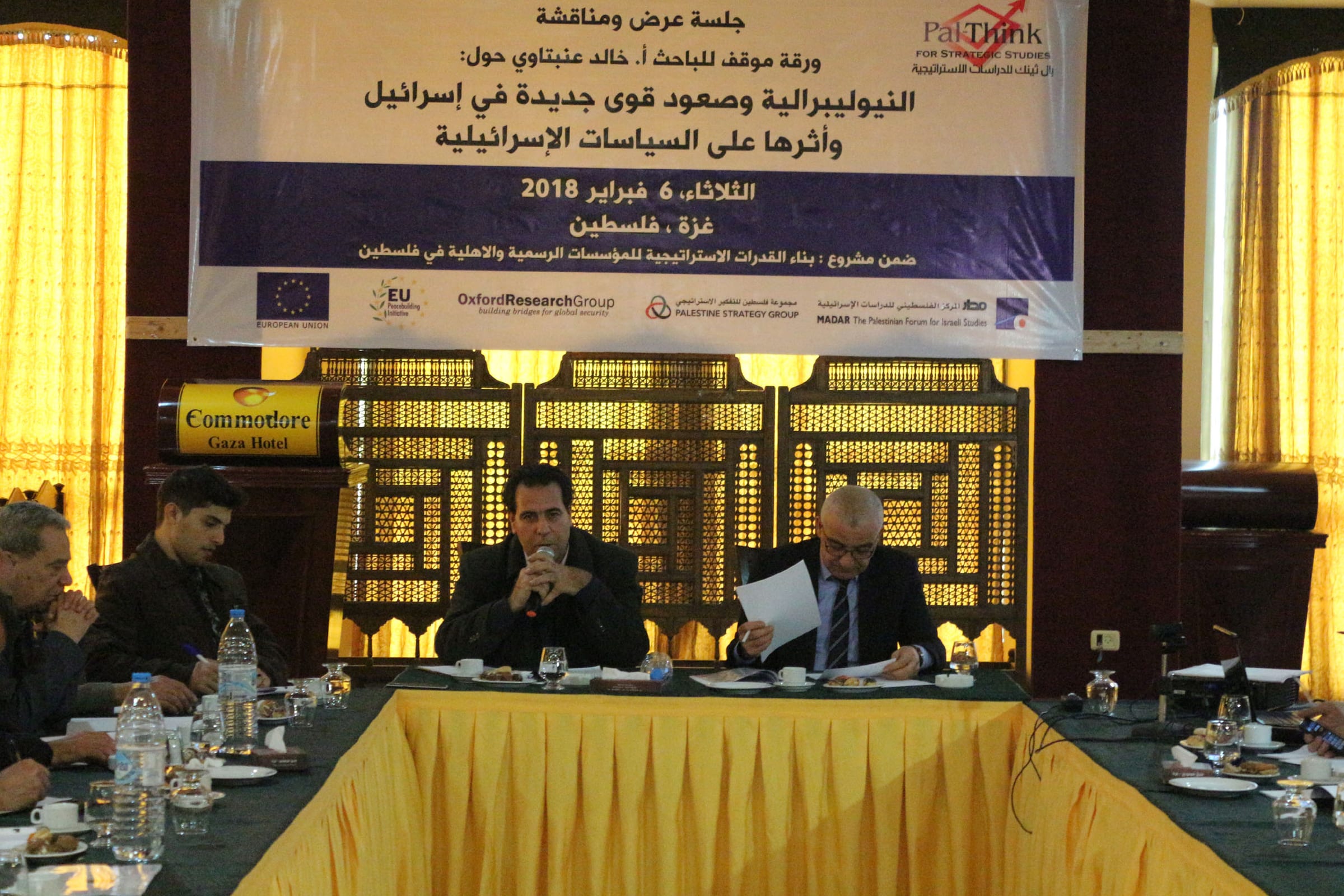
A number of writers, analysts, and specialists in the Israeli affair in the Gaza Strip discussed a position paper on “Neoliberalism and the rise of new forces in Israel and its effect on the Israeli policies internally and externally”, by the researcher Khaled Anabtawi, specialised in Israeli affairs, who was hosted via Skype from the city of Haifa to present and discuss what the paper raised. Dr Wajih Abu Zarifa, professor of political science and the writer and political analyst, presented a commentary on what it contained, with the goal of enriching it and setting observations on the most prominent of what the paper took up.
The session was opened by Omar Shaban, director of the “Pal-Think” for Strategic Studies institution, welcoming the attendees and the participants. Shaban said: “The Pal-Think for Strategic Studies institution strives to shed light on the issues that concern the Palestinian affair and the region, in an endeavour to enrich the deep Palestinian discussion and dialogue in a way that helps in building a strategy suited to the local and regional challenges. Omar Shaban praised the research paper, which aims at studying the economic and class dimensions in Israel and that's effect on the Palestinian cause, especially in light of the appearance of the new right connected to the influential economic blocs in Israel and that's effect on the political side in Israel.
The researcher Anabtawi presented a background on the rise of the neoliberal economy in the world, which began in the seventies and came to affect the market economy and its freedom, the emergence of privatisation policies and many manifestations, and the change of the form of political and cultural representation, and he focused on the point that the rise of neoliberalism in Israel came as a result of the world changes. This step formed an announcement of a great turn in the pattern of the Israeli economy, whose headline was the fall of the pattern of the welfare-economy state and the transformation to the pattern of the new liberal economy, with the goal of freeing politics from the pressure of the trade unions and the labour organisations. The researcher touched on the structural relation between the occupation and neoliberalism and the dialectical relation existing between the triangle of neoliberalism, privatisation, and the occupation — where the settlement project formed, in this triangle, an instrument of compensation for the weak economic classes harmed by the privatisation project and the neoliberal economic system, pointing to transformations inside religious Zionism and the formation of a class of the settlers' leadership that pledges its class interest to the neoliberal system. He said that the transformation of the settlements into a compensatory instrument for the fall of the Jewish welfare state led to the Israeli enticements that the government of Israel presents to the settler public, and the size of the governmental privileges presented to the settlements' residents exceeds the privileges and social services for the residents of Israel.
He pointed to the phenomenon of the transformation of the settlers and their leadership into an organic component in the neoliberal Israeli economy, and this accords with the transformation of the occupation and the settlement project into a voluntary instrument in the state's hand to compensate the economically weak classes and strata; therefore these classes have come to see a social class interest of theirs in the continuation of the occupation and the settlement project — as the right's rule guarantees the continuation of the supremacy of the Jewish worker and the curbing of the use of the Palestinian workers through strangling the Palestinian municipalities and besieging them, and thereby the settlement and occupation project is produced.
As for what relates to neoliberalism's relation with the new right and the crystallisation of new political pressure sectors, the researcher Anabtawi said that one can point, for example, to the Shas movement and its continuous drift toward Zionism and the Zionist right as an example of the dialectical relation between the dominant economic pattern and the political orientation — pointing to the relation of some Israeli organisations, such as the Ateret Cohanim association, Elad, Yisrael Sheli, the Im Tirtzu movement, and others, with the Likud party, and the channelling of the projects and budgets accompanying the settlement.
He reviewed the duality of the security stability that leads to political stability, and the relation of the great capital holders to the rule, the funding of the electoral campaigns and the rightist associations, and the control of the media and its direction toward the right — affirming that the settlement project has formed, for the Israeli governments without exception, a central and organic component in the neoliberal system.
Dr Wajih Abu Zarifa affirmed the importance of the subject “Neoliberalism and its effect on the Israeli policies” and thanked Mr Khaled Anabtawi for his preparation and distinguished presentation of the paper. He noted that the arrival of the Israeli right to power has not made the Israeli side a partner in the settlement, especially in light of the Israeli efforts in developing the settlement enterprise and dominating more of the lands — for the settlement option rests on land in exchange for peace, and accordingly there is no longer any possibility of peace, especially as the Israeli right has settled the conflict on its continuing forever without a horizon of solution, in light of its not abandoning the settlement enterprise and the settlements.
The participants affirmed in their interventions the importance of the paper and what it presented of analysis around the subject of neoliberalism and its effect on the Israeli policies, and all affirmed that with the deepening of neoliberalism and privatisation the Israeli economy has come to head more toward the monopolisation of the most important economic sectors by the class of capital holders — and this class has an interest in the continuation of the right's rule, and accordingly the increase of the settlement and the failure of the settlement solution.
It is recalled that this session comes within the project “Building the strategic capacities of the official and civil institutions in Palestine”, organised by the “Pal-Think” for Strategic Studies institution in cooperation with the Palestinian centre for Israeli studies “Madar”, the Palestine Strategy Group, and the Oxford Research Group, with support from the European Union.