A dialogue with Jihad Harb on interim alternatives for achieving national unity
Pal-Think held a Zoom dialogue on the policy paper «Thirteen years after the division: interim alternatives between unity and separation» by researcher Jihad Harb, under its «Dialogue in an Article» programme.
- Date
- 2020-08-10
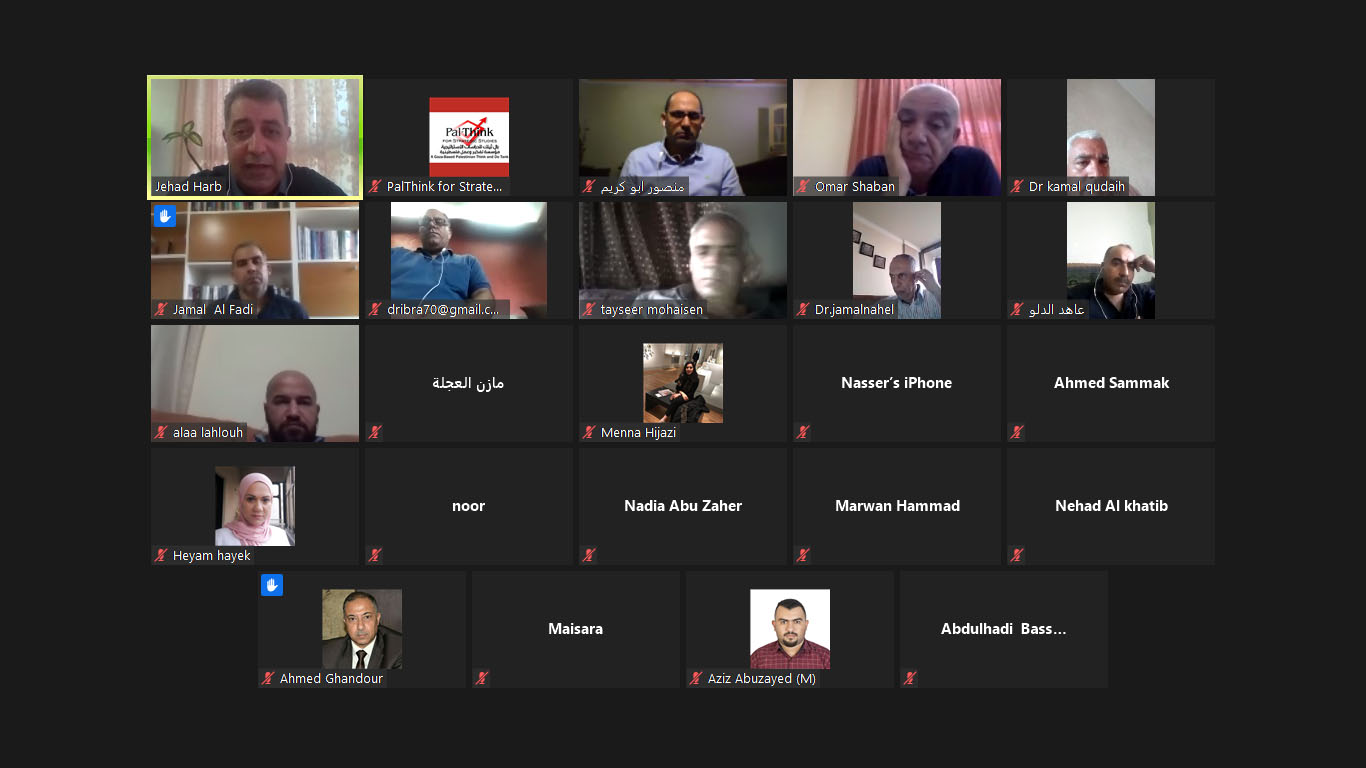
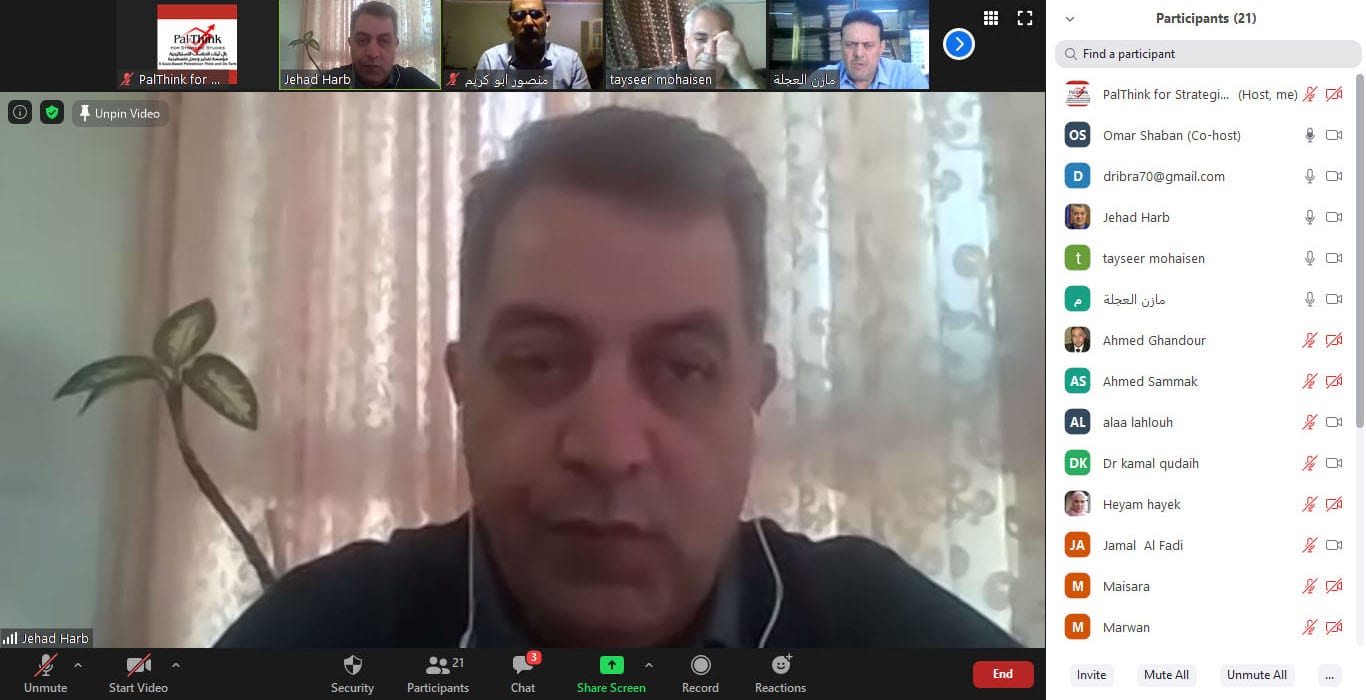
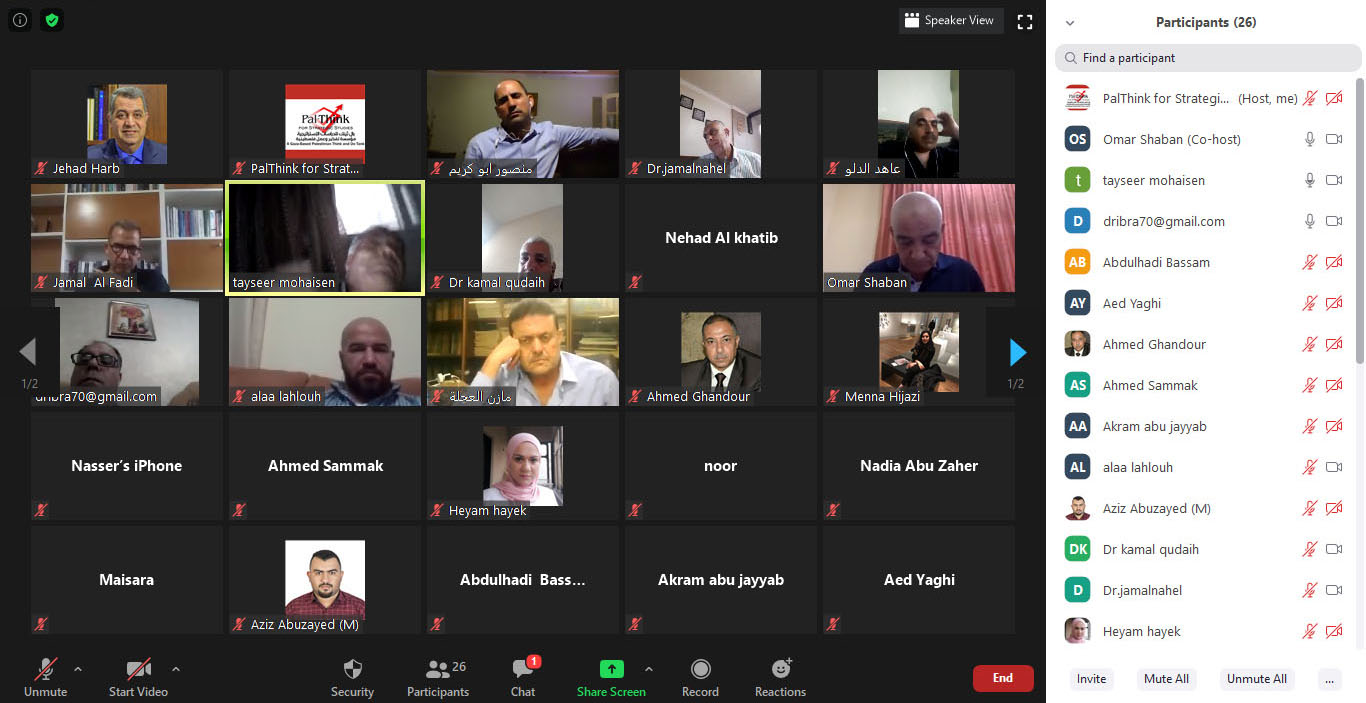
Pal-Think for Strategic Studies organised a dialogue session via the Zoom programme on a policy paper titled “Thirteen years after the division: interim alternatives between unity and separation” by the researcher Jihad Harb, within the programme “Dialogue in an article”, which the institution launched to stir discussion about important Palestinian issues with a group of specialists in the political and economic affair.
The session was opened by the director of the “Pal-Think” institution, Mr Omar Shaban, welcoming the participants, and he said: “In continuation of Pal-Think's work as a Palestinian research and joint-thinking institution working since January 2007, we launch a programme titled Dialogue in an Article, to enrich the discussion about issues that concern the Palestinian people in particular, to shed light on some of the distinguished, high-quality articles that pass by unnoticed without light being shed on them. The dialogue sessions will be held every two weeks, and we will host the writer or the researcher to stir the discussion with a group of specialists in the political and economic affair.”
He added: “This article carried something new, for it rests on the idea that the complete unified reconciliation may not be realised soon, and it is impossible for us as Palestinians to continue in this state (the division). Mr Jihad pointed in his article to some terrifying indicators that show the size of the gap at the economic, social, and psychological level between the two parts of the homeland. Whoever moves between the Bank and the Strip feels the size of the difference. Therefore we must search for middle solutions, to be a bridge that carries us to the future and to the complete national unity at the political and social level.”
It is worth mentioning that this paper was issued by the Palestinian Center for Policy and Survey Research and presented three alternatives and judged them. In his turn, the researcher Jihad Harb began his talk by thanking “Pal-Think” for its efforts, and said: “The conference held by each of: the member of the Central Committee of the “Fatah” movement Jibril Rajoub, and the deputy head of the political bureau of the Hamas movement Saleh al-Arouri, on the second of July 2020, gave some people hope, but in truth the two sides carried no real vision for ending the division. To avoid any confusion, the principal option for me is ending the division, restoring national unity, and unifying the institutions and programmes of the Palestinian Authority. But in light of the current situation and the absence of horizons for ending the division, I set three alternatives, namely: a confederal union between the West Bank and the Gaza Strip, or a federal union between them, or the adoption of administrative decentralisation.”
He added: “The weighing between the three temporary and interim alternatives rests on four considerations, namely: their capacity to shorten the transitional period for ending the division, Palestinian public opinion's acceptance of them, their contribution to drawing the future of state-building, and the extent of their success in building a democratic political system. As for this paper's backgrounds, they are: the popular pessimism spread among the Palestinians and the division, the division's effect on the economic gap between the Bank and the Strip, the future of democracy, and the axes of the regional conflict at the Palestinians' expense.”
He continued: “The first alternative is establishing a confederal union between the Bank and the Strip. This temporary alternative rests on establishing two separate entities or “states”, one in the Gaza Strip and another in the West Bank, but connected by shared economic relations, and their external political positions unified within a joint council before the international community. This alternative allows the possibility of building separate institutional systems and granting them legitimacy through holding elections. The form of the political system and its limits and the kind of economic system can be chosen. But this alternative increases the dangers of political separation between the Bank and the Strip, the possibility of unity not being realised, and the fear of Israel promoting that the Palestinian state exists in Gaza so as to isolate the Bank for itself.”
He went on: “The second alternative: adopting the federal system. This alternative is represented in the existence of a politically and administratively decentralised unity, such that each “region” undertakes to pursue economic policies and a tax system. Also the legal and educational systems may be different. In it there is control by the regional authorities over the security forces. Also the regional authorities derive their political and administrative competence from the constitution, while the central government undertakes the affairs of external relations, the signing of agreements, and defence. This alternative keeps the central unity of the Palestinians in one state while taking into consideration the needs, circumstances, and economic and cultural capacities of the inhabitants of each region separately. It allows the possibility of a democratic system arising in each region and at the national level, considering it a transitional stage for the gradual return to the complete unity of the two regions. But this alternative keeps the possibility of separation standing in light of the existence of two different legal systems, each region holding to the correctness of its system; and it may not realise national unity.”
He added: “The third alternative is adopting decentralised unity, with the existence of a central political authority but with administrative decentralisation. This proposal requires the existence of two administrative regional authorities in the West Bank and the Gaza Strip established by an administrative decision from the central authority, and the competences of each of them can be widened or narrowed, along with what the two undertake of coordinating the plans and efforts of the local authorities in each region — since each region enjoys a degree of internal economic and administrative homogeneity with which it can be considered an independent unit. The central authority undertakes the taking of the principal decisions and the adoption of single economic policies, while the regional and local authorities undertake the adoption of a local tax system and the existence of independent and different local budgets, and the existence of shared elements in the legal and educational system at the state level and others local; and each of the central, regional, and local authorities shares in the control over the security forces according to specified rules — which lightens the central authority's grip on the security apparatuses and contributes to strengthening their professionalism.”
He concluded by saying: “The third alternative is the most able to create this balance in light of the current circumstances, because it provides the mechanisms and instruments of national fusion, strengthens the unity between the West Bank and the Gaza Strip, and observes the needs, circumstances, and economic and cultural capacities of the inhabitants of each region separately. It also allows the adoption of local development on the basis of administrative decentralisation in the country, grants the possibility of holding the general elections to strengthen the legitimacy of the political system, and limits the dangers of the democratic transition. This alternative limits the dangers of separation in the future, unlike the other two alternatives — which harmonises with the position of the majority in Palestinian public opinion, which greatly refuses the possibility of other forms of relationship arising between the two wings of the Palestinian entity, such as confederation or federation.”
The participants' questions turned on the possibility of reforming the Liberation Organization and its role in realising national unity, the dangers of a federal or confederal union arising under the occupation in the West Bank and the Gaza Strip, and the possibility of ending the division completely and applying the previous reconciliation agreements.
To read the researcher's paper: http://pcpsr.org/ar/node/816