A dialogue with Dr. Ibrahim Fraihat on the US withdrawal from Afghanistan and the Taliban's return
Dr. Ibrahim Fraihat of the Doha Institute for Graduate Studies argued the US withdrawal from Afghanistan reduced American influence over the Palestinian–Israeli conflict and proved that change must come from within — resistance is not futile, but it has limits.
- Date
- 2021-09-09
The professor of international conflict resolution at the Doha Institute for Graduate Studies, Dr Ibrahim Fraihat, said that the American withdrawal from Afghanistan reduced the United States' influence over the Palestinian–Israeli conflict, and proved that change must come from within, and that resistance is not futile but has its limitations — pointing to the possibility of the American administration negotiating with the “Hamas” and “Islamic Jihad” movements as it negotiated with the Houthis and the Taliban.
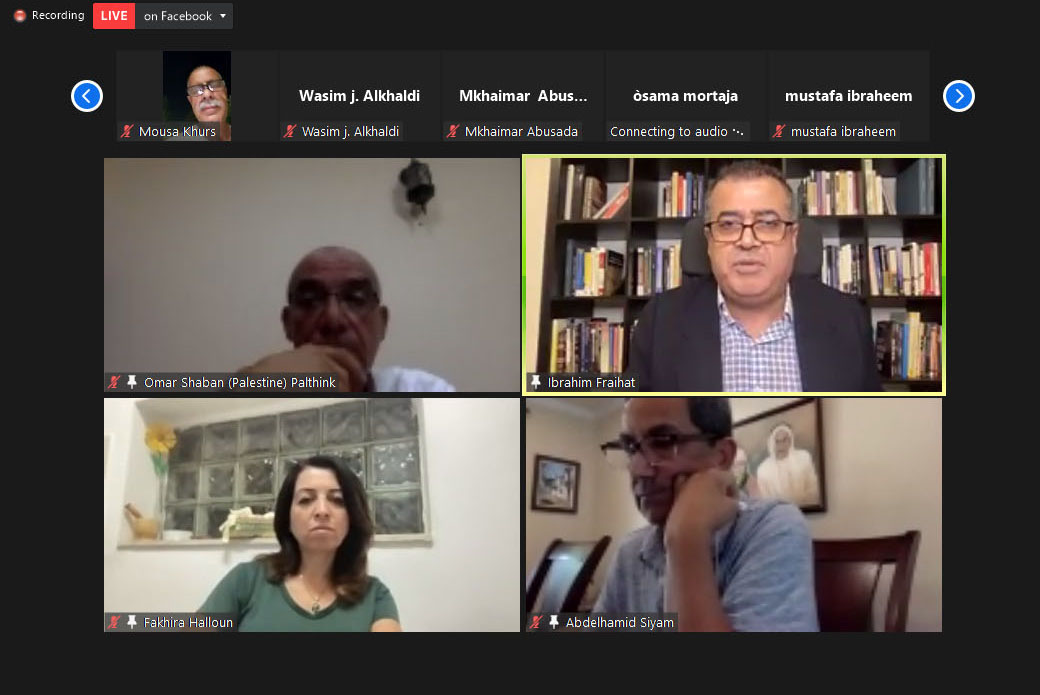
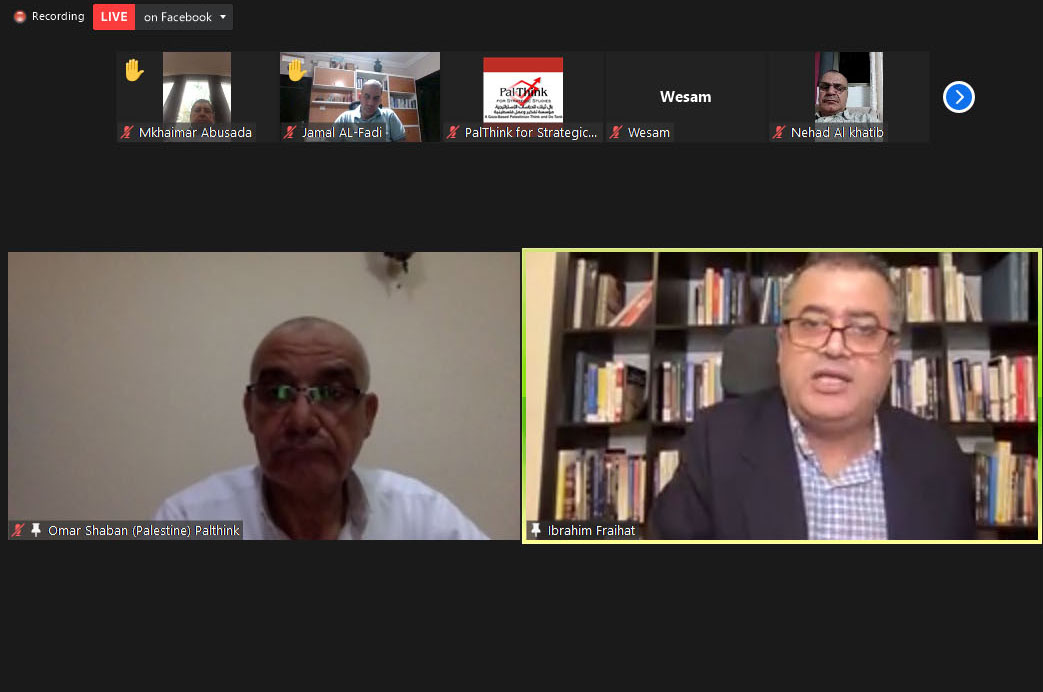
This came during a dialogue session, via the Zoom programme, organised by Pal-Think for Strategic Studies titled “The American withdrawal from Afghanistan and the Taliban's return to power: causes, repercussions, and expectations”, yesterday, Wednesday, with the participation of thinkers, intellectuals, university professors, and others.
The session was opened by the director of “Pal-Think”, Omar Shaban, welcoming the guest and the attendees, affirming Pal-Think for Strategic Studies' role in discussing the issues of Palestine and the world”, and said that the American withdrawal from Afghanistan is a matter of the utmost importance, and commanded intensive coverage from the international media.
For his part, Dr Ibrahim Fraihat said that the growth of the American military presence in Afghanistan — from 1,300 soldiers in 2001 up to one hundred thousand in 2010 — proves the American administration's orientation toward deciding the battle militarily despite its failure at that; a matter that pushed it to search for any moral victory, and this was embodied in the assassination of Osama bin Laden in 2011. He added: “Obama did not conceal the withdrawal plan, and the American administration grasped in 2011 that military victory was impossible, so it began searching for other solutions: it reduced the number of soldiers in Afghanistan to eight thousand in 2016, and the beginning of the negotiations over the withdrawal started when the Taliban opened a representative office in Doha.” Dr Fraihat affirmed that the owner of the withdrawal decision is the former American president Donald Trump, when he signed the agreement in February 2020 — excluding the Afghan government and his allies. He pointed out that Kabul fell in effect from the moment the agreement was signed, and not on 15 August 2021. He continued: “The one who signed the defeat is Donald Trump; Joe Biden is the one who implemented — but he did not implement the withdrawal in an organised way without civilian losses or chaos, and he is responsible for the manner of exit, not the decision of exit.”
The Afghan experience and the Palestinian experience
Dr Fraihat made clear that there are three matters that must be taken into consideration:
First: the American withdrawal from Afghanistan will affect the Palestinian cause, because the United States came out defeated, its influence is receding, and its capacity to make a true difference in the conflict has stepped back.
Second: change does not come from outside — and this was proven in 2008 when the then prime minister Salam Fayyad failed in what is known as “Fayyadism”, which is building the state's institutions by relying on external funding to win international recognition, and that collapsed shamefully. Indeed, “Fayyadism” caused reliance on external funding to provide the salaries of 180 thousand employees in the Palestinian Authority, which caused the loss of the Palestinian political decision.
Third: resistance is not futile but has its limits — the American army and its allies lost about five thousand soldiers, while the Taliban and the Afghans lost some 150 thousand, but they were able to achieve a result, though a limited one. Affirming at the same time that negotiating without possessing power achieves nothing, and the Palestinian party has been negotiating since Oslo relying on international good intentions and promises from here and there.
Dr Fraihat said: “The Taliban negotiated and signed the Doha agreement while resisting; and when the withdrawal was delayed by a single day, NATO wanted to submit a request to the Taliban to allow them to be a day late. This issue exists in the world literature of negotiation: negotiations do not happen without cards of power — if someone goes to negotiate without cards of power, they go to beg, and then talk of national constants and a national project is in vain.”
Can America negotiate with “Hamas” or “Islamic Jihad”?
Dr Fraihat answered: “Everything is possible. After a direct war of 20 years, America began to give way toward the Taliban, and this goes back to achieving cards of power on the ground. But the question is: does America negotiate with those it names terrorists? And the answer, according to what we see, is yes — the Taliban are among them. Indeed, the Houthis too were on the terrorism list, from which they were removed at the hands of the Biden administration. In politics everything is possible.” He added: “But does this mean that negotiation with Hamas or Jihad will necessarily happen? The answer: no, not necessarily. Because when the Taliban were able to notify the American administration of their acceptance of negotiation in 2011, they had achieved important military gains. And the question is: can the Palestinian factions that adopt armed struggle achieve this thing? The answer to the question is left to the future.” The professor of international conflict resolution affirmed that the Houthis' and the Taliban's capacity to achieve gains — to be removed from the terrorism list and to be spoken with — does not necessarily mean that “Hamas” and “Jihad” can achieve the same results. Pointing out that Hamas achieved during the last war what is called building hard power, which is a step forward. He added: “Despite the importance of Hamas's hard power in negotiations, I am not certain that the Hamas that waged the last war in 2021 is the Taliban of 2011. The Taliban and the Houthis proved that steadfastness and continuous resistance lead to international recognition, but this does not mean that what Hamas reached in 2021 is the same as what the Taliban reached in 2011 when the American withdrawal from Afghanistan began — but it is a step forward and a building of hard power.”
What after the withdrawal?
The professor of international conflict resolution said: “The American administration failed in managing the withdrawal — the beginning of its disorganised exit goes back to February 2020.”
He affirmed that the United States abandoned the Afghan government, stressing that it is not the first time it has abandoned its allies — it managed the nuclear agreement in 2015 in the same way. Dr Fraihat added: “The moment of withdrawal from Afghanistan resembles Carter's moment, when (the American president Carter) failed to bring the hostages out of the American embassy in Iran, and that led to the ending of his political future. And although the disorganised withdrawal is a mark of shame in the history of the current American administration and American history as a whole, I do not assert that this will end Biden's political future.” He pointed out that Washington's political legacy in dealing with international issues will remain a curse pursuing it, as happened in Vietnam. Dr Fraihat made clear that the greatest challenge before the Taliban is reconstruction, and it hinges on three factors:
First: the security factor — summed up in the Taliban's capacity to control the Afghan jihadist groups in Afghanistan, a matter the United States and its allies were incapable of during the past twenty years.
Second: the factor of national reconciliation — and the Taliban's performance in it is weak, because they failed in several matters, among them: they could not solve the problem of the “Panjshir Valley” by negotiation and used the military option. They also formed their government with most of their ministers from Kandahar — that is, they did not reflect the ethnic diversity in Afghanistan, not to mention the absence of any woman in it. Third: the Taliban's international acceptance, a matter that depends on two axes:
- First: the Taliban's capacity to control the jihadist groups.
- And second: achieving the minimum of human rights, and there being no shameful conduct — such as preventing females from education, or smashing televisions and the like.
The professor of international conflict resolution Dr Fraihat said: “If the Taliban do not submit to the demands of America and the West, they will be pursued abundantly with human rights issues; and when they accord with its interests they will not be given the green light completely, but with some cautions — although the Biden administration has a clear policy toward dictatorial presidents and regimes, namely: we will not support them but we will not fight them. We have not seen any clash with anyone since Biden took power, despite the reduction of financial support to some.”
The Taliban and the states of the region
Dr Fraihat made clear that China accepted the new situation quickly, and its sole motive is the economic factor, because Afghanistan needs a reconstruction process extending for tens of years. As for the Russian position, it is confused, because there is a long history of enmity between Kabul and Moscow — pointing out that the latter fears the rise of a hardline Islamic government in Kabul, a thing it fought in several places; but it is conscious that there is a vacuum after the American withdrawal, and needs to coexist with the Taliban instead of fighting them. Noting that Washington threw the burning ball into the Russian lap: for 20 years the former was fighting the Afghan jihadist groups on Moscow's behalf, and now the latter must deal with matters. He added: “As for Iran, it is not comfortable with the existence of a Sunni government, and there is also a history of tension in relations between the two parties. As for the Taliban and Pakistan, they are in harmony, but it has a big problem with India.” The participants' questions ran around the causes of the disorganised withdrawal, the absence of talk of an internal reconciliation in Afghanistan, whether the withdrawal is a pre-emptive step by America to entangle Russia and China in other places, and the causes of the failure of the former prime minister Salam Fayyad's project of building a Palestinian state of institutions from donors' money?