A political seminar on the US elections' consequences for the Palestinian question
A Pal-Think–Friedrich Ebert political seminar urged Palestinian decision-makers and opinion leaders to develop the Palestinian narrative within American society, as the progressive current's support grows.
- Date
- 2020-10-16
A political seminar organised by the “Pal-Think” for Strategic Studies institution in cooperation with the German “Friedrich Ebert” foundation recommended to the political decision-makers and opinion leaders in Palestine to strengthen and develop the Palestinian discourse and narrative inside American society, in light of the growth of the positions of the progressive current supportive of the cause in the United States generally, and inside the Democratic Party specifically.
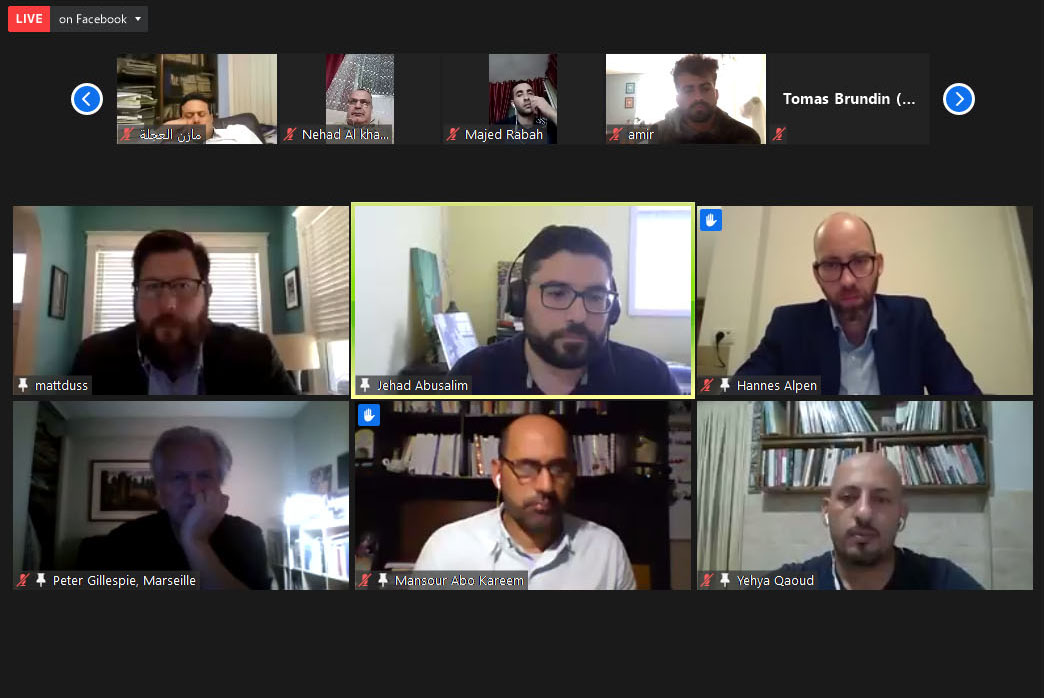
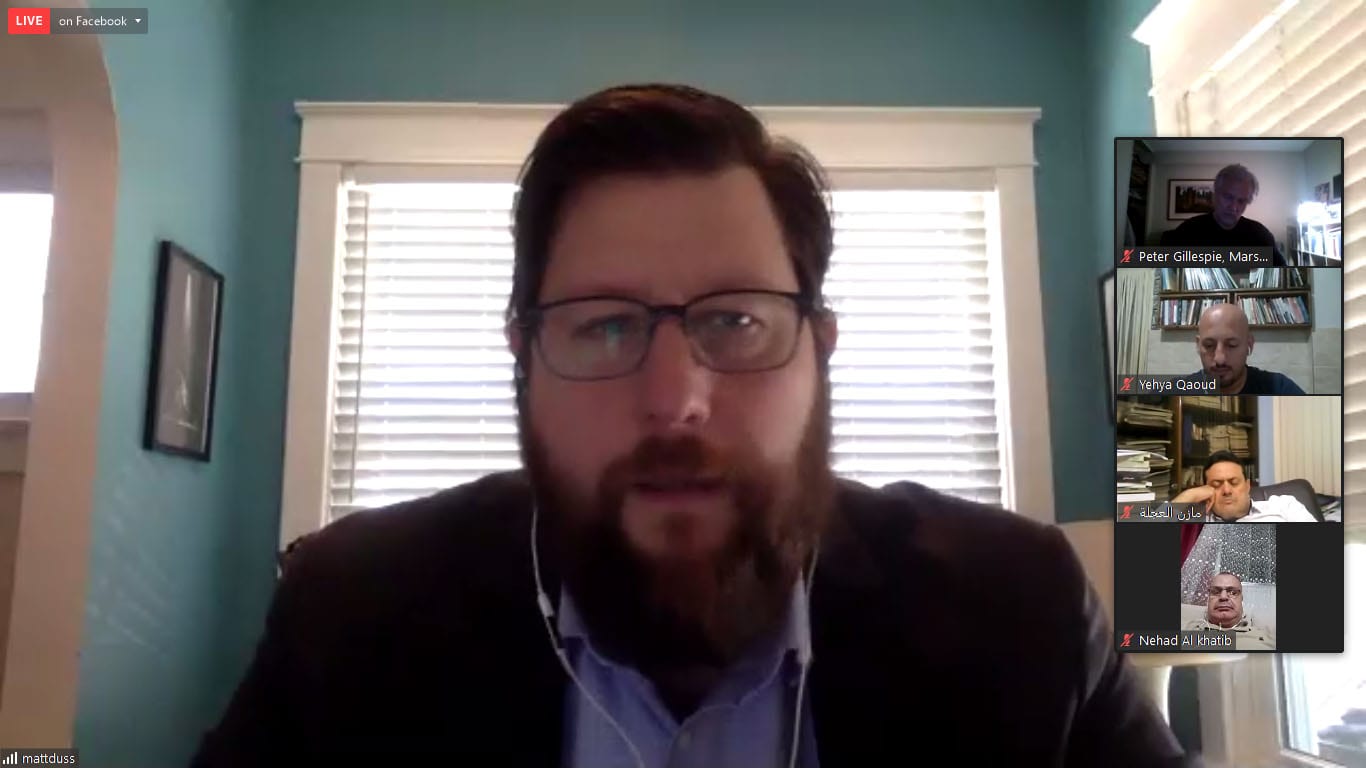
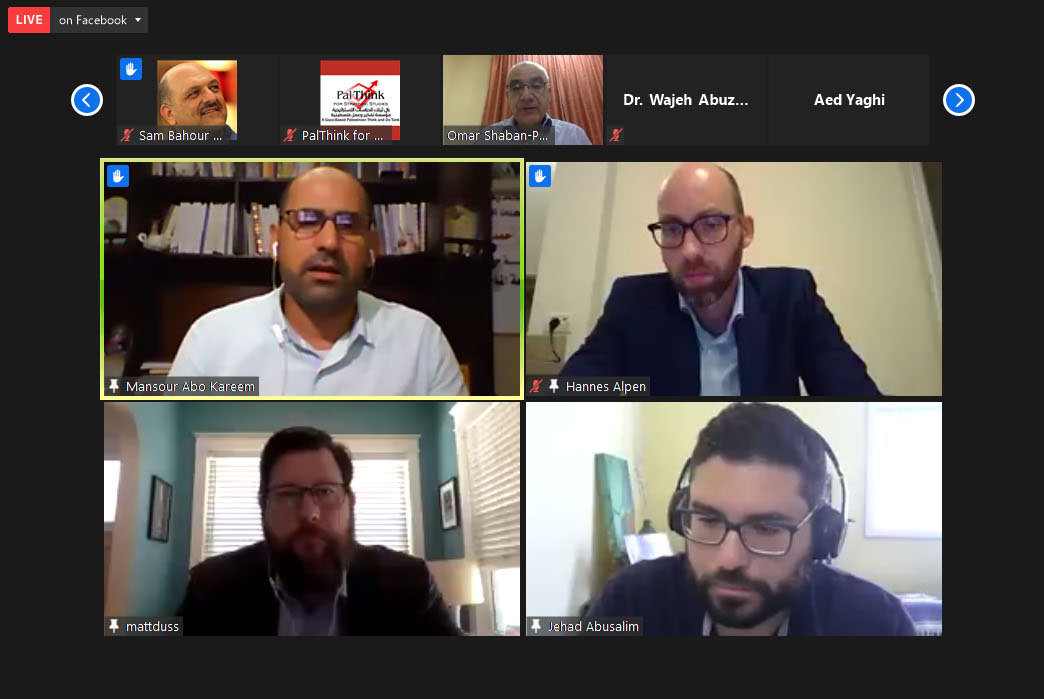
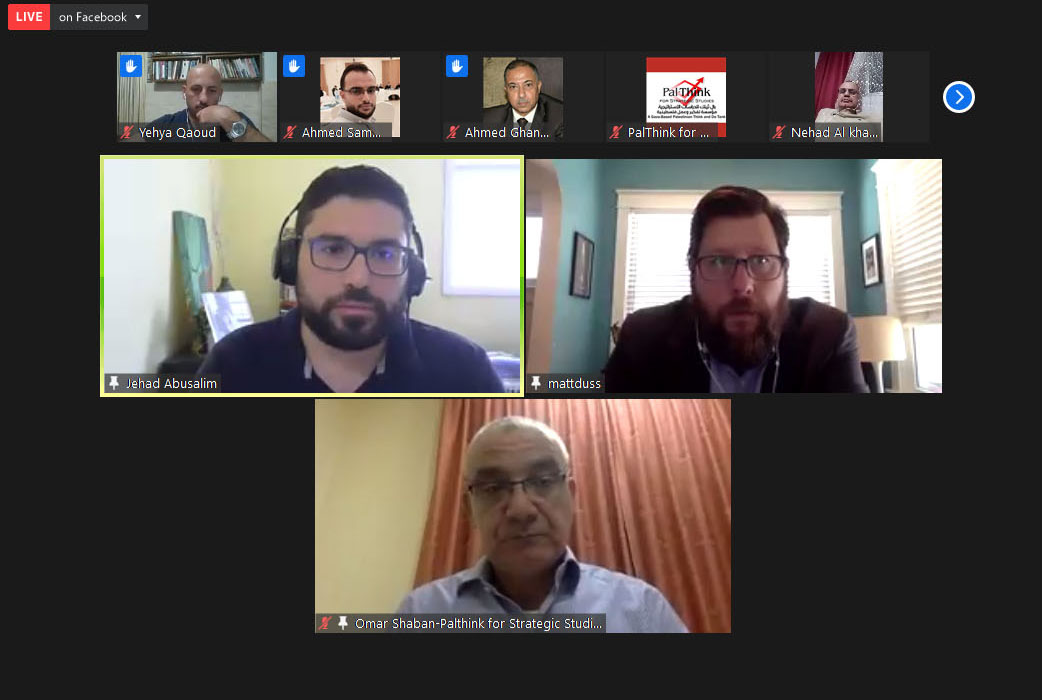
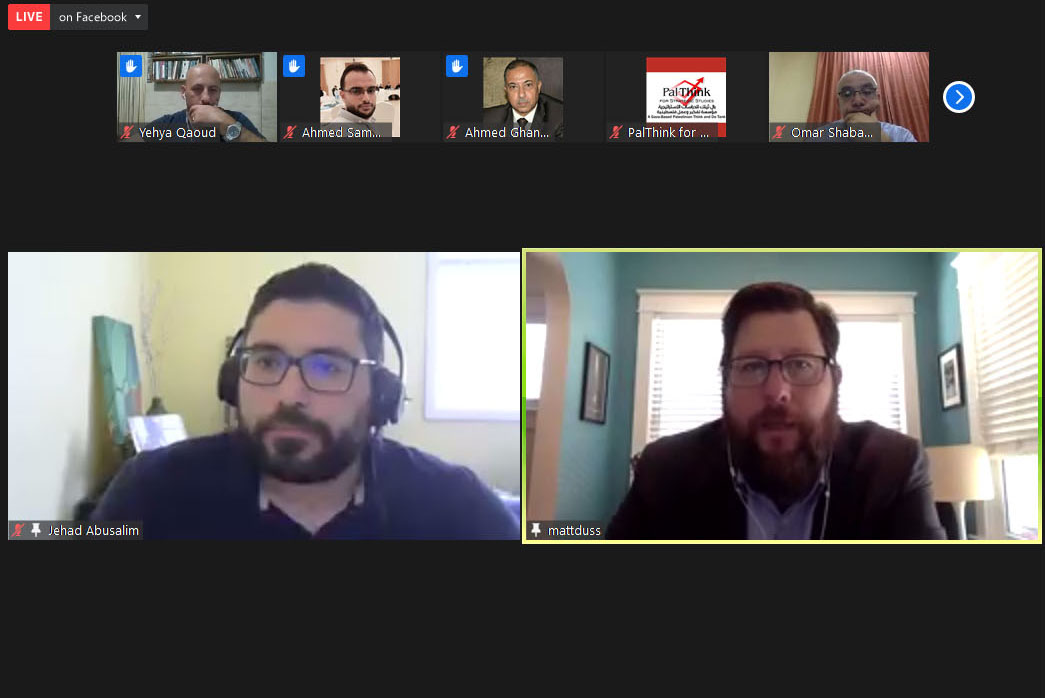
The “Pal-Think” institution hosted in its political seminar under the title “The scenarios of the American elections and their reflections on the Palestinian cause” Mr Matthew Duss, the international-relations advisor of the member of the American Congress, Senator Bernie Sanders.
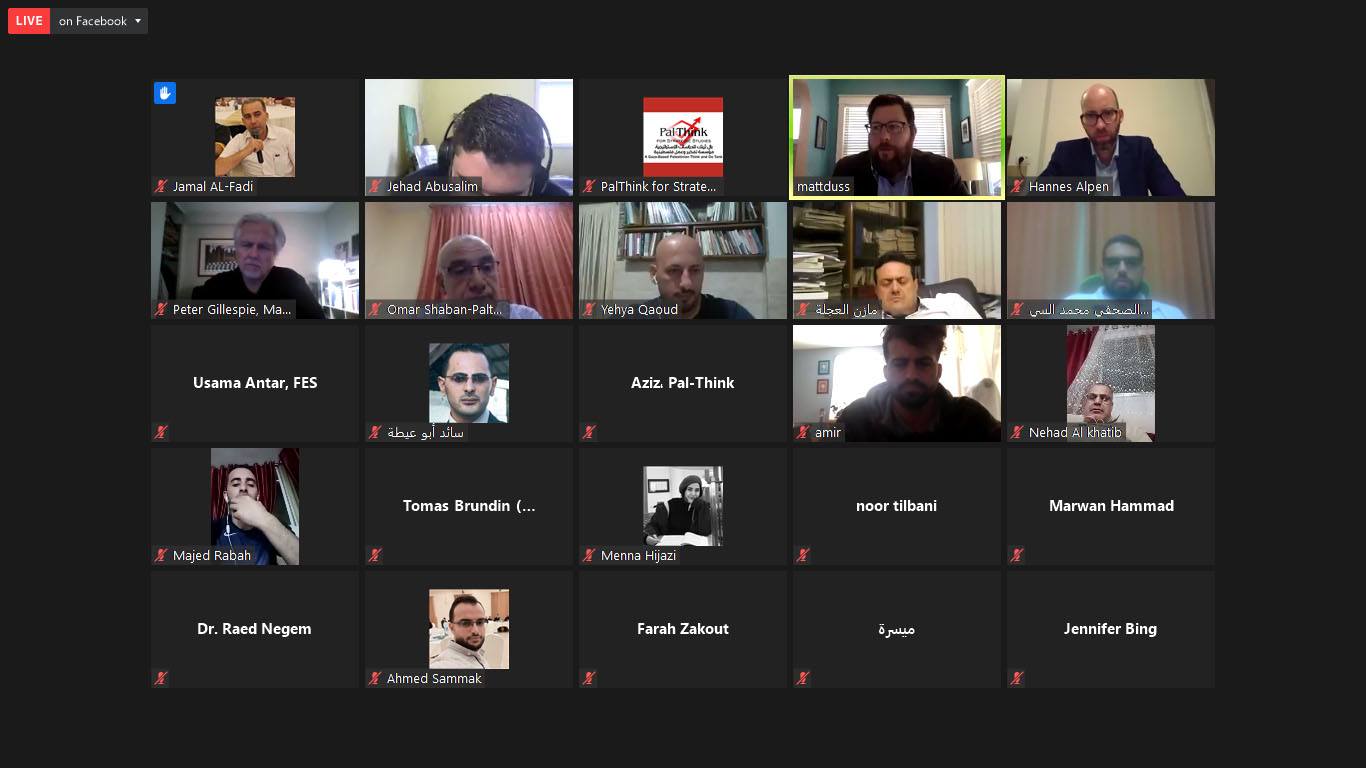
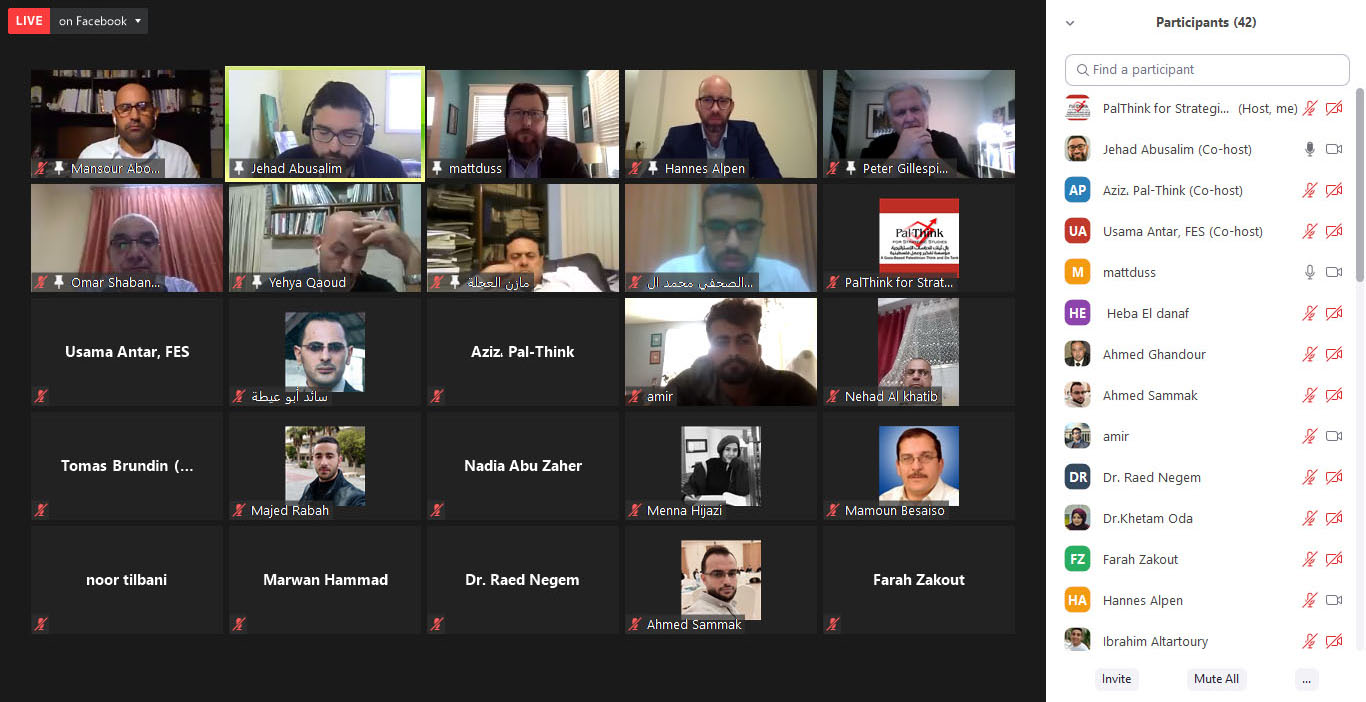
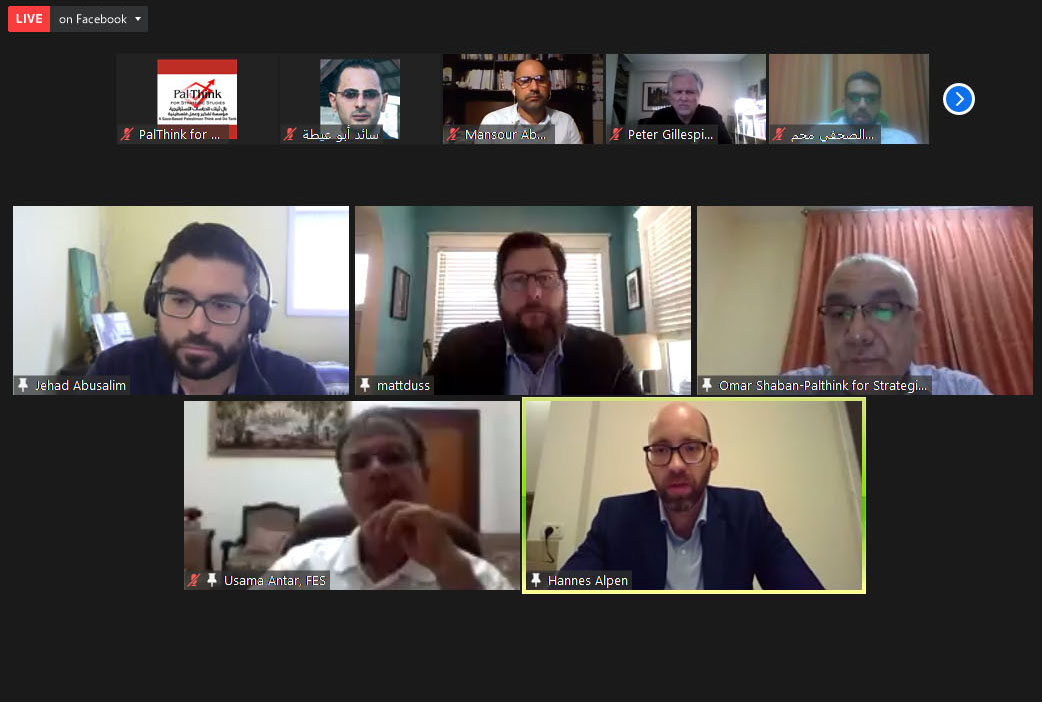
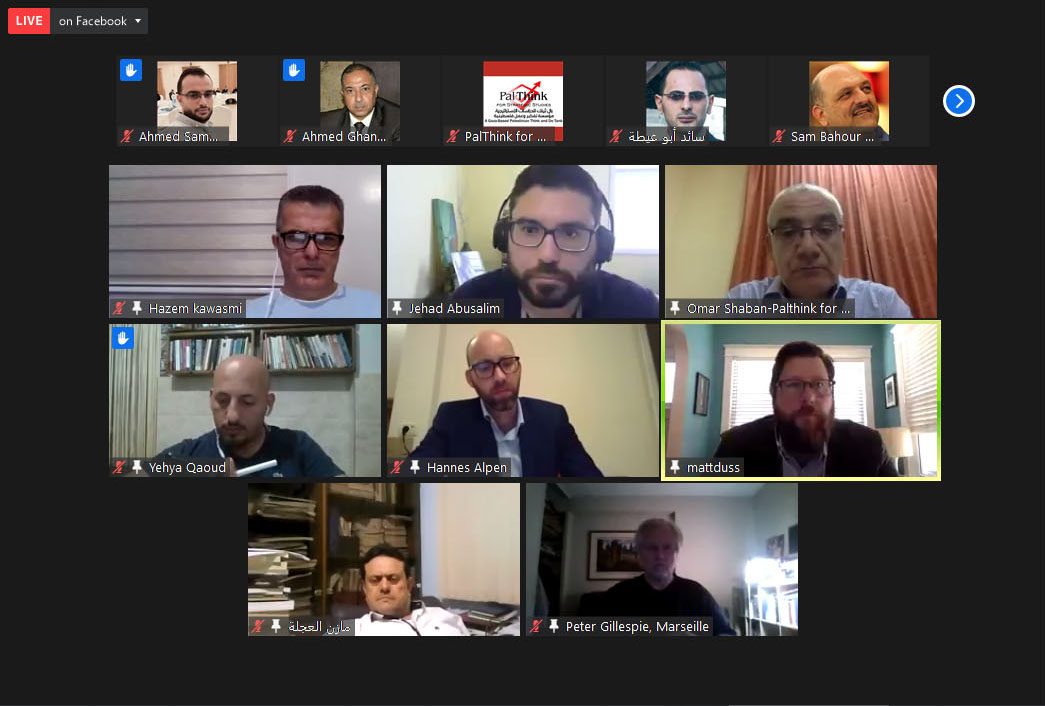
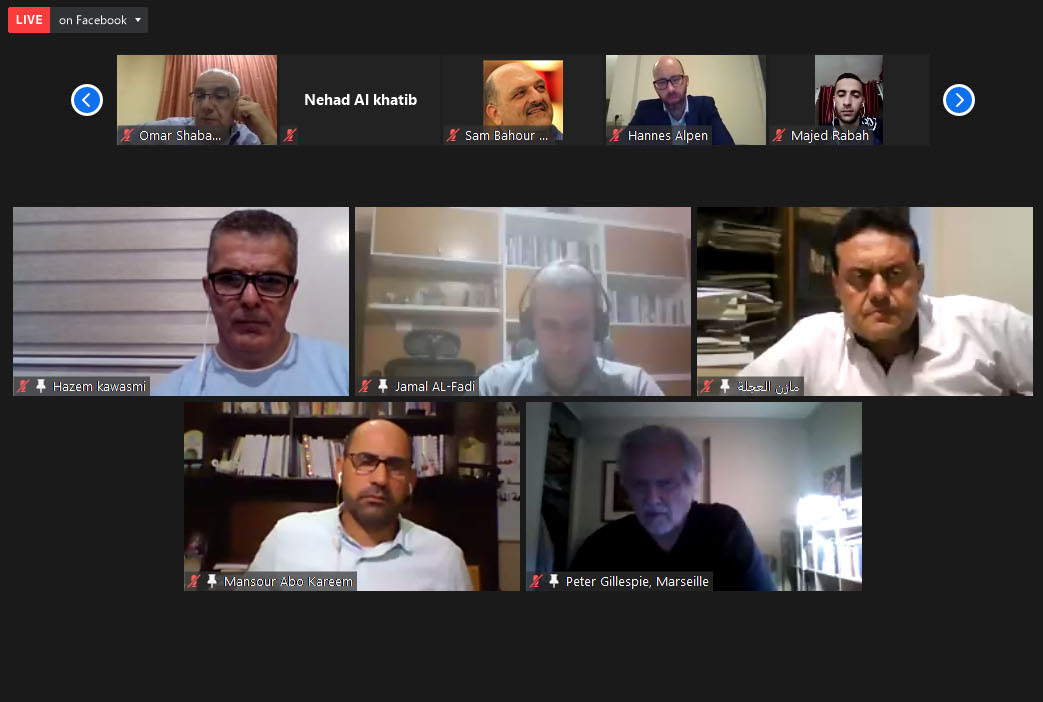
The political seminar, moderated by Mr Omar Shaban, director of the “Pal-Think” institution, was attended by the director of the German Friedrich Ebert foundation in the Palestinian territories, Mr Hannes Alpen, alongside an elite of experts and specialists and representatives of civil-society organisations, and diplomats from Jerusalem, Ramallah, and Europe. Mr Jehad Abusalim, doctoral student at New York University and formerly a fellow of the Pal-Think institution, did the interpreting. Mr Omar Shaban made clear that the political seminar aims at learning the reflections of the American elections on the Palestinian cause, especially in light of the difference of visions between the Republican and the Democratic Party concerning the Palestinian–Israeli conflict.
Mr Omar Shaban pointed out that the think tanks, research centres, and institutions concerned with foreseeing the future are such as to make the process of drawing policies and making decisions in the Arab world of higher quality should decision-makers give them attention — noting that the seminar encourages the culture of constructive dialogue and calm discussion.
In his turn, the director of the German Friedrich Ebert foundation in the Palestinian territories, Hannes Alpen, made clear that his foundation is committed to the fundamental ideas, values, and principles of social democracy, and seeks to realise social justice among the various communal components. Alpen sees that the American administration headed by Trump undermined trust in democracy when it imposed by force its vision concerning the Palestinian–Israeli conflict, far from any international understanding or UN decision related to the Palestinian cause — pointing out that the democratic world has come to wish to see the Democrats' policy toward the issues of the Middle East.
The scenario of a Trump win
From his side, Matthew Duss, the international-relations advisor of the member of the American Congress Senator Bernie Sanders — who spoke in his personal capacity — sees that Donald Trump's policy toward the Palestinian cause will not change should he win a second term; rather he will work to strengthen his current approach resting on the logic of force and unilateralism as an alternative to the principle of right and international law.
He mentioned that Trump's policy is summed up in his insistence on destroying any independent Palestinian political entity, and entrenching the idea of the Palestinians' existence as second-class citizens in “Israel” — which harmonises with the vision of the hard-line Israeli right.
Duss made clear that Trump will never change his vision toward the Palestinian cause, for reasons relating to his personality, such as his obsession with his agenda, his ideas, and his principles rooted in the right-wing camp toward many issues.
He mentioned that there are transformations and facts that cannot be excluded should Trump win, saying: “Trump's administration, should he win, will be in confrontation with the progressive current in the Democratic Party, which presents positive and unprecedented positions toward the Palestinian cause.”
The scenario of a Biden win
Duss sees that the win of the Democratic candidate Joe Biden in the coming presidential elections may contribute to the United States' return to the international consensus, the strengthening of the two-state solution according to the United Nations resolutions, and the opening of the lines of contact and communication between Washington and Ramallah, which were disrupted because of Donald Trump's vision.
Duss excluded that Biden would proceed with the step of returning the American embassy from Jerusalem to Tel Aviv, since that step would not serve the conflict's solution; while Biden may take positions in the Palestinians' favour, such as reopening the office of the Palestine Liberation Organization's mission in Washington, opening the American consulate to the Palestinians, restoring the funding of UNRWA, and founding a positive and productive relationship with the Palestinian leadership.
On the annexation plan, Duss said: “Biden rejects the annexation decision, and I believe he will not recognise it and will not confer legitimacy on it should Israel apply it.”
Duss made clear that the Palestinian cause may not obtain the required attention and focus in the first years of Biden's administration for many reasons, among them his occupation with the American domestic issues, such as the racial divisions inside American society, and the occupation with rebuilding the United States' relationship with its allies at the international level.
On the relationship between the American administration and Israel should Biden win, Duss pointed out that there is a large sector in the Democratic Party that opposes Israel greatly, such as Ilhan Omar and Rashida Tlaib, and they call for the necessity that American support for Israel be conditional on the latter stopping its violations against the Palestinians.
As for the veto decision in Biden's era should he win, Duss said: “I do not know how Biden's team might deal with the Palestinian moves in the international forums, but what I know is that there are discussions under way to remove the ban on the Palestinians' use of the legal instruments and the international mechanisms.”
He mentioned that the Palestinian cause has become an important issue in the rising progressive camp in the United States, saying: “The Palestinian cause has become one of the important issues for the progressive camp, since it connects to the racial issues that are at the core of its attention, and it looks upon it as a just cause resulting from the legacy of racial oppression.”
Duss hoped that the experience of Obama — who remained for eight years waiting for Netanyahu to come to negotiate — would not be repeated, pointing out that bringing the Israeli team to the negotiating table depends on the measures the American administration will impose on “Israel”.
Unifying the discourse and developing the narrative
Duss called on the political decision-makers and opinion leaders in Palestine to strengthen and develop the Palestinian narrative inside American society, in light of the growth of the positions supportive of the cause inside the progressive current in the Democratic Party.
He pointed out that the American bias in Israel's favour was the result of the influence of the Israeli narrative and its capacity to shape American public opinion — which calls for strengthening the Palestinian narrative inside American society to bring about a breakthrough in the Palestinian cause's favour.
Duss called on the Palestinians to put the internal house in order, to address the international community and the American Congress in a unified way, and the necessity of highlighting their right to self-determination and national liberation.
The scenarios of winning and losing
Duss did not offer his prediction concerning the win of either of the candidates for the American presidency, except that he pointed out that the American candidate of the Democratic Party, Joe Biden, leads President Donald Trump by ten points at the national level, in addition to his lead in states the Democrats lost in the previous presidential elections in 2016, such as the state of (Wisconsin).
He made clear that the predictions remain oscillating in light of an important factor, represented in that Trump is a president standing for a second round — and candidates for a second term are usually more fortunate in winning a new period, especially with the great media support Trump enjoys; while pointing out that the latter faces the voters' loss of trust in him because of corona and the issues related to racial discrimination.
He made clear that Biden is trying to reach the Republicans who do not support Trump, citing the Democratic Party's electoral convention in which spoke Colin Powell, advisor of the American president George Bush, John Kasich, the former Republican candidate for the presidency, and others who seek to prevent Trump reaching a second term; Biden likewise tries to unify the Democrats in his favour, through cooperating with Bernie Sanders and the progressive current in general.