Workshop: the Israeli elections and their consequences for the Palestinian question
Given the importance of Israel's parliamentary elections and the changes and reflections they carry for the Palestinian question, Pal-Think held a workshop reading the elections and their consequences.
- Date
- 2015-03-02
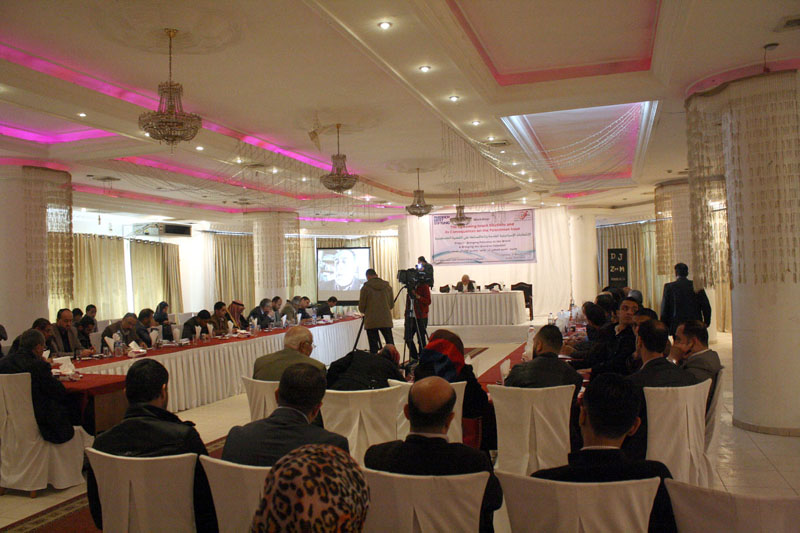
In continuation of the philosophy of Pal-Think for Strategic Studies as an independent Palestinian think tank concerned with the Palestinian affair internally and externally in a professional, independent manner without a prior ideology, and given the importance of the subject of the parliamentary elections inside Israel and what accompanies them of changes and reflections affecting the Palestinian cause, especially in light of the Palestinian-Israeli conflict — the Pal-Think for Strategic Studies institution held a seminar titled “The coming Israeli elections and their reflections on the Palestinian cause”, in the frame of the joint cooperation between Pal-Think and the German Friedrich Ebert foundation, with the participation of a group of experts, political analysts, experts in the Israeli affair, and academics from the Gaza Strip, and from the occupied interior via Skype. The seminar was opened by Mr Omar Shaban, director of the Pal-Think institution, welcoming the attendees and noting the importance of the subject of the Israeli elections that will take place on the seventeenth of this March. In his turn, Dr Osama Antar, Gaza Strip programmes director at the Friedrich Ebert foundation, welcomed the attendees and the speakers, affirming several points, the most important of them the reflections of the Israeli elections on the current Palestinian situation and the post-elections stage, the existence of many raised scenarios related to the elections and to the Palestinian-Israeli conflict, and the necessity that Palestine begin making a purely Palestinian policy able to confront the future challenges. The discussions within the seminar rested on three principal axes:
• The issue of the Arabs of the interior and their representation inside the Israeli parliament, the Knesset — where Ms Aida Touma, member of the Democratic Front for Peace and Equality, spoke in her intervention via Skype of how they, as the Arabs of the interior, were able to unite four political parties on contesting the Israeli elections as one unified list that throws its weight into the Knesset elections; these parties are the Democratic Front for Peace and Equality, the Islamic Movement, the National Democratic Assembly, and the Arab Movement for Change. Ms Touma also spoke of the racist laws enacted by the Knesset — namely the raising of the threshold percentage for entering the parliament, and this formed a danger to the Arab representation in the Knesset, threatening the interests of the Palestinians of the interior. She also pointed to the difficulties and challenges that accompanied the formation of the unified list, such as the difference of the movements' ideologies; but after going through the discussions, unification was reached under one list to repel the fascist racist onslaught inside Israel aiming to take the Palestinians of the interior out of the Israeli political game. She also spoke of the political programme on which this list rests, the most important of which is reaching a political agreement to solve the pending issues with the Palestinians, among them the refugees' issue, the independence of the State of Palestine, and the rolling back of the occupation. She concluded, saying: “We hope to bring you glad tidings on 18 March of the increase of our strength”. In this regard also, Dr Asad Ghanem, professor of political science at the University of Haifa, added that they, as the Palestinians of the interior, still have hope in these elections, from the standpoint of the importance of the nationality law, which relates to the very being of the Palestinians of the interior. He commended the raising of the threshold percentage for the representation of the Palestinians of the interior in the Israeli parliament, explaining that by the fact that it united the political parties divided in the Palestinian interior for 20 years, unifying thereby their voice and their goals.
• The coming Israeli electoral map — where Dr Asad spoke in his intervention via Skype about the electoral map inside Israel, making clear the unexpected changes that could characterise the Israeli elections and that could change the whole equation. He added that there is a new Israeli right inside Israel that has a relation to the rise of the right in Europe, which centres on the fascist policy in dealing with the minority as strangers, and it has been succeeding successively since the year 2001 — adding that since 1992 the same prime minister has not succeeded twice in Israel, but Benjamin Netanyahu has succeeded more than once, and this must be taken into account by the Palestinians. He added, explaining, that the rise of the Israeli right goes back to a principal cause, which is the demographic change inside Israel: the rightist groups that vote have increased owing to the rise of the proportion of the religious, the Easterners, the immigrants, and the settlers — making clear that this situation in Israel is difficult to predict a change of, as it is considered one of the explanations of the rise of the right's party. Noting that, as it appears, Benjamin Netanyahu is the strongest candidate for the government, and if not, he is the one who most possesses the possibilities of forming a government. He added, saying, that the conflict's agenda is not central and not concluded. On another side he noted that Barack Obama's power is retreating before Netanyahu, and that whoever believes Obama will issue orders to Netanyahu to withdraw from Jerusalem and the West Bank is deluded; rather there is a pressing Zionist lobby in America which is what issues the orders to the American government. He concluded his word with the point that the solution of the Palestinian conflict and the Palestinians' relation to one another is contingent on the internal changes in Israel, through building a unified society inside Israel — for if the Palestinians of the interior succeed in creating the required change inside Israeli society, that may contribute to changing the Palestinian-Israeli equation.
• The demographic change inside Israel and its effect on the electoral map — where the writer and political analyst Mr Akram Atallah from Gaza said that the Israeli Knesset has always laboured at developing the laws that cast out the Arabs and limit their political participation, and at affirming that the Palestinian Arabs form a danger to Israel. He noted also that the Palestinian and his cause are always summoned as advertising material for the electoral propaganda of the Israeli parties, pointing out that there is a difference between the electoral weight and the demographic weight inside Israel: he made clear that the joint Arab list forms 20.7% of the demography in Israel, but the voting bloc reaches 15%, while the Jews form 85% of the electoral weight — expecting that the new government would be formed from the right or the alliance with the rightist centre. In the conclusion some interventions and discussions were raised around the reflections of the coming Israeli elections and speculations as to whether they would be of positive or negative return for the Palestinian cause in its various pillars.