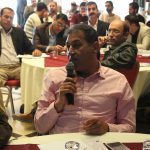
Workshop: «Israeli-Jewish demographic changes and their political dimensions»
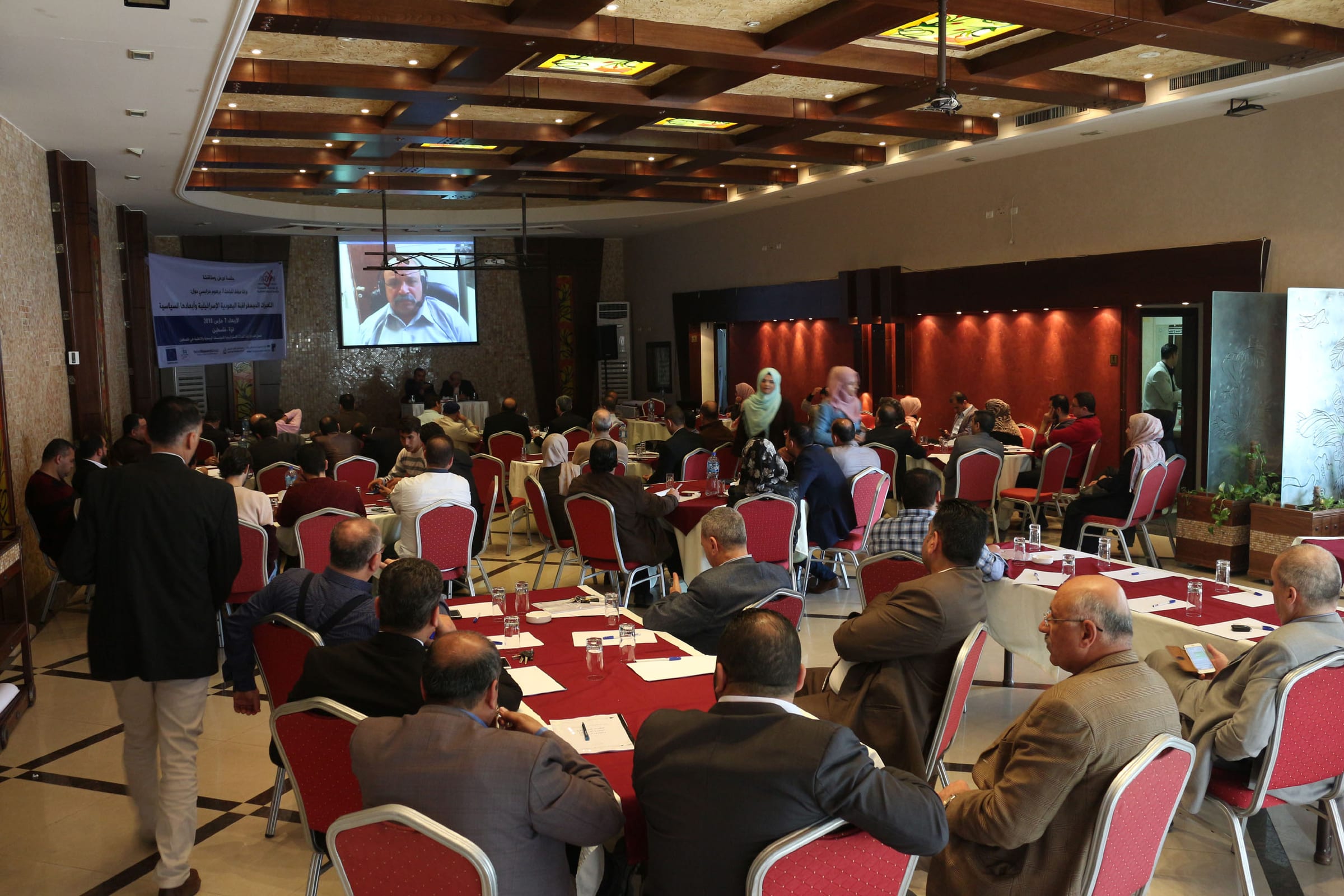
Pal-Think held a dialogue presenting the research paper «Israeli-Jewish demographic changes and their political dimensions», hosting by Skype from Nazareth its author Barhoum Jaraisi, political writer specialising in the Israeli political map.
- Date
- 2018-03-18
Pal-Think for Strategic Studies organised a dialogue meeting to present and discuss a research paper titled “The Israeli Jewish demographic changes and their political dimensions”, where it hosted via Skype from Nazareth the paper's author, the researcher Mr Barhoum Jaraisi, the political writer specialised in the political map in Israel, and the commentator from Gaza Dr Adnan Abu Amer, specialised in the Israeli affair, with the attendance of a group of analysts, writers, politicians, media workers, and youth in Gaza. This meeting comes within the project “Building the strategic capacities of the official and civil institutions in Palestine” in cooperation with the Palestinian centre for Israeli studies “Madar”, the Palestine Strategy Group, and the Oxford Research Group, with support from the European Union.
The session was opened by Mr Omar Shaban, director of the Pal-Think for Strategic Studies institution, welcoming the researcher Jaraisi and the attendees. Shaban spoke: “The Pal-Think institution always strives to strengthen the role of researchers and youth in shedding light on the issues that concern the Palestinian affair and enriching the deep Palestinian discussion and dialogue, in a way that helps in building a strategy suited to the challenges and circumstances the region witnesses in general and the effect of that on the Palestinian cause in particular”
Omar Shaban praised the research paper and its importance in studying and understanding the Israeli Jewish demographic changes and their political dimensions and the extent of that's effect on the Palestinian-Israeli conflict, in addition to the paper's importance in what it took up of the nature and forms of the internal conflict in Israeli society and the discrimination and division within Israeli society.
The researcher (Barhoum Jaraisi) presented a background on the nature and forms of the demographic changes within Israeli society, making clear all the demographic fluctuations and their social, economic, and political reflections, in addition to the size of the great and central obsession the demographic factor forms in the Zionist project since its emergence — as the greatest obsession was guaranteeing a Jewish majority in Palestine, and specifically in the areas on which the Israeli entity was established. The researcher added that on this background, and with the goal of “settling the demographic battle”, the Zionist movement opened the doors to the migration of the adherents of the Jewish religion from the Arab and Islamic states, until the proportion of the Eastern Jews reached, in the eighties, 47% compared with the Western Jews.
The researcher mentioned that the demographic fluctuations Israel witnesses go back to two fundamental factors, which also have a great effect on the political balances and the nature of the ruling circle:
The first factor: the entry of the migration waves from the Soviet Union, the states of Eastern Europe, and Ethiopia in the nineties and after, which overturned all the demographic equations that had rested on ethnicity.
As for the second factor: the overturning of the balances through the sharp rise in the proportion of the religious, in their various currents, among the Jews themselves, because of their high reproduction rate compared with the reproduction rates of the secular.
The researcher touched on a presentation of the conditions of the stratum of the Eastern Jews in Israel, and said that over long years they faced institutional and communal racial discrimination, and suffered from difficult social and economic conditions in addition to political exclusion. All this faded gradually and quickly, owing to what the Israeli entity witnessed of the huge migration waves in the nineties and in the first two-thousands, 80% of them from the states of the former Soviet Union. This huge migration reflected in a series of social and economic changes and also reflected itself on the political map, and there came to be a constant improvement of the conditions of the Eastern Jews, and they vanished entirely from the poverty rates as a separate communal stratum, and their place was taken by what is known as the strict Jews, the “Haredim”. The great posts opened before them in the years of 1995, when the first Eastern Jew reached the post of foreign minister, and later an advance began to be noticed in the military ranks — the chiefs of staff beginning with Shaul Mofaz the Iranian — and in 2000 (Moshe Katsav) assumed the presidency of the state, and he is an Eastern Jew.
The researcher sees, among the most important conclusions he presented in his study, that the demographic anxiety in the Zionist movement at this stage is concentrated in three aspects:
The first: the decline of the numbers of the Jews in the world, as the number of the Jews in the world is 14 million souls, among them 6.5 million residing in Israel, and the cause of this decline is the mixed marriage between the adherents of the Jewish religion and the other religions, and also by force of the weakness of the natural reproduction rate, matching the rates of the developed states.
The second: the proportion of the Jews and the Palestinians in historical Palestine, and the question of the intended Jewish majority and the preservation of the Jewish majority in Israel — this factor that stands behind the Zionist consensus rejecting the return of the displaced to their historical homeland.
As for the third and last aspect, which is the subject of the research: the internal Jewish demographic fluctuations in Israel — and this has become the preoccupation of the Zionist movement, especially in light of the increase of the proportions of the religious as a whole and in particular the strict “Haredim”.
In addition to that, and according to the researcher's estimates in light of what the study presented, there is no room for any external political force — and in our case the Palestinian forces and organisations — to address the Israeli street through ethnic groups; and the attempts to work with Jewish groups on an ethnic basis may be exposed to the accusation that the Palestinian or Arab “external” front, or any other party from the world, is moving in internal conflict arenas — and this would be more like a rebounding blow, if the expression is correct, because of the presumed incitement against whoever takes the initiative of such a move.
Dr (Adnan Abu Amer) spoke, commenting on the study, of the importance of the subject of the Israeli Jewish demographic changes and their political dimensions in understanding and summarising the nature of the internal situation in the Israeli entity, and what it contained of strong information and data, and he made clear the necessity of working on rooting some of the concepts and terms within the study.
He added that in the Jewish migrations one must point to the efforts of the Zionist movement in achieving that, and its role in attracting the Jews from all the world to Palestine; and that the term (mixed marriage) may usually be admissible in marriages of different nationalities or divergent religions and opposed sects, such as the Jews and the Christians. Abu Amer mentioned that for the term mixed marriage to be current within Israeli society between a Jewish man and a Jewish woman of one nationality and one religion only — because the spouse may be an Eastern or a Western Jew — indicates the state of fragility existing within Israeli society and the extent of the problematic and the nature of the identity composing this entity, despite the state of external cohesion of security, military, and political dimension.
The participants affirmed through their interventions the importance of the paper and what it presented of valuable information, and its reliance on the proportions and statistics in the analysis and in understanding the shape of internal Israeli society and the development of the demographic conflict internally, and that's effect on Israel's continuation and survival — especially as there has come to be a transformation in the conflict from an ethnic conflict to a religious–secular conflict; in addition to that, to what extent the demographic fluctuations in Israel may affect the peace process
Mr Omar Shaban concluded the session, praising the attendees' participations and the fruitful and deep discussion by the researcher Barhoum Jaraisi and the commentary of Dr Adnan Abu Amer. Shaban added, saying: these meetings come within the project (Building the strategic capacities of the official and civil institutions in Palestine), whose duration is three years, and these discussions will be presented in the strategic report 2020.