Pal-Think holds a dialogue on Rwanda's exit from civil war
Pal-Think's director Omar Shaban said every country that has passed through civil war learned the same truth: the decision to rise and reconcile must be a national one, made by internal will as in Rwanda — not by decree of the great powers.
- Date
- 2021-09-21
The director of Pal-Think for Strategic Studies, Mr Omar Shaban, said that the truth all the world's states that passed through civil wars came to believe is that the decision of rising and reconciliation must be a national decision and by internal will — like Rwanda — and not by decision of the major states; and this is a matter the Palestinians must work on after the failure of the rounds of reconciliation in the various Arab and Western states over a decade and a half.
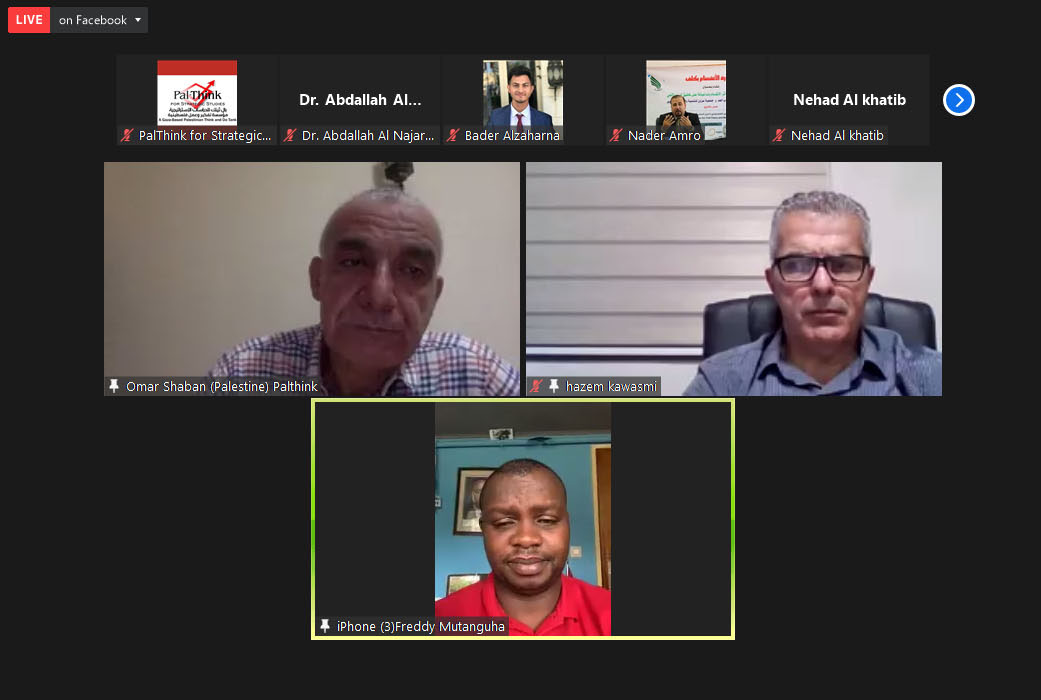
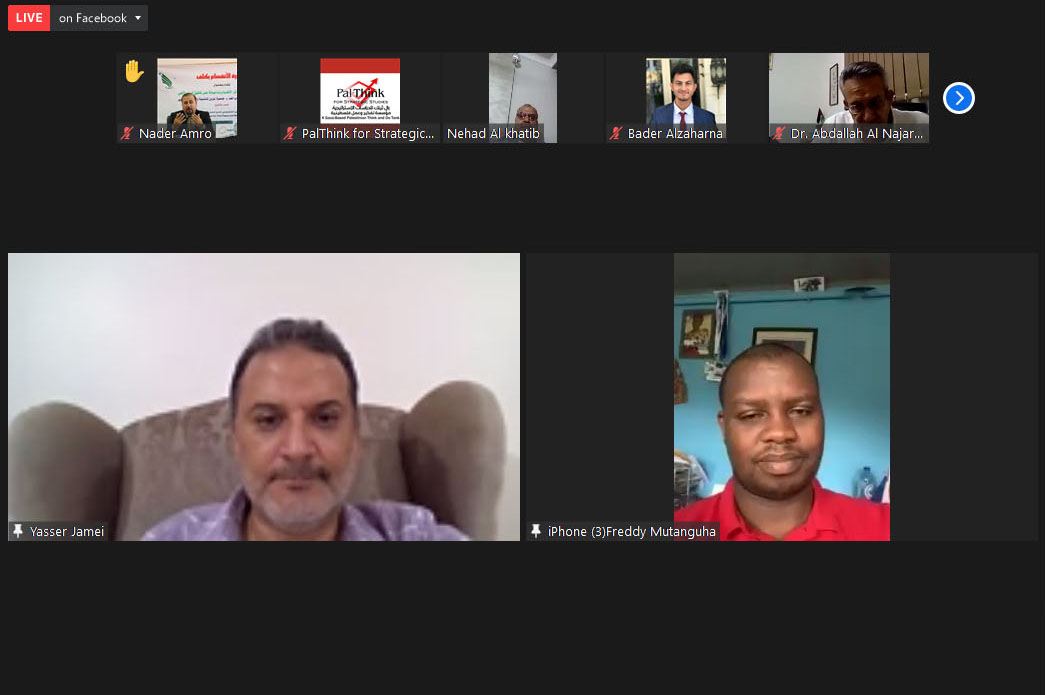
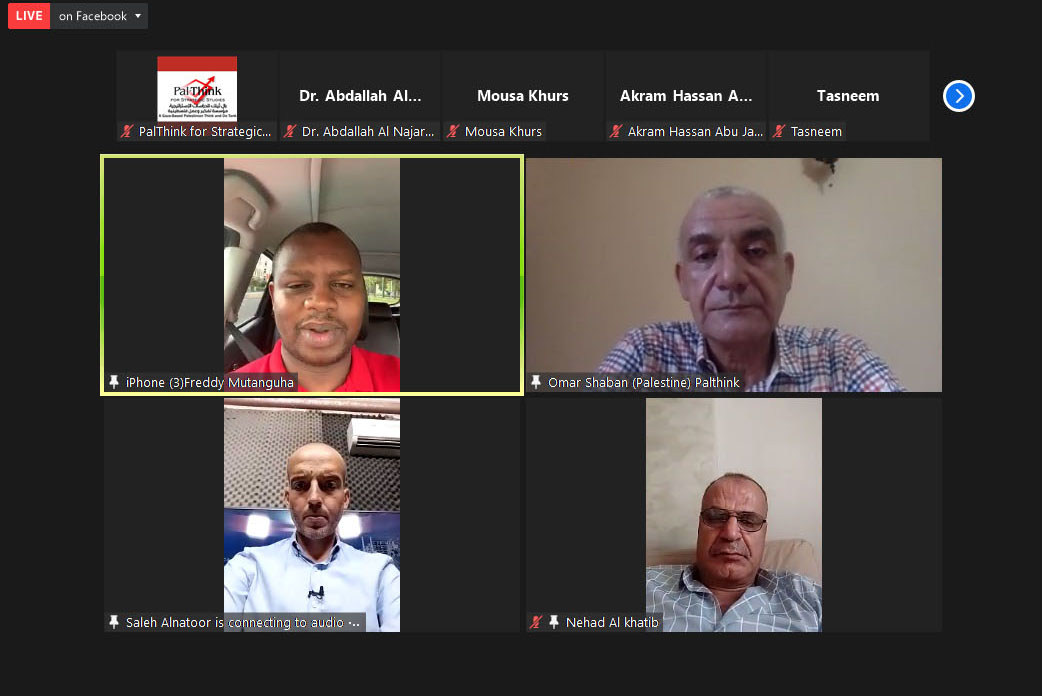
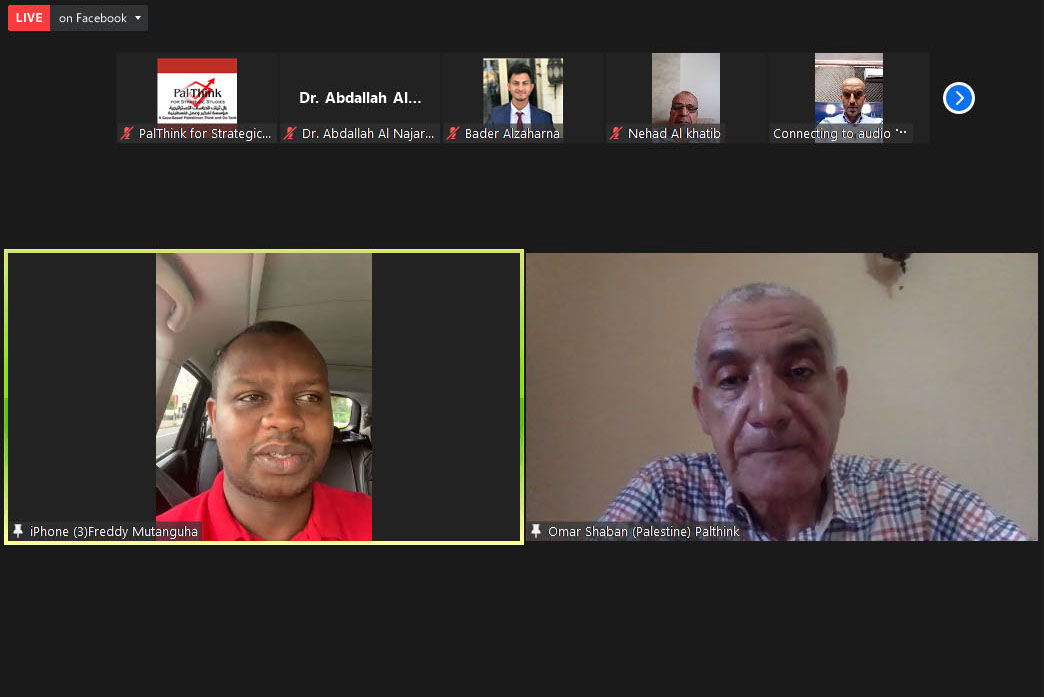
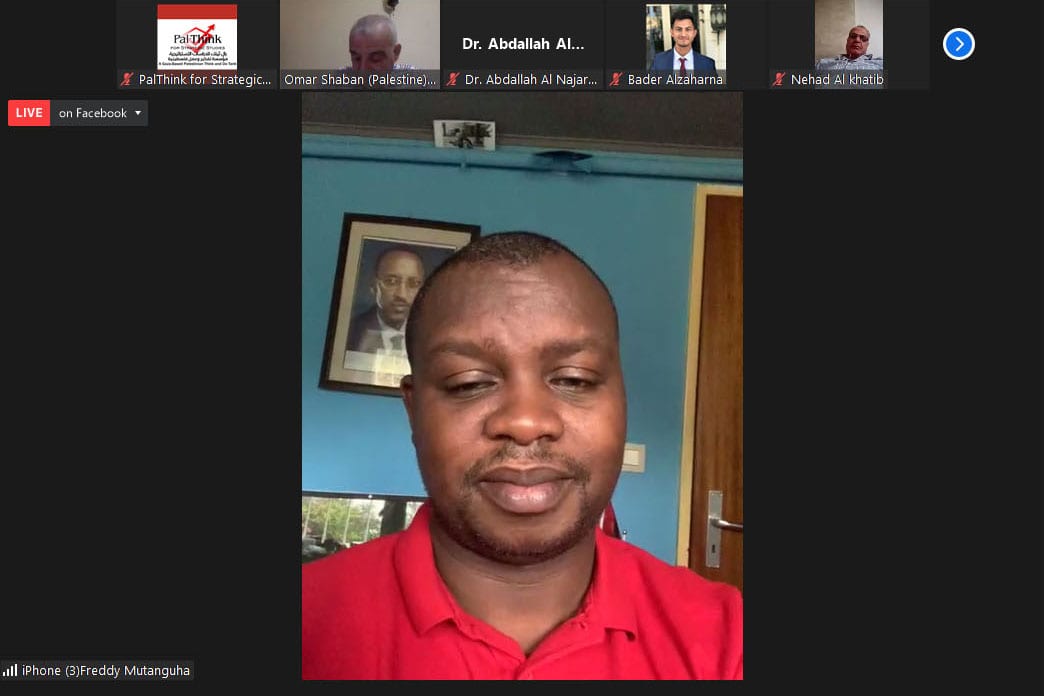
This came during a dialogue session titled “International experiences in national reconciliations: the experience of Rwanda”, organised by the institution and moderated by Shaban, during which the director of the Rwandan Aegis Trust organisation, Freddy Mutanguha, was hosted.
Shaban said: “Rwanda presents an example and model to be emulated in the world. It lived a bloody conflict in 1994, whose victims were some one million Rwandans in a ferocious civil war. Despite that, it was able to emerge from this predicament and achieve economic growth counted among the highest in the world, and Kigali, Rwanda's capital, became one of the most important capitals in Africa.” Shaban affirmed that the Rwandan experience deserves careful study by the Palestinians, especially in light of the division that has harmed the Palestinian cause — pointing out that despite the good intention of the efforts exerted to end the division, they failed, which made everyone pay the price.
For his part, the director of the Rwandan Aegis Trust organisation, Freddy Mutanguha, opened his talk by thanking “Pal-Think” for the hosting and by acquainting the attendees with Rwanda, saying that his state lies in the eastern part of the African continent and its area is 23 thousand square kilometres; Germany and Belgium colonised it and worked to divide the population into three categories: the Hutu, the Tutsi, and the Twa. Today its population is 12 million, and it is a developing state working hard to advance its economy.
Freddy Mutanguha added: Rwanda was a Christian state with Muslim minorities who were considered enemies and were persecuted by the political regime at the time — which is why the greatest number of the dead in the 1994 massacre were Muslims. As for today, Rwanda grants complete respect to all religions, and there is freedom and complete respect for all religions.”
Freddy revealed that he and his sister are among the survivors of the 1994 massacre: his parents, four sisters, and six children were killed, so he grew up an orphan from when he was 10 years old — a matter that wearied him greatly in his life.
The massacre
He continued: “The king was killed in 1996 because he called for independence, and colonialism was working to destroy the kingdom and make it a republic. Also, a million citizens were killed in roughly 100 days.” And he said a million Rwandans were killed. Afterwards the current president succeeded in stopping the massacre and led the liberation movement in the nineties.
Freddy set out that it was the people who liberated the state, because it grasped the exorbitant price it would pay if that chaos continued, and became certain that accepting division and racial discrimination would lead to the abyss — affirming that the international community was not interested in what was happening in Rwanda, and did not intervene when the massacres occurred despite the presence of the United Nations peacekeeping forces in Rwanda; therefore the government put them out and told them: we no longer need you, because the Rwandans decided to rise by themselves.
The challenges of rising
The Rwandan guest added: “The liberation movement was not founded on a liberation programme only; rather it made the idea of liberation a way of life — as all the spectra of Rwandan society took part in making the decision of disposition over all the state's apparatuses, such as the army, law, justice, and others.”
He pointed to the existence of many challenges that faced the reconciliation process at the time — among them that the survivors and the perpetrators of the massacre were living in the same city; the state's emptiness of experts and professionals; the opposition to the reconciliation plan from the Tutsi tribe, which is the largest there and used to monopolise all the public posts and privileges; the deterioration of the economic situation because of the civil war; and denial and non-acknowledgement of the crisis.
The steps of rising
Freddy said: “The first step was achieving justice: they chose a group of wise elders for each area, resorted to dialogue, and tried the perpetrators of the crimes legally; the perpetrators confessed publicly to their crimes, so some forgave them, and a true reconciliation occurred.
The second step is rising economically: they opened the field to investment, and allowed Africans to enter Rwanda without needing a visa, and other nationalities to obtain the visa upon arrival at the airport.”
He added: “The third step was fighting corruption, so they unified the national identity cards. And the fourth step is applying the law to everyone without leniency toward anyone.”
Freddy affirmed that the current president, who brought his country out of the civil war, is likewise one of the survivors of the massacre, and accordingly felt the pressing necessity to stop the war and for the reconciliation, which took 10 years to achieve.
The Rwandan guest pointed out that the reconciliation was voluntary and the citizens forgave the perpetrators of the crimes willingly — affirming that they resorted to dialogue with civil society.
Freddy expressed his pain at the continuous falling of Palestinian victims, and said: “My point of view on solving the Palestinian–Israeli conflict is that the Palestinians accept the Israelis and vice versa, because the solution is in their hands, and they must respect the principles of human rights. What happened in Rwanda is that the victims said: we are ready to listen to the culprits, and the culprits said: we are ready to listen and feel the victims' pain — and this is what occurred. You want a political leadership that has the political will to turn truly toward the peace process and to begin serious steps.”
He added: “Reconciliation is very important and I am committed to it. Our political leadership began with the issue of security, and it took time to become a mediator for the reconciliation process. And the dialogue process on several communal issues took time from the political leadership. And I can say, after 17 years of working on communal reconciliation: now I have forgiven the culprits.”
He pointed out that he needs no one to force him to forgive the culprits, or to respect people and their feelings.
Forgiving the culprits
Freddy continued: “Why do we need to forgive the culprits? The matter is not for you alone; it is related to your children, your wife, and your country. It is a means of healing the wounds you suffer from the killing of those you love. When you decide to reconcile and forgive, and when the culprits accept to ask for pardon and forgiveness, you feel as if you had lost 100 kilograms of your weight. When I decided to begin the journey of forgiveness and reconciliation, I found that many others also want reconciliation.”
He continued, saying: “Reconciliation is a matter not related to your person alone; it is related to your children, your generation, and your people. Begin from your country, for the sake of the soundness of the reconciled society, and so that the economy grows and the health system improves.”
The participants' questions ran around how the culprits transformed into peaceable citizens, the factors that made a difference in the Rwandans' minds so that they accepted to forgive the culprits, the international community's intervention in Rwanda's internal affairs, and how to benefit from the Rwandan experience in the Palestinian condition