Pal-Think discusses the humanitarian situation in Gaza and an assessment of interventions: reality, achievements, obstacles
A Pal-Think Zoom discussion, «The humanitarian situation in Gaza and an assessment of interventions: reality, achievements, obstacles», recommended organising the aid and funds entering the Strip to increase their impact, and activating social-security programmes.
- Date
- 2021-01-12
A discussion session carried out by Pal-Think for Strategic Studies via the Zoom programme, titled “The humanitarian situations in the Gaza Strip and the evaluation of the interventions: reality, achievements, and impediments”, recommended the necessity of organising the help and funds entering the Strip to increase their effect, and the necessity of activating the social-security programmes to guarantee workers' rights — to improve the living situation in Gaza and enable people to face the repercussions of the corona crisis.
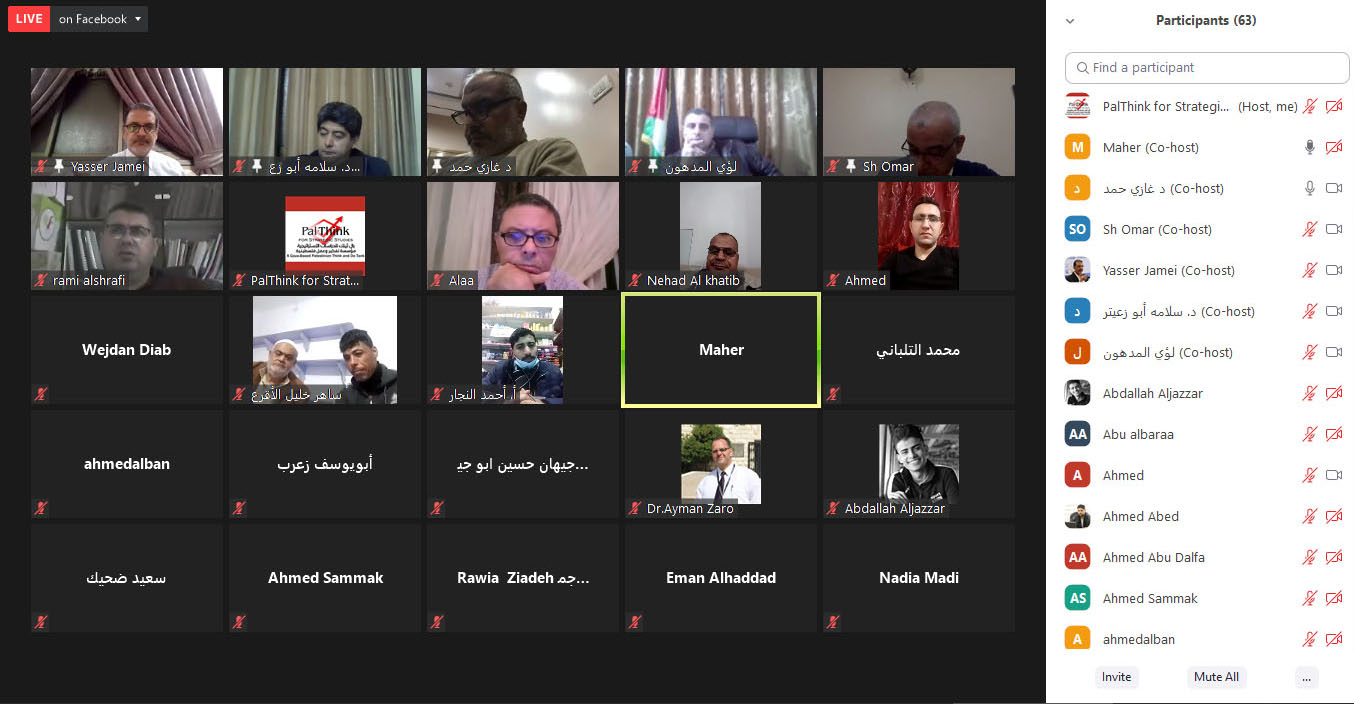
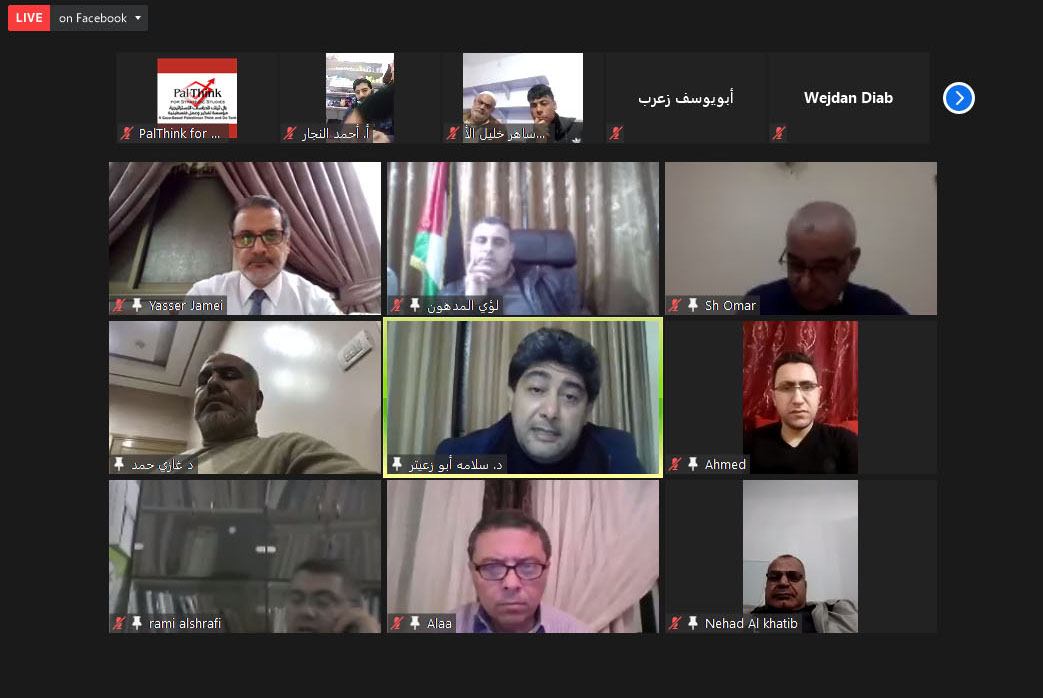
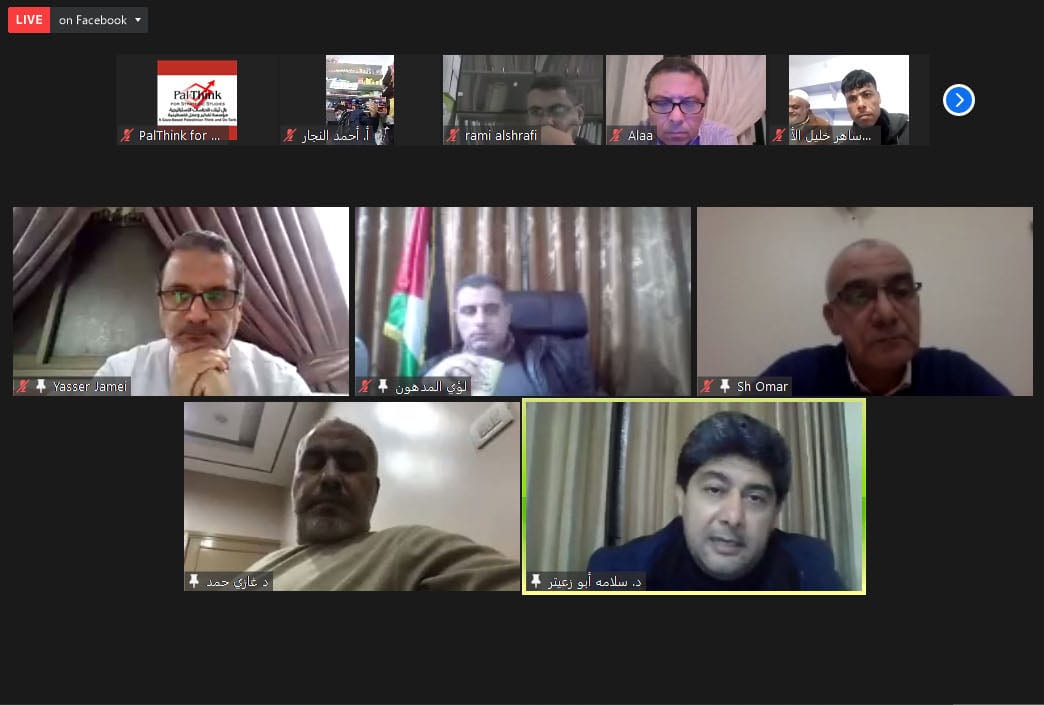
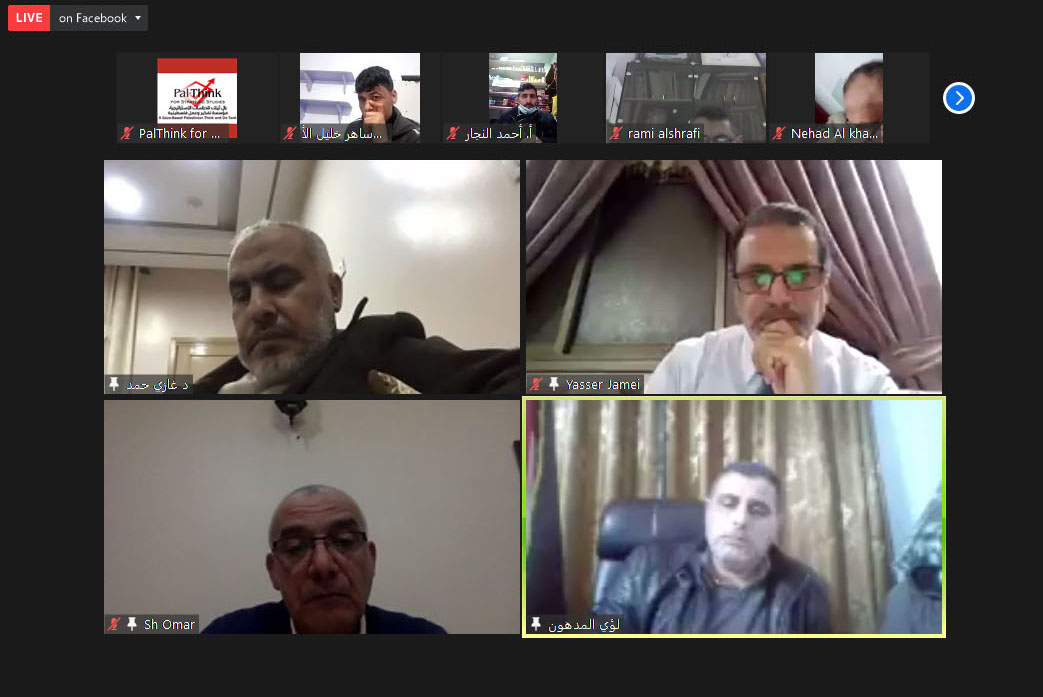
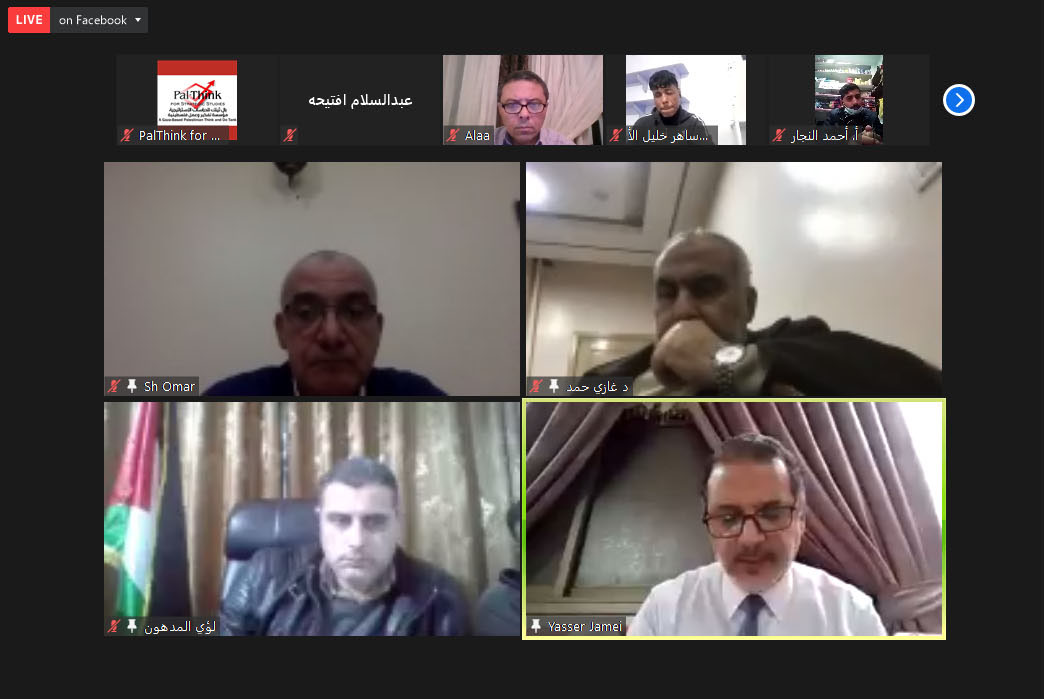
Hosted in the session were: the director of the Gaza Community Mental Health Programme, Dr Yasser Abu Jamei; the undersecretary of the Ministry of Social Development in Gaza, Dr Ghazi Hamad; the commissioner-general of the Ministry of Social Development in the southern governorates, Mr Loay al-Madhoun; the member of the general secretariat of the General Federation of Palestinian Trade Unions, Dr Salama Zeaiter; and the director-general of employment at the Ministry of Labour in Gaza, Eng. Maher Abu Rayya — with the attendance of academics, representatives of civil society organisations, rights advocates, and researchers.
The session was moderated by the institution's director, Mr Omar Shaban, who opened it by welcoming the guests and attendees, and said: “Pal-Think is a research and reflection institution that sheds light on the events and interventions taking place in the Gaza Strip at a time when it witnesses a severe blockade and suffers from the effects of three bloody wars, with the retreat of the international community's support — and the coronavirus pandemic came to pour oil on the fire.” He added: “The accursed division affects all our lives. There is a great rise in the rates of poverty, unemployment, and social deviations, and we can only stand firm and dialogue to search for solutions, because we are all equal in the concern.”
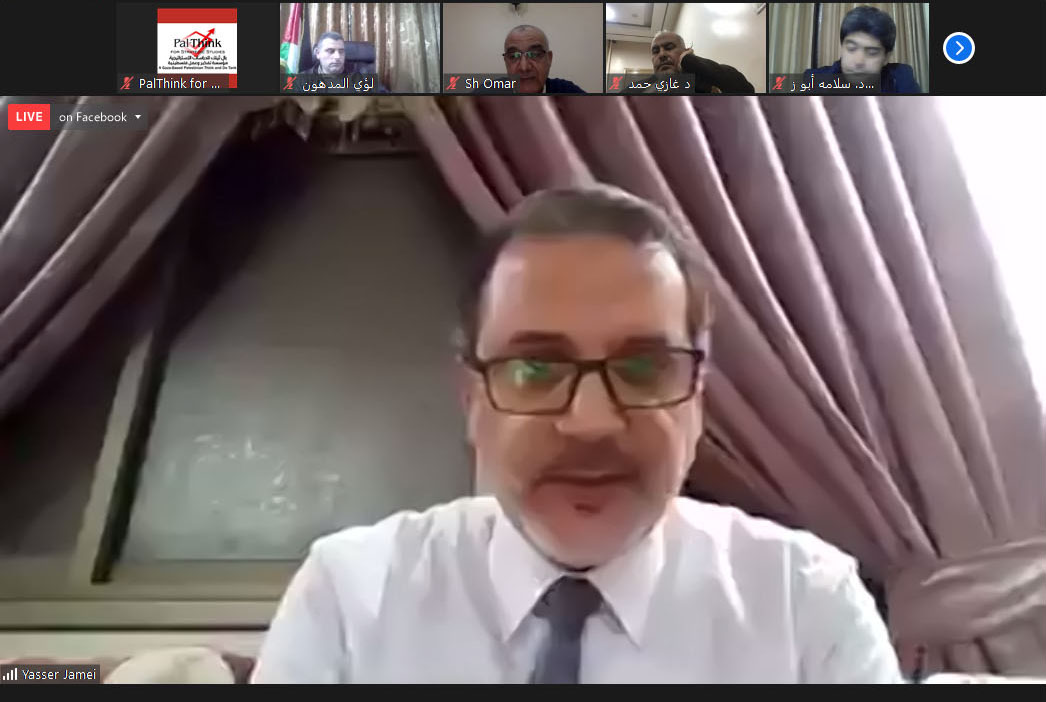
For his part, the director of the Gaza Community Mental Health Programme, Dr Yasser Abu Jamei, said there are five factors that led to the aggravation of the pressures tied to the coronavirus pandemic, namely: the medical factor — Corona caused the deaths of many in the world's states, and even in Palestine and the Gaza Strip the death rate was 1%; the second factor is the fear of the coronavirus, a matter that caused psychological pressure; the deterioration of economic conditions, which grew sharper during the corona phenomenon; the stoppage of the educational process and social distancing; and finally the health situation in the Gaza Strip.
But what are the psychological effects the coronavirus caused? Dr Yasser answered by saying: “The growth of anxiety and tension, increased by following the news. The growth of family problems owing to the husband and children being at home more of the time, the increase of pressures on housewives, and the rise of the anxiety rate among children; also the bullying and social stigma from which the quarantined suffer, and the service providers who deal with the sick and have borne many psychological pressures for their fear of passing the infection to their families. Also, talk began recently of the emergence of the phenomenon of suicide because of the psychological pressures, and the rise of the depression rate among women to 37% compared with 23% for men, among whom the anxiety rate reached 16%.”
As for the solutions, Dr Abu Jamei pointed to the necessity of attempting to return to the routine of daily life, the importance of social closeness through the telephone or the internet while preserving bodily distancing, and communicating with the sick through the telephone or social media. And finally, requesting the service from the Gaza Community Mental Health Programme or the Ministry of Health in the case of the aggravation of psychological pressures.
For his part, the undersecretary of the Ministry of Social Development in Gaza, Dr Ghazi Hamad, made clear that the role of the Ministry of Social Development in Gaza is working to direct relief work toward productive and sustainable work — pointing out that they present the service to 23 fragile categories, such as divorced women, widows, persons with disability, and others.
He said: “We were taken by surprise by the coronavirus, so we mobilised a great part of our capabilities and resources to face the epidemic. We were able to cover the needs of 26 thousand persons who entered the quarantine centres at a cost that reached 8 million shekels. And we were able to cover the needs of 31 thousand families of those quarantined at home at a cost of 5 million shekels as food help, in addition to presenting the psychological service to the quarantined children and women, whether in the quarantine centres or in the homes of the quarantined. And during that we did not stop presenting the service to the poor or persons with disability or the other fragile categories.”
Dr Ghazi Hamad pointed out that the national and institutional cohesion was extremely important, saying: “International and local institutions, the chambers of commerce, the banks, businessmen, and others stood beside us, and they had a great role because we did not have the capacities to bear all these responsibilities. Also, the accord between us and Ramallah helped us much and was a quality leap for unifying the institutions to work within the frame of the Ministry of Social Development.” He concluded by saying: “There is a great quantity of help, projects, and funds entering the Gaza Strip, and it needs organisation.”
The commissioner of the Ministry of Social Development in the southern governorates, Mr Loay al-Madhoun, opened his talk by mentioning the programmes the Ministry of Social Development presents in the Gaza Strip: it presents the protection programme and the purchase-voucher help through the World Food Programme — pointing out that they present their services also through partner institutions such as Oxfam and others. He noted that they present psychological-support services to persons with disability and the quarantined, in addition to their presenting meals to the isolation and quarantine centres from the pandemic's beginning until now.
The ministry's interventions
What about the Ministry of Social Development's interventions to ease the crisis's effects? Al-Madhoun answers by saying: “The emergency help the ministry presented exceeded 40 million dollars. We presented cash help worth 700 shekels to 12 thousand beneficiaries, presented more than 15 thousand purchase vouchers over 3 to 5 months, and also presented 1,200 shekels to 1,200 families — in addition to presenting 200 agricultural and plant projects to 200 families. And finally we help in paying the wages of the poor and paying the electricity and water bill and restoring homes.”
In the same context, the member of the general secretariat of the General Federation of Palestinian Trade Unions, Dr Salama Zeaiter, affirmed that the workers who work by the day-wage system are the most harmed by the crisis — pointing out that the unemployment rate in Gaza exceeds 54%, and that more than 70% of workers are paid below the minimum wage.
The workers are the most harmed
He said: “About a million male and female workers used to work in the Palestinian labour market; the coronavirus pandemic reduced the number to 840 thousand, and there were also 400 thousand workers out of work — thereby the number of the unemployed becomes 600 thousand. In the Gaza Strip there are more than 260 thousand unemployed, in addition to 45 thousand workers who became unemployed and could not provide their basic needs, and there was no social protection for them.”
Zeaiter added: “Some employers seized the opportunity and did not pay their workers' wages during the quarantine and the closure periods. Others expelled their workers, and yet others extended working hours — not to mention those who lowered wages greatly, reaching 50%; a matter that requires pressure from the institutions in a transparent and just manner. And this requires employers to bear their responsibilities, and also an intervention from the government.”
Dr Salama recommended the necessity of recovering the funds of the workers who worked inside the Green Line during the past decades, and the necessity of activating the social-security institution to guarantee workers' rights.
The Ministry of Labour's interventions
As for the director-general of employment at the Ministry of Labour in Gaza, Eng. Maher Abu Rayya, he said his ministry worked to strengthen the steadfastness of the workers in the damaged sectors through financial help worth one hundred dollars to 82 thousand harmed persons, with a budget that reached 8.5 million dollars. Five temporary employment programmes were likewise carried out through the government and the donor institutions, and 6,600 beneficiaries were employed in the sectors of health, agriculture, industry, tourism, education, and the municipalities, with a budget of 9 million dollars.
He added: “We supported 50 small and micro establishments in the services and commercial sectors with a total value of 300 thousand dollars” — pointing to the existence of a quarter of a million job-seekers, for whom only 1,450 temporary work opportunities were provided.
Abu Rayya concluded by saying: “We recommend that there be a national fund to support the workers, the continuation of the wages of workers and employees during the pandemic, the continuation of support for small and micro enterprises, and the reconsideration of the mechanism of distributing the compensation of the harmed workers.”
The attendees' questions ran around the transparency, methods, and criteria of the Ministry of Social Development's work during the pandemic and the justice of the distribution of the cash help to the workers, the ministry's role toward “UNRWA's” intention to reduce the help — “the coupons” — in the Gaza Strip, the Ministry of Labour's role toward the graduates, and the government support for kindergartens.