Pal-Think holds a digital seminar on opinion polls and the Palestinian elections
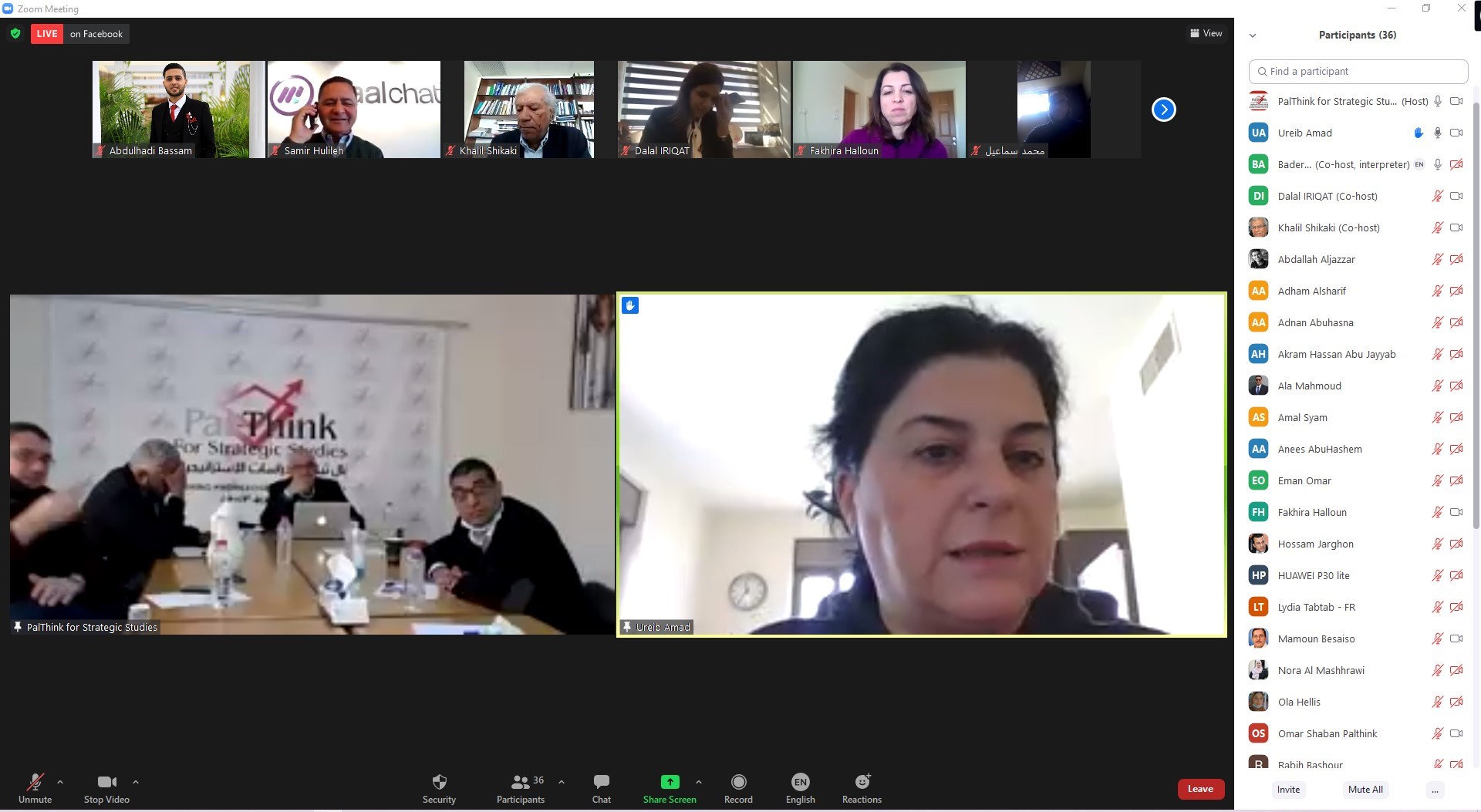
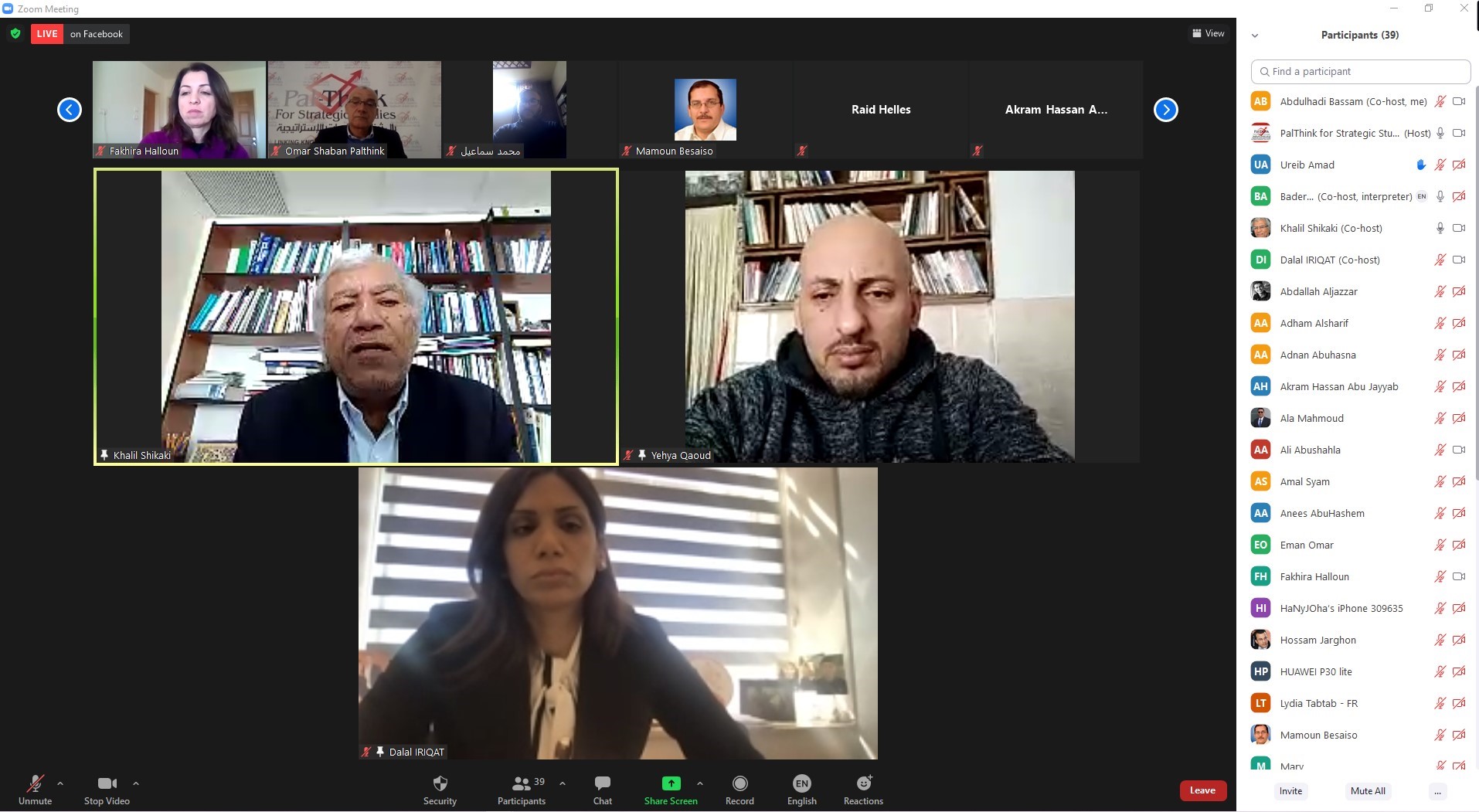
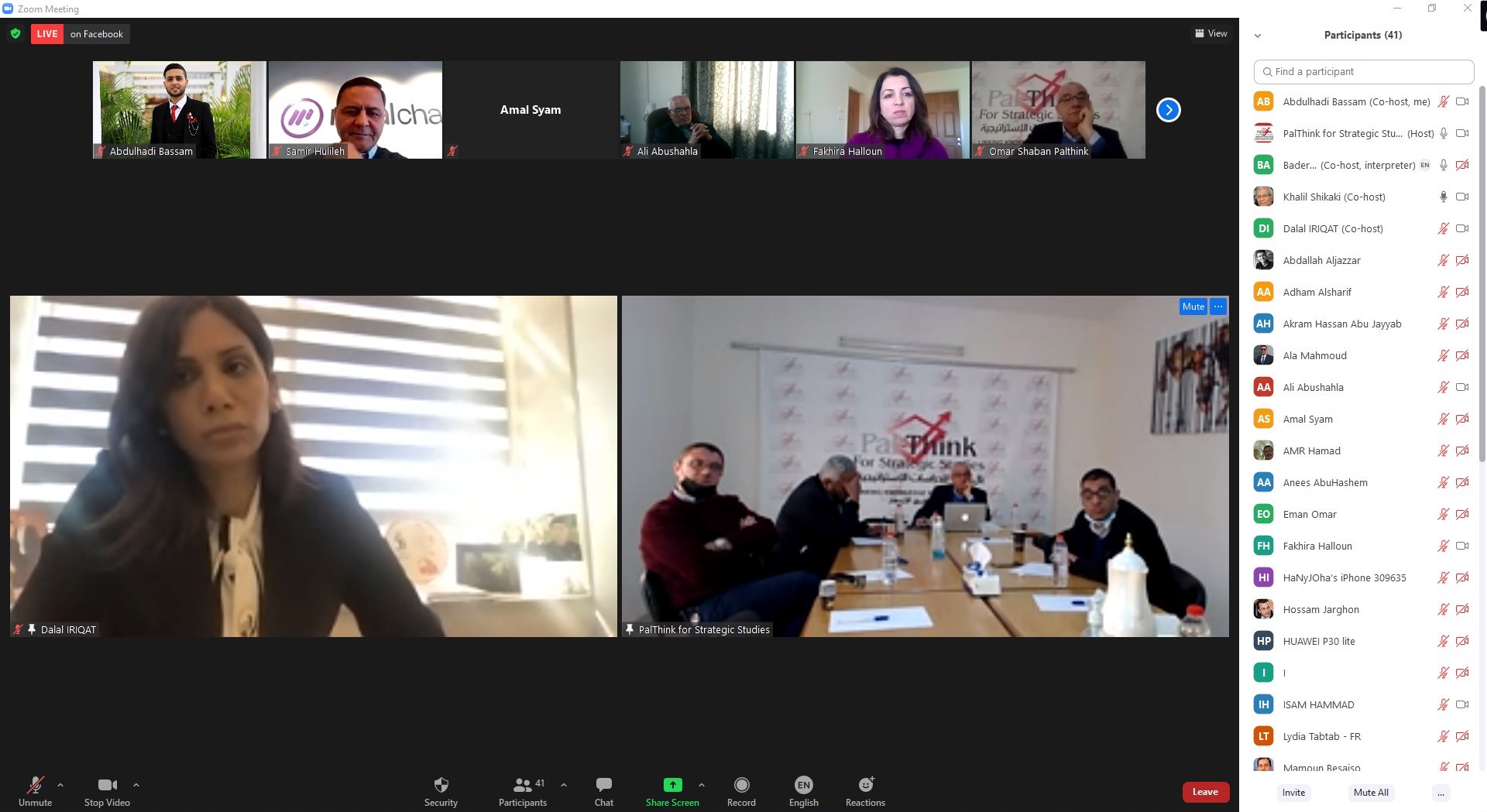
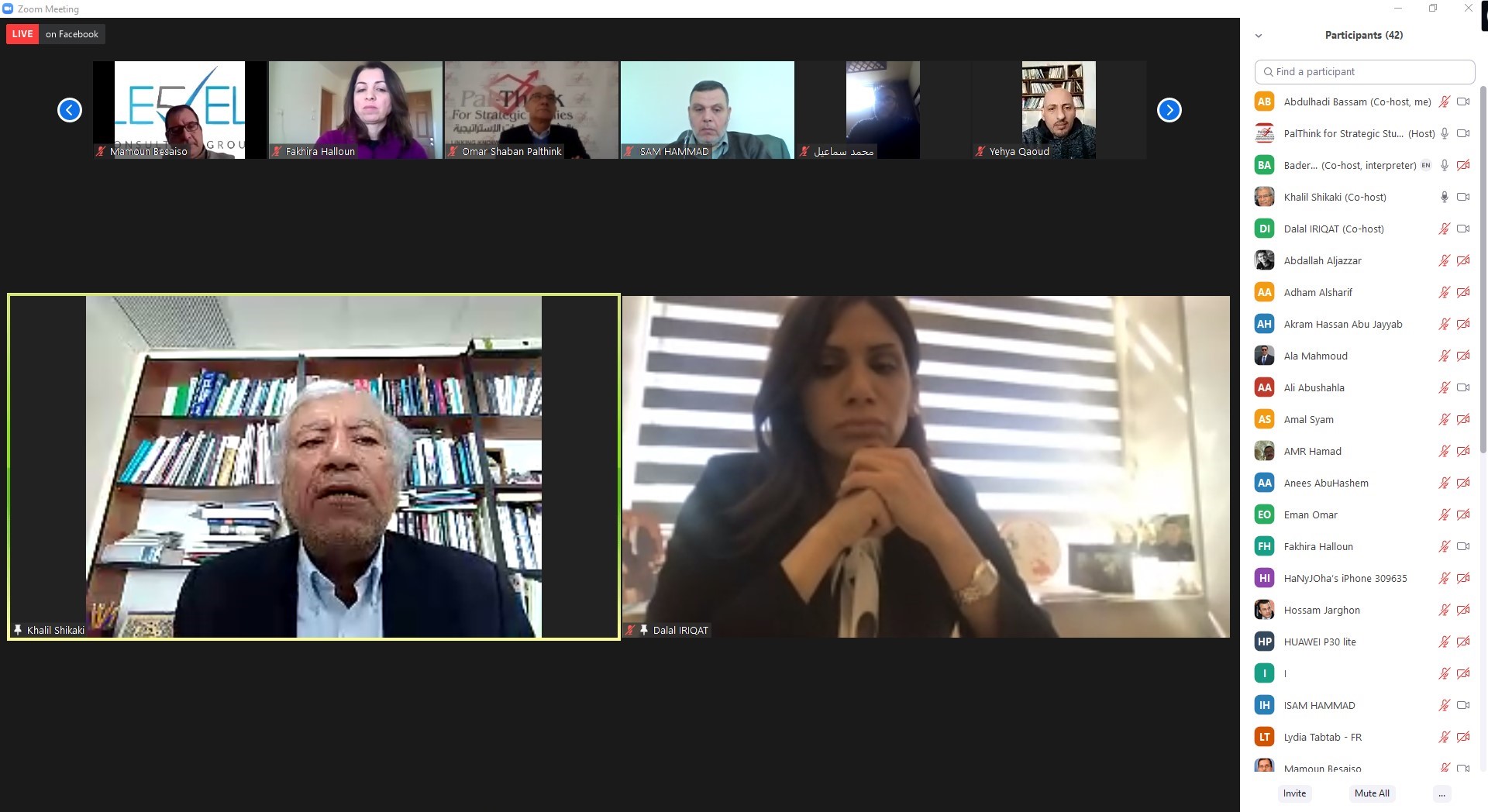
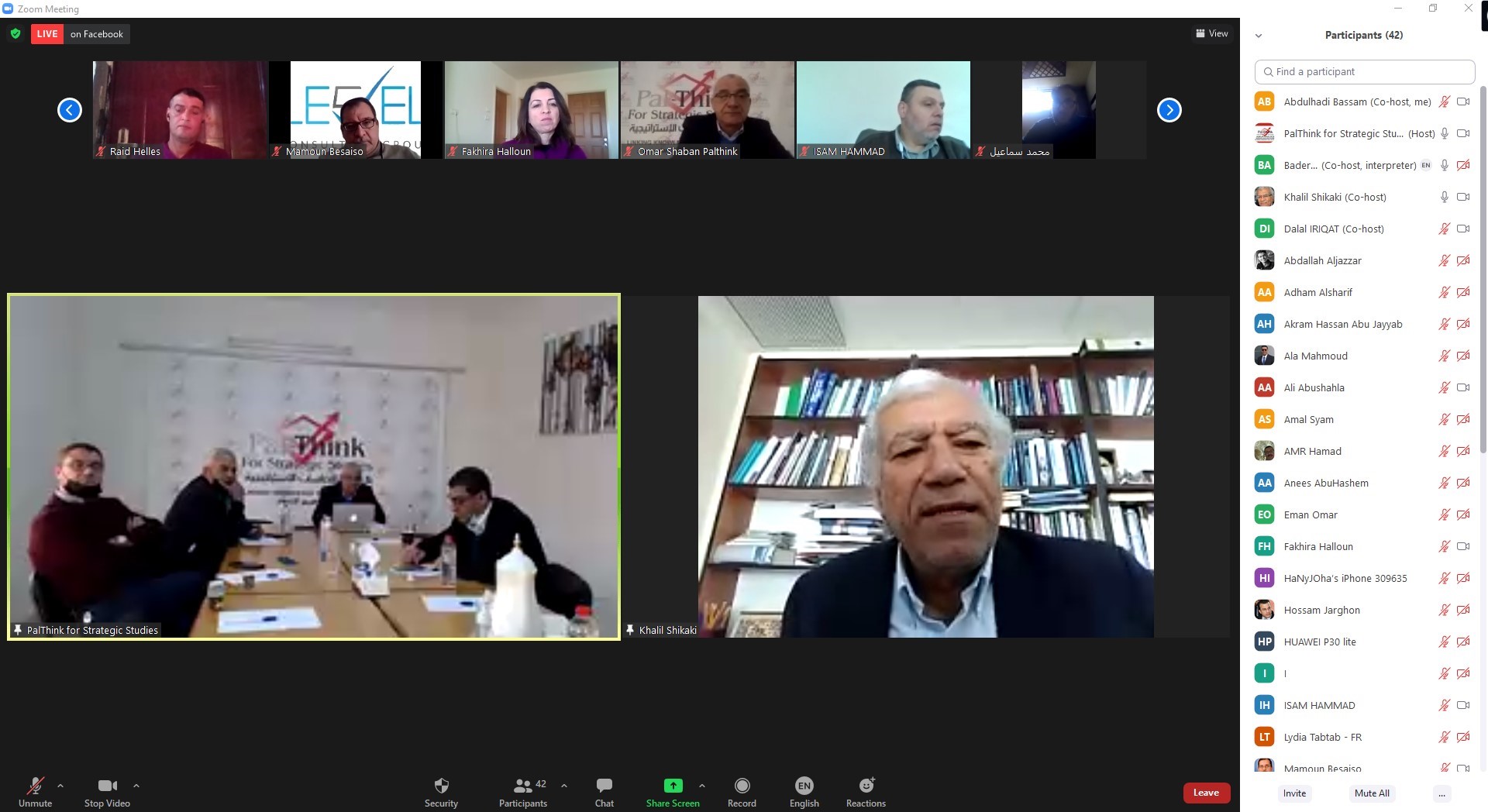
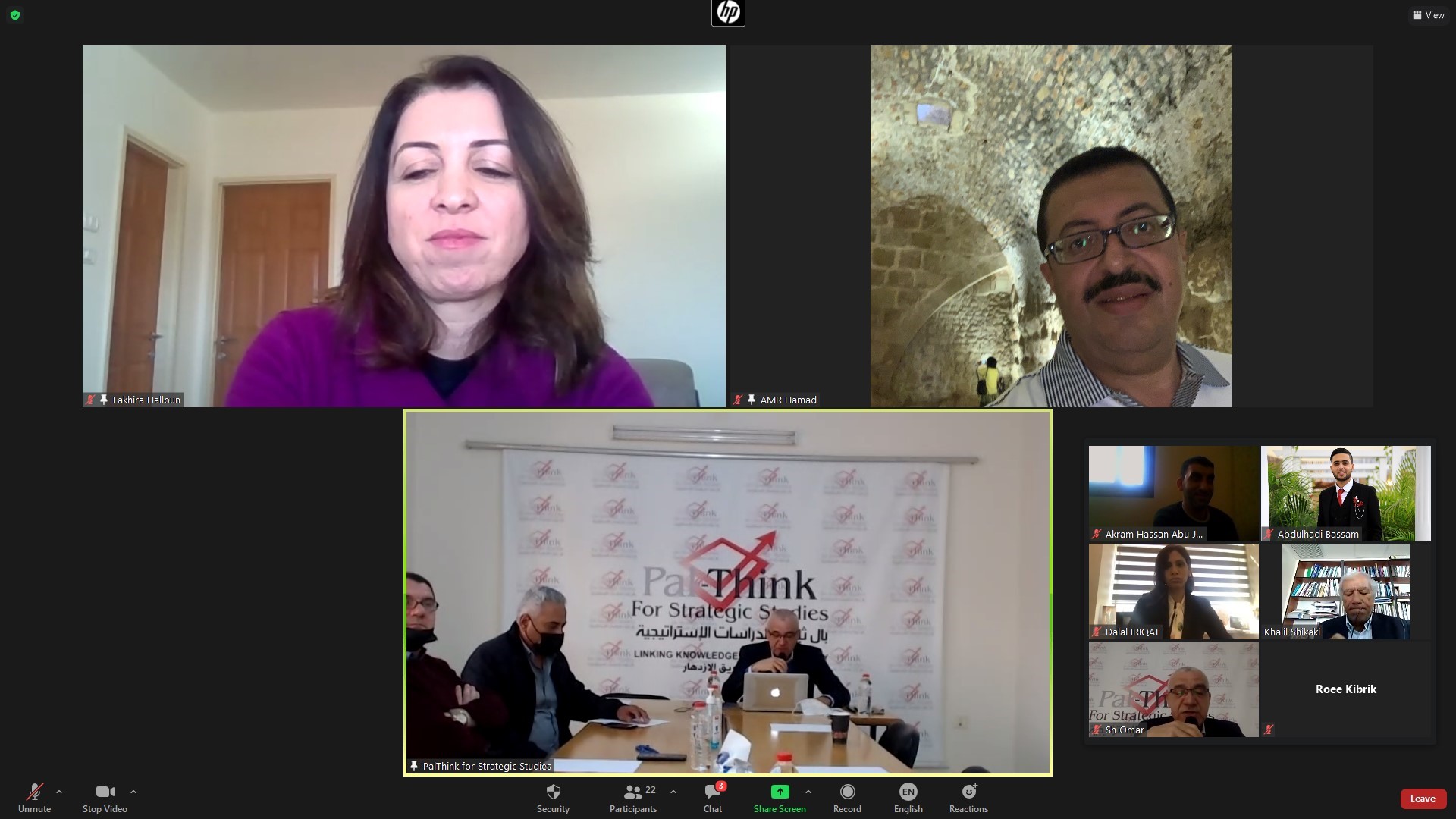
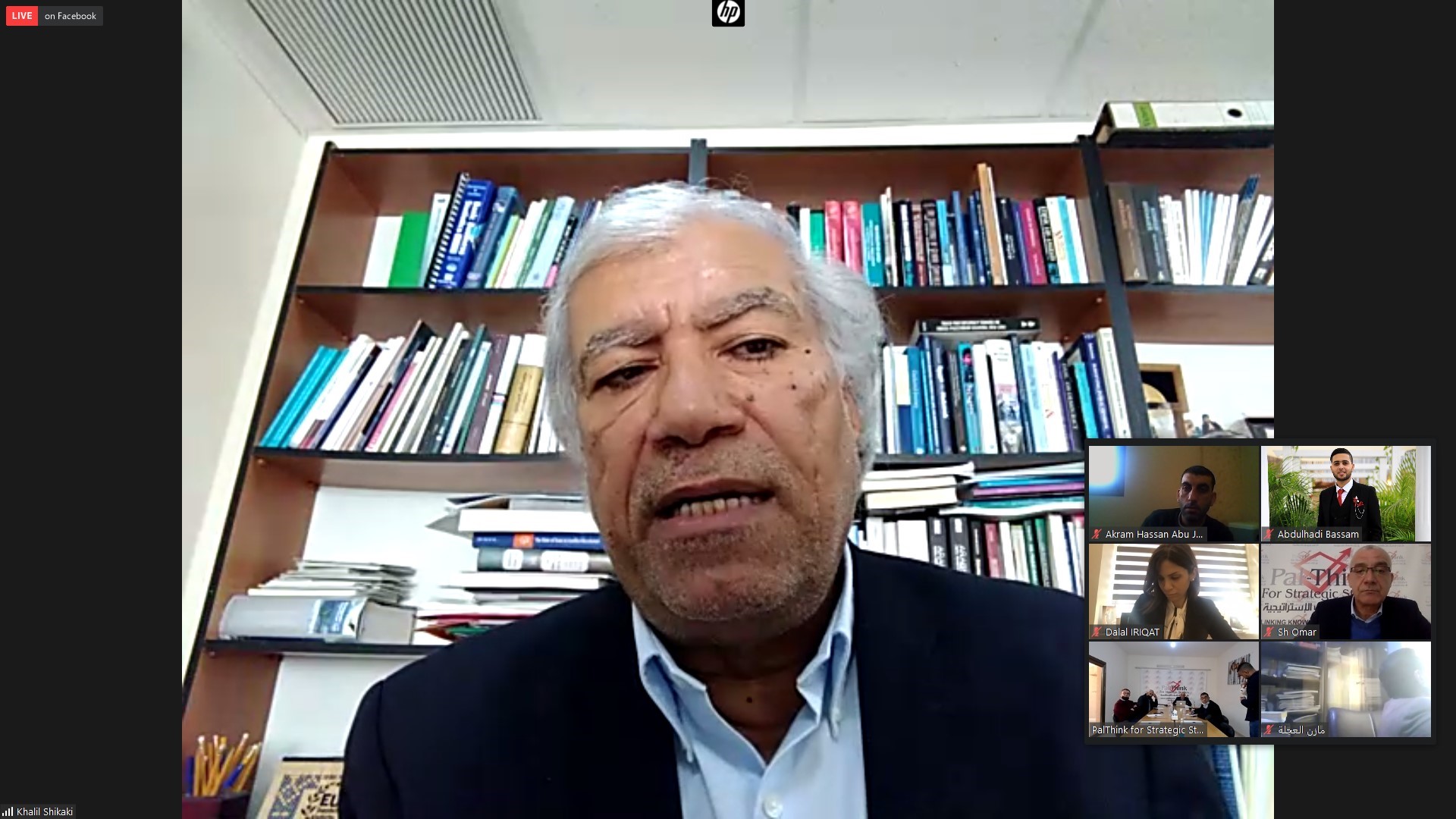
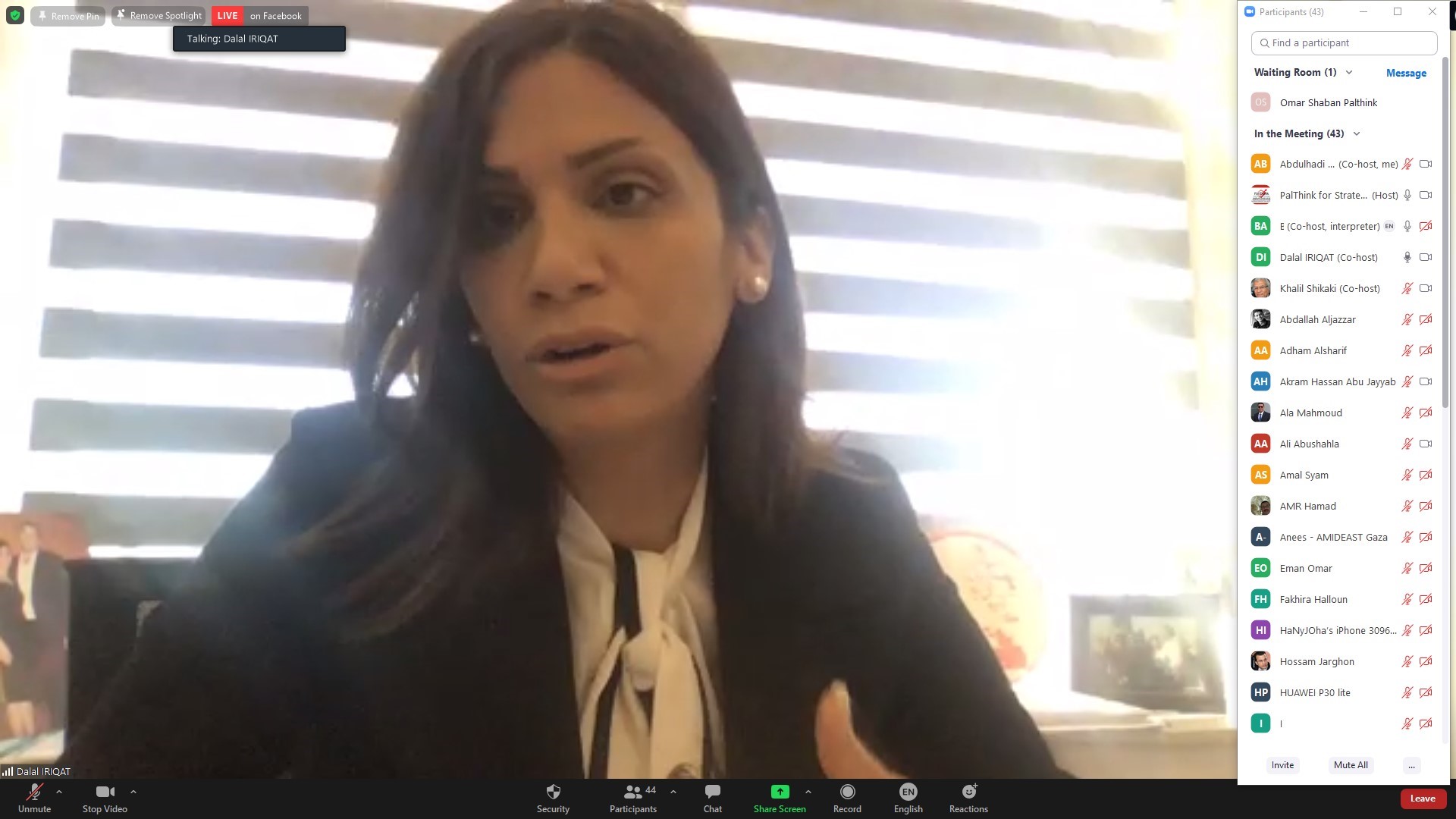
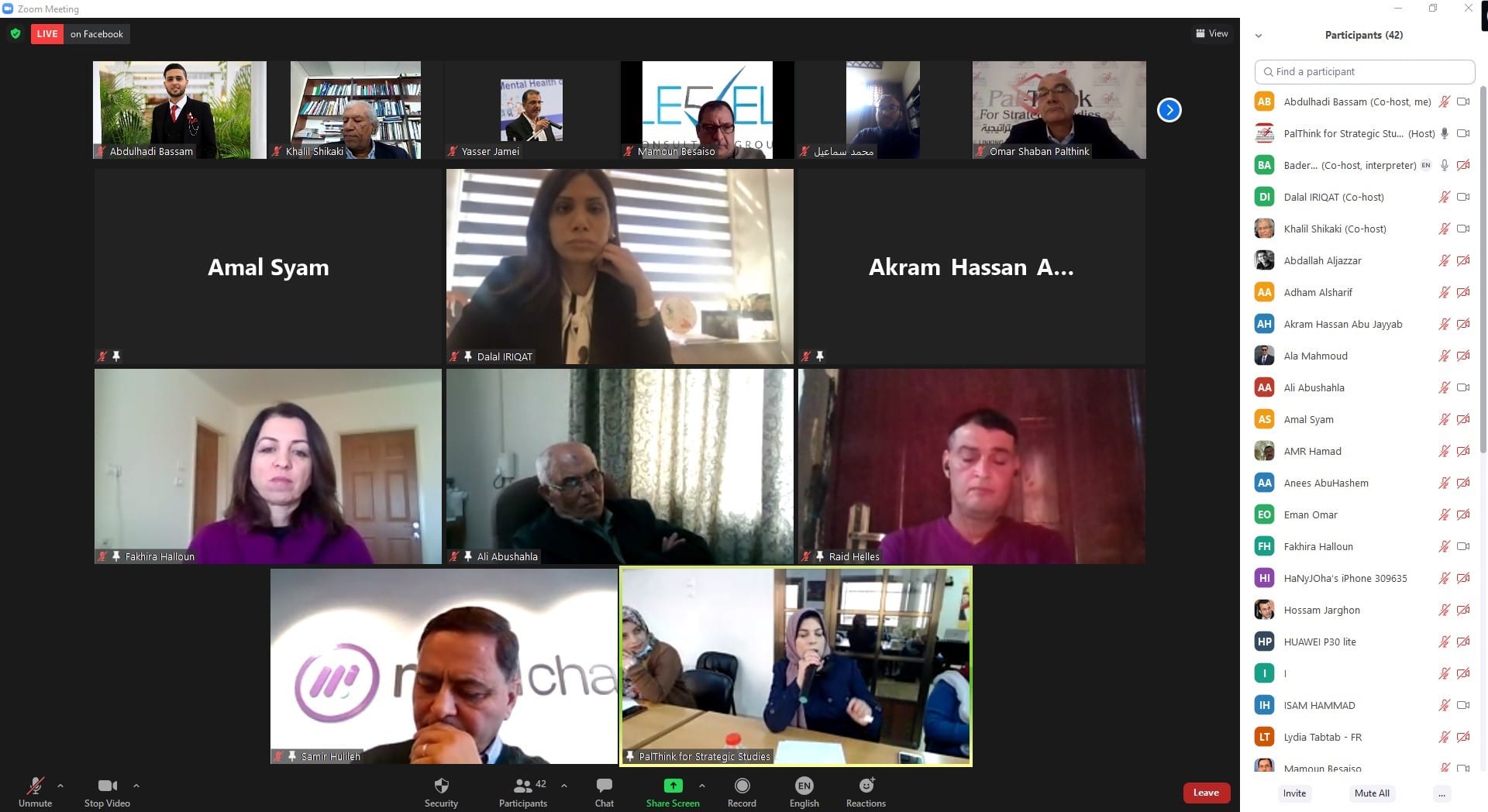
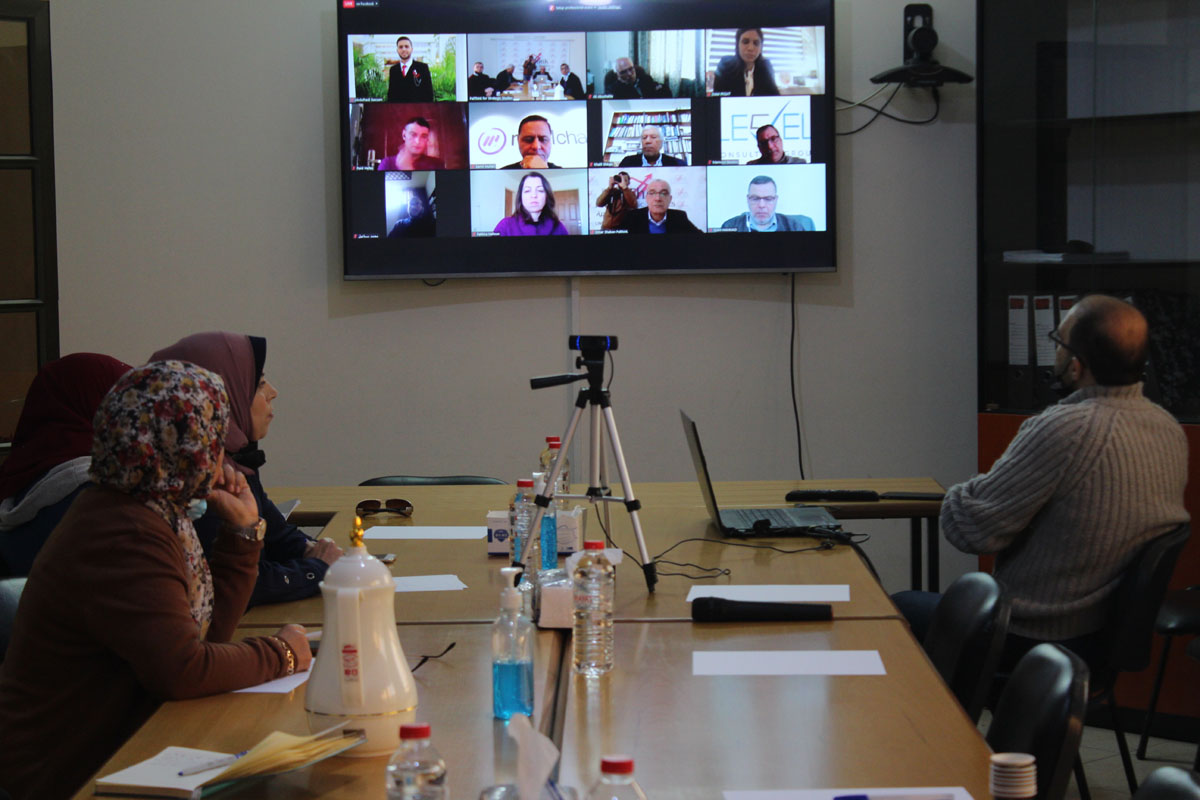
Pal-Think and the Palestinian Centre for Policy and Survey Research held a digital seminar, «A reading of opinion polls on the Palestinian elections», hosting Dr. Khalil Shikaki, the centre's director, and Dr. Dalal Iriqat.
- Date
- 2021-02-10
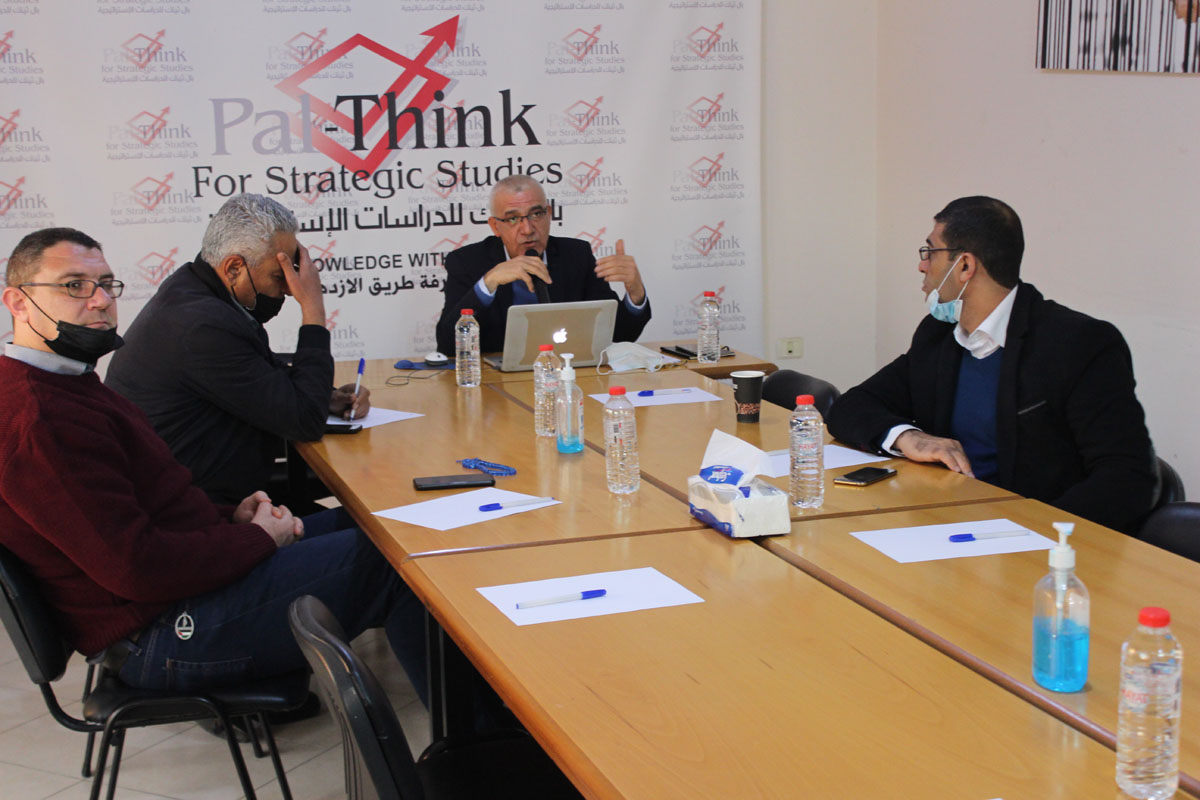
Pal-Think for Strategic Studies and the Palestinian Center for Policy and Survey Research organised a digital seminar titled “A reading of the opinion polls around the Palestinian elections”, during which Dr Khalil Shikaki, director of the Palestinian Center for Policy and Survey Research, and Dr Dalal Erekat, professor of conflict and conflict resolution at the Arab American University in Ramallah, were hosted.
The encounter was moderated by Mr Omar Shaban, director of Pal-Think for Strategic Studies, who opened the seminar by welcoming the attendees and guests, and said: “There is great frustration among the youth, and we need the emergence of new, young leaderships — the Palestinian project is in a crisis.” He added: “We are happy to organise this encounter, which answers several questions, most importantly: the extent of opinion polls' capacity to measure true public opinion, whether in the world or in Palestine; do the results of opinion polls change from time to time; and what is the vision of the Palestinian Center for Policy and Survey Research of the current Palestinian condition on the eve of the elections, in light of talk of the growing popularity of the Hamas and Fatah movements and the growing desire of youth for the emergence of leaderships new in thought and approach.”
Shaban concluded by saying: “We at Pal-Think keep pace with events, and we worked with the Swiss government on the subject of reconciliation, and we welcome all the institutions that want to work with us. We hope the coming days carry glad tidings.”
For his part, Dr Khalil Shikaki, the centre's director, made clear that the function of opinion polls related to the elections is not only prediction but also knowing electoral behaviour. The polls' accuracy is tied to their capacity to be neutral, to the soundness of the representative sample, and to the availability of knowledge of who will take part in the elections.
He added: “Often when the predictions are wrong, the principal cause is the inability to predict the magnitude of participation of certain categories. For us, these categories are the religious, the youth, and women, because they have particular orientations about whom they will elect. And should the rate of their participation in the elections increase or decrease, the result will differ.”
He pointed out that ordinary polls have a representative sample of the whole society, and do not ask about behaviour but about people's opinions — such as: do you support democracy or not, do you support the president or not.. etc. — because people are ready to speak of their opinions for hours, but do not like to speak of their behaviour, considering this a private question they prefer not to speak of.
Shikaki continued: “Some institutions work for profit sometimes. In 2006 there were profit-making institutions working in the field of opinion polls, and the candidates would turn to them to know whether they would win or not. Most of the time there was a motivation for these institutions to inform them that the chances of their winning were high, because this is the sole way to continue their work — they want the candidate to return to them again in order to know the extent of his popularity or his chance of winning. So if the material factor is the sole motive, their research and polls may have no credibility.”
He went on: “In the legislative elections of 1996 and the presidential elections of 2005, our results were nearly identical to the official elections' results. In 2006, Hamas took part in the elections, and we had no reference point — knowledge of the voter's behaviour in the previous elections. Now we have a reference point, but it weakens year after year because there are 14 years since the last elections; despite that, it is useful for knowing the orientation of the persons who voted in 2006.”
Our polls before the previous elections were accurate
He noted that polling in the majority system, “the districts”, is far more difficult than in the proportional-representation system, “the lists” — because in the latter the possibility of error falls greatly, owing to the distribution of votes over large numbers of candidates.
Dr Khalil Shikaki said: “In 2006 our polls showed that Fatah would obtain 42% of the votes, and it obtained 41% in the elections. And we said the other parties would obtain 16% of the votes, and they obtained 15%. And we said Hamas would obtain 35%, and it obtained 44% — and the difference lay in those who had not yet decided to whom they would vote. Compared with the districts, in 2006 we predicted half the winners — that is, the best 17 candidates for Fatah, and the overwhelming majority of them actually won. And we predicted Hamas's victory in the cities of Gaza and Hebron, and it won. In the presidential elections we predicted Abu Mazen would obtain 65% of the votes, and he obtained 67%. And we predicted Mustafa Barghouti would obtain 22%, and he obtained 21%.”
He added: “Now, in the latest opinion poll we conducted, there are about 20% of the sample who have not yet decided for whom they will vote. In the coming poll in month 3, this category will be smaller because they will perhaps be acquainted with the candidates. Generally, opinion polling for these elections will be easier for the professional polling institutions.”
Marwan Barghouti has the best chance in the presidential elections
The director of the Palestinian Center for Policy and Survey Research continued: “At the present time, if there were a presidential candidate from Hamas such as Ismail Haniyeh, and Fatah's candidate were Abu Mazen, then Abu Mazen's chances of winning are nearly zero. Abu Mazen will not win in elections against Haniyeh, because the latter has popularity inside the Hamas movement and in Palestinian society as a whole. Many people will not vote for Hamas but will vote for Ismail Haniyeh. But if the candidate were Marwan Barghouti, then it is certain that Marwan would win, even if Abu Mazen and Ismail Haniyeh were candidates — true, he would not win a majority, but he would obtain the largest number of votes, go to a second round, and win in it.”
He went on: “As for the legislative elections, the current polls indicate that Hamas will take a third of the votes, that Fatah will obtain slightly more than that, and the other forces will obtain 10% of the votes; and there are 20% of the public who have not yet decided whom they will elect until this moment. But these results are insufficient until this moment to build upon — not like the presidential elections, in which the proportion of those who have not yet decided to vote is less than 10%. The third forces and the youth could influence these elections. As for Abu Mazen, he is Fatah's weakest point — he is the one who loses his popularity with all ease because of the political developments. And when positive developments happen, Fatah may improve, but Abu Mazen does not improve much; he is a principal point of weakness for the Fatah movement.”
He pointed to the possibility of the results changing within a month because of the political developments — many polls changed during the last five years because of the war on Gaza, the formation of the accord government, the social-security issue, the issue of cutting relations with Israel and their return, and America's recognition of Jerusalem as Israel's capital.
He affirmed that the public in Palestinian society has lost confidence in opinion polls because it does not trust the political leadership, and this reflects on the opinion polls — its principal cause being the division. He noted that the Cairo meetings will affect the participation rate in the elections, because it has currently reached 70%, while in 2006 it reached 77%. He likewise deemed it probable that the youth would not vote, because they are the most harmed by the standing political system — especially as 83% of them believe there is no freedom of opinion in Palestine.
Fatah would collapse if a great split occurred within it
The guest of “Pal-Think” said: “Should a split occur within Fatah, Hamas will win the highest proportion of the votes.
And if Marwan Barghouti split off and formed a list, he would obtain 25%; and if Mohammed Dahlan formed a separate list, he would obtain 7% of the votes. Fatah without Marwan Barghouti would obtain only 19% — and this means it would collapse in the case of a great split. Whereas Hamas is a more disciplined and committed movement, so there will be no split; and should one occur, the effect will depend on the popularity of the persons splitting off.”
He added: “It is expected that the participation of the Palestinians of East Jerusalem will be very small, because it has appeared plain that since the wall's completion the Palestinians there have begun to be isolated from the West Bank and to go toward West Jerusalem. Their learning of Hebrew has increased, and their studying of Hebrew curricula — all these matters indicate the existence of a severance from the West Bank, and will inevitably reflect on participation in the coming elections.”
Dr Khalil Shikaki concluded by saying: “But I affirm the incorrectness of taking these polls to generalise them onto the results of the coming legislative elections — but should conditions remain as they are, they will be correct.”
For her part, Dr Dalal Erekat, professor of conflict and conflict resolution at the Arab American University in Ramallah, said: “The polls are very important in light of the absence of the Legislative Council, and very important for the Palestinians to focus on these polls, whose results are supposed to reflect on the manner of decision-making. The polls show us information, but the most important thing is deploying this information. I hope it is deployed by decision-makers, and that their decisions be built on the polls that show the majority's opinion.”
She added: “There are many polling centres in Palestine, and unfortunately some of them do not do their work with transparency and professionalism.
When we speak of a poll's accuracy there are many criteria, among the most important of them freedom of opinion and expression in the Palestinian street — and this reflects on the extent of the respondent's frankness and truthfulness. Also, when we ask the respondent about their commitment to some matter, their answer will be different from their neighbours', for example, on the same matter. In addition to the manner of formulating the question.”
She concluded by saying: “In the standing Palestinian condition, and in light of the amendment of the elections law without a Legislative Council, I would have hoped we would measure the public's opinion concerning the elections law, the rate of women's participation, and the existing conditions.
I hope the elections happen and that the citizen deals responsibly with the opinion polls — especially as they no longer believe in their capacity for change.”