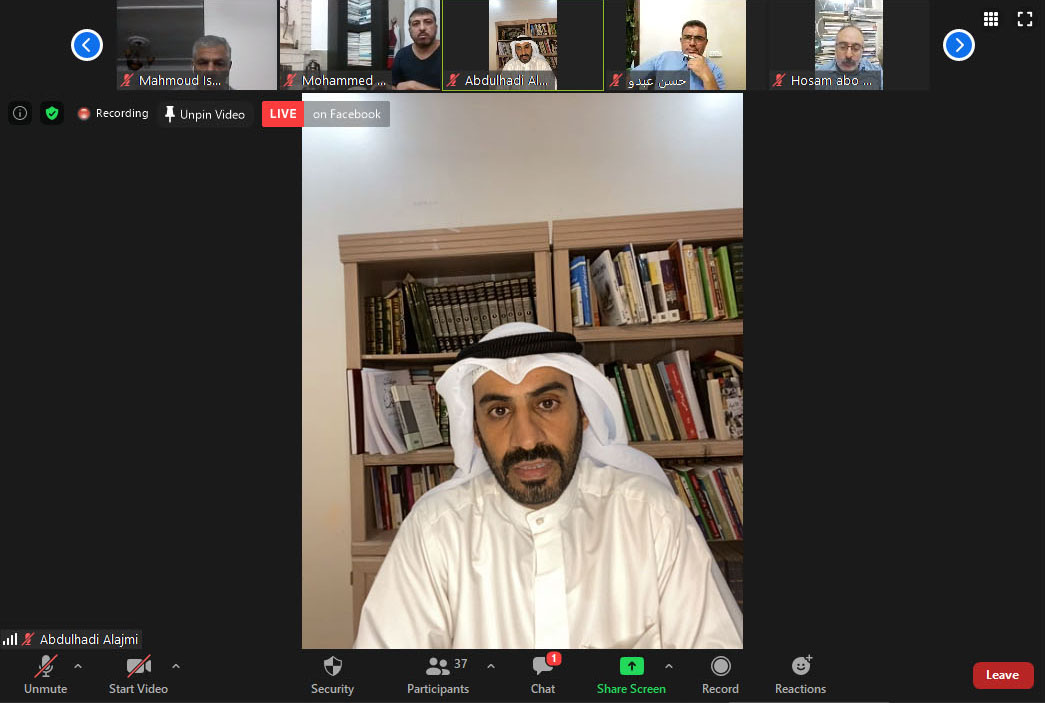
Pal-Think holds the seminar «Gulf attitudes towards the Palestinian question — a view from the Gulf»
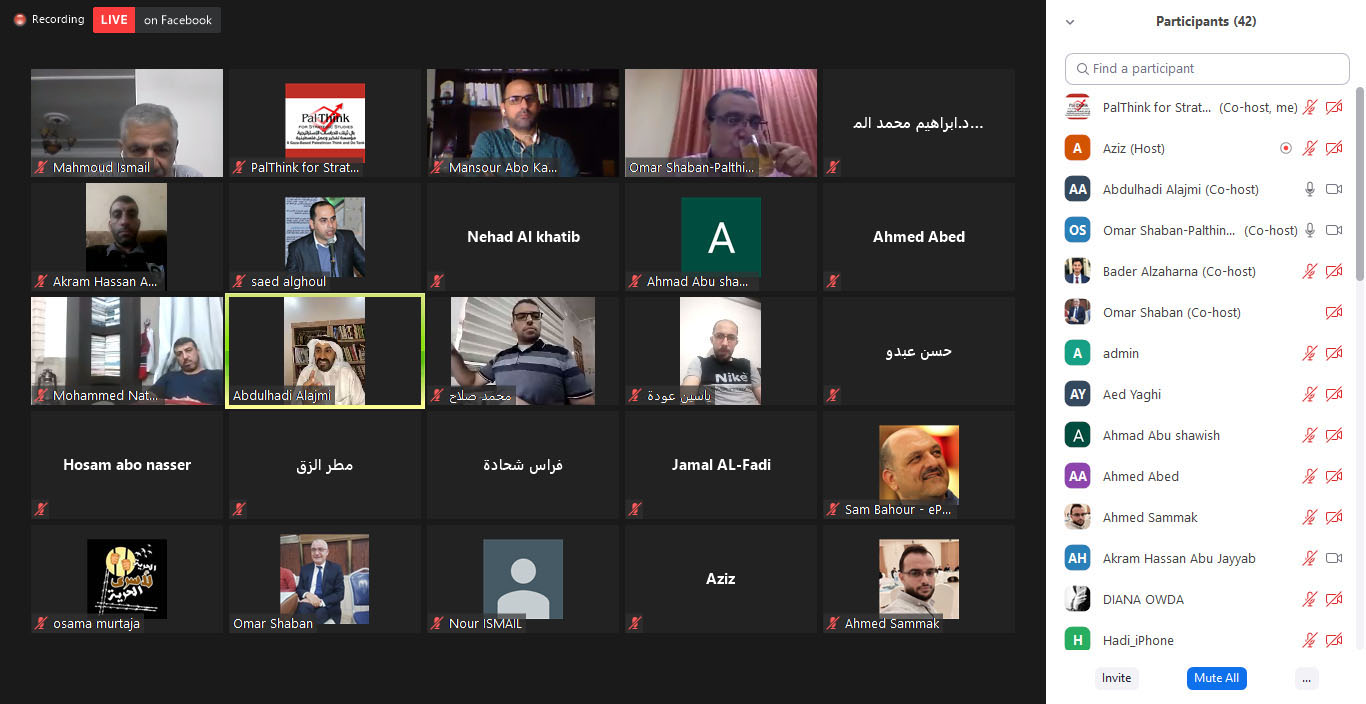
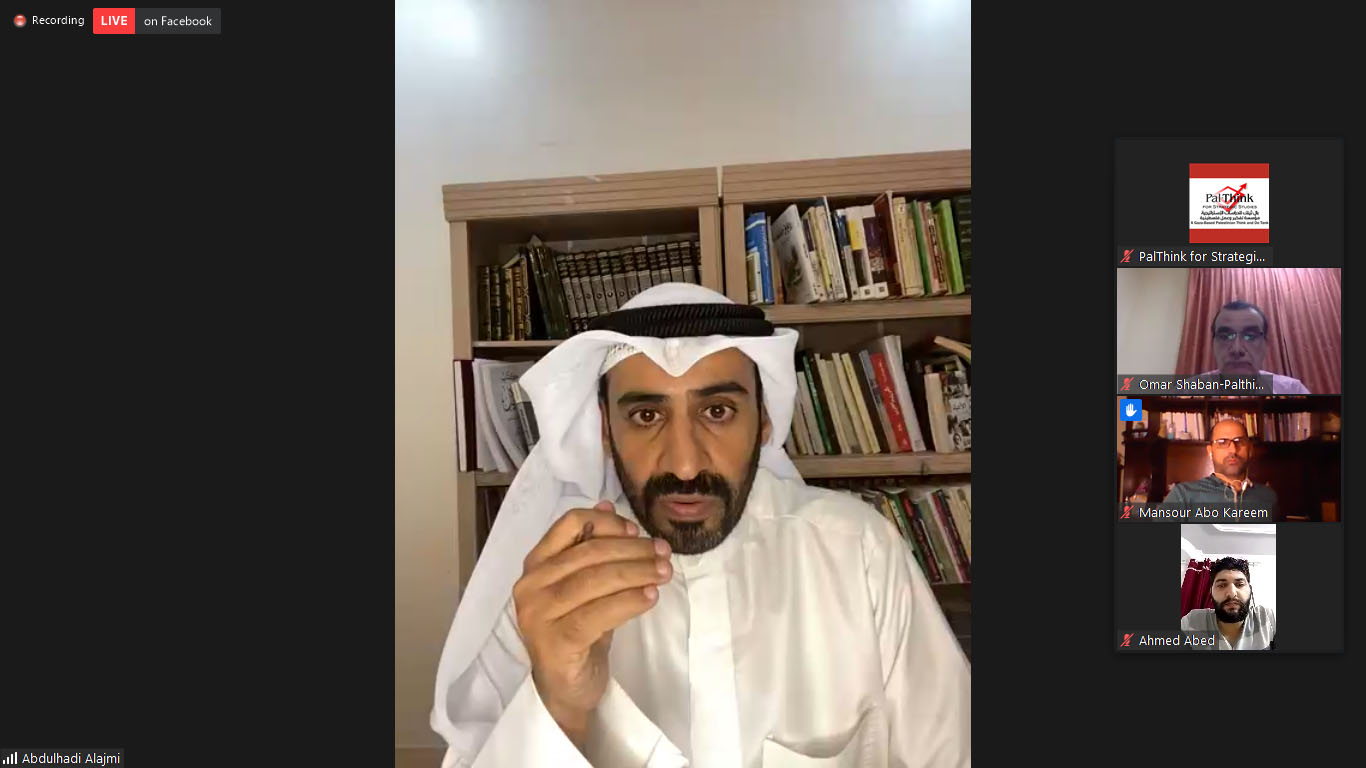
Pal-Think held the political seminar «A reading of Gulf attitudes towards the Palestinian question — a view from the Gulf», hosting Kuwaiti professor Abdulhadi Al-Ajmi, moderated by director Omar Shaban.
- Date
- 2020-09-26
The “Pal-Think” for Strategic Studies institution organised a political seminar titled: “A reading of the Gulf's orientations toward the Palestinian cause — a viewpoint from the Gulf”, during which it hosted the Kuwaiti professor Abdulhadi al-Ajmi.
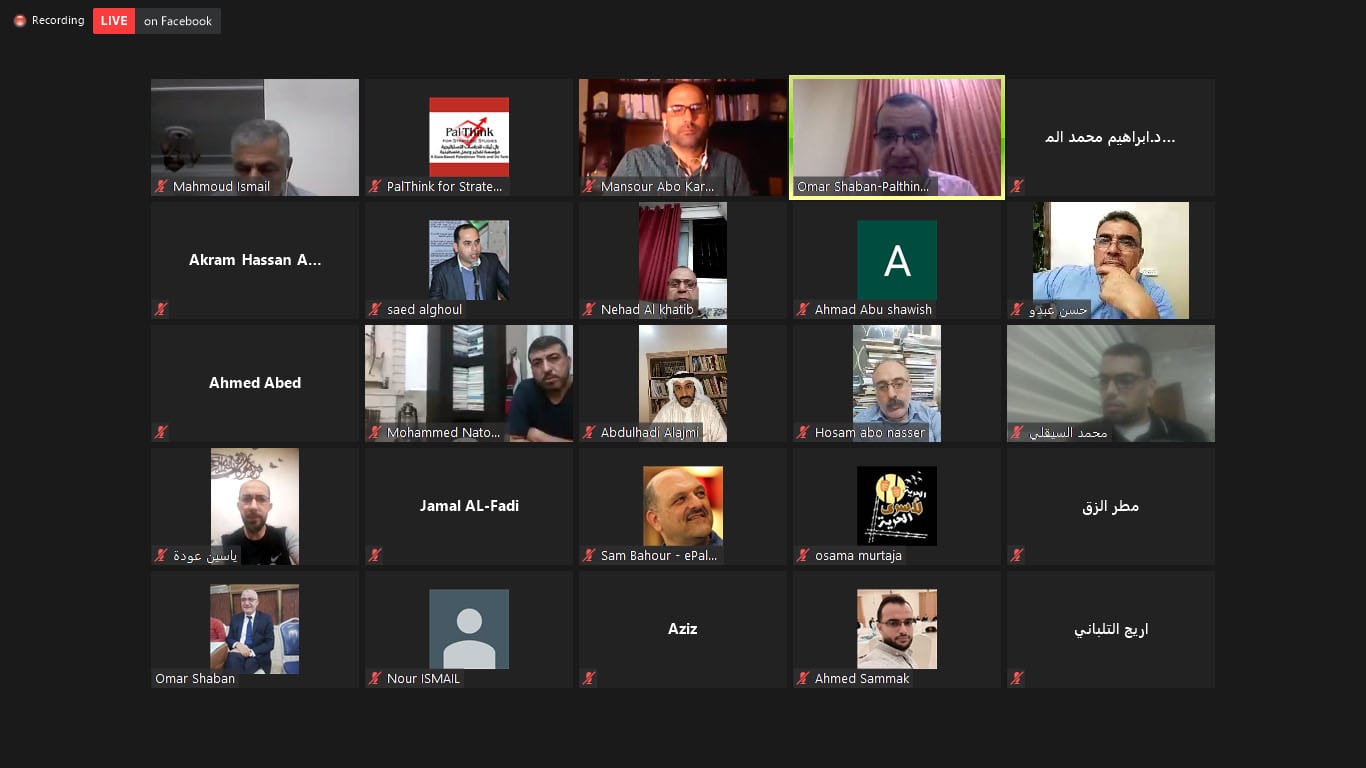
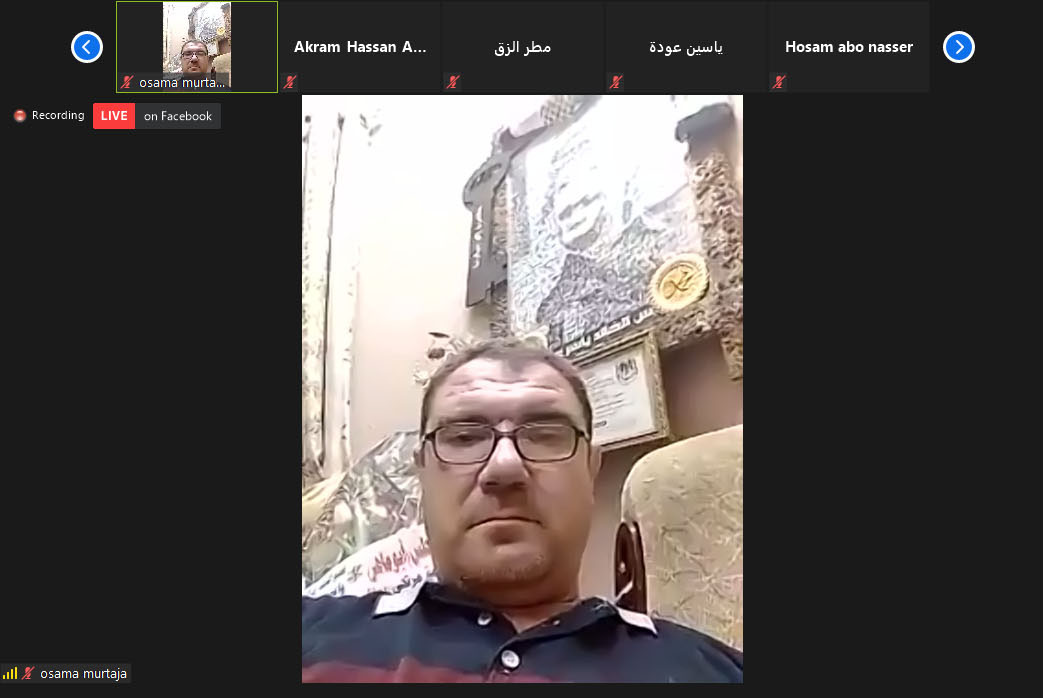
The digital political seminar, moderated by Mr Omar Shaban, director of the “Pal-Think” for Strategic Studies institution, was attended by an elite of university professors, a group of researchers, and representatives of civil-society organisations from inside Palestine and outside it. This comes within “Pal-Think's” continuing efforts to strengthen discussion of the local and regional issues.
Mr Omar Shaban, director of the “Pal-Think” for Strategic Studies institution, said in opening the political seminar: “The political meeting with Professor al-Ajmi aims at strengthening the role of reason and the foundations of scientific discussion about the public issues and the challenges storming the Palestinian cause.”
Mr Omar Shaban added: “The specialised political seminar aims at a deep political understanding of the Gulf states' orientations toward the Palestinian cause, and it is an attempt to foresee the opportunities and challenges facing the Palestinian cause” — pointing out that the political seminars and the hosting of specialists strengthen the principles of the Pal-Think institution, which aims at joint thinking and independent research”.
Dr Shaban stressed the necessity of adopting rational, wise discourse in addressing the peoples, and not being dragged into any reactions of uncalculated results.
From the “three noes” to normalisation!
Professor Abdulhadi al-Ajmi sees that historical courses, events, and accumulations since the eighties contributed to the disintegration and fragmentation of the Arab position toward the Palestinian cause — such as the signing of the Camp David agreement in 1979, and the invasion of Iraq in 2003, which caused the Liberation Organization to lose part of its alliances and relations in the region.
Al-Ajmi made clear that the course of normalisation with the Israeli occupation developed after a series of Arab and Palestinian crises, reaching the launching by the late Saudi king Abdullah bin Abdulaziz Al Saud of the “Arab Initiative” for peace in 2002, which rests on the principle of “Israel's” withdrawal from the occupied Arab territories in exchange for the Arab states' moving toward establishing peace with “Israel”.
Al-Ajmi pointed out that the Israeli occupation did not respond actually and practically to the Arab Initiative, saying: “The real problem the Arabs face is that the Israelis do not respond on the ground to the international decisions or the Arab initiatives or the agreements with the Palestinians — for the Israeli governments make a profession of procrastination and manipulation, and evade in many ways the commitments and the decisions.”
Al-Ajmi mentioned that the “peace initiative” King Abdullah launched formed an essential transformation in the official Arab position toward the Israeli occupation, since the Arab regimes became acknowledging in principle their intention to normalise with the Israeli occupation — but in exchange for giving the Palestinians part of their rights.
He stressed that the idea and principle of normalisation with the occupation was founded and set clearly and plainly in King Abdullah's peace initiative, and it represented at the time the minimum for the Arab regimes for normalising with the entity.
Strategic collapses!
He mentioned that the outbreak of the “Arab revolutions” in the last decade and the fall of regimes and the holding together of others seized the attention of the Arab street; also the violence some regimes practised led to a weighing, in some Arab mentalities, between the traditional enemy represented in the Israeli occupation and some Arab regimes that killed hundreds of thousands of their citizens in exchange for remaining in the seat of rule — and those mentalities came to see that the Arabs' rulers are harsher on them than the Israelis, which led some of them to accept the idea of normalisation.
Arranging the region and Trump's elections
Professor al-Ajmi sees that the Americans and the Israelis have rearranged the Arab region in their favour, and placed it in a state weaker than it was in the eighties and nineties — pointing out that the Arab condition suffers from great weakness the more the years advance; expressing his worry that the current situation may be better than what the situations will come to in the coming ten years.
Al-Ajmi sees that the agreement of the Emirates and Bahrain is not a normalisation with “Israel” so much as it is a normalisation agreement with the United States — specifically an agreement to serve “Trump's” electoral interests. Al-Ajmi considered normalisation a service from the Gulf regimes to Donald Trump, who will face presidential elections during the coming months — on a belief of those regimes that presenting any accomplishment raises Donald Trump's electoral fortunes, and his success in a second presidential round will pour into their interest.
Qatar first in the Gulf and Oman the most daring
Professor Abdulhadi mentioned that the State of Qatar comes in the first rank in the Gulf in communication and talks with “Israel” from the historical respect, saying: “Qatar at an early stage wanted to have political weight in the region, and it found that developing the relationship with the Israelis through representation offices or the like could grant it that opportunity to play a fundamental role in the region.”
He pointed out that the Sultanate of Oman comes in the second rank in the Gulf in respect of communication and relationship with the Israelis — noting that the Omani position formed a great shock for observers, since the visit of the prime minister of the Israeli occupation Benjamin Netanyahu to the Sultanate of Oman and his reception by Sultan Qaboos contained unusual daring; expressing his astonishment at the reply of the Omani foreign minister when asked about the particulars of Netanyahu's visit to Muscat and its repercussions, for he replied at the time saying: “It is our right to communicate with everyone!”.
The Emirates makes pretexts and Bahrain “does not care much”
On the Emirates, he made clear that it used as a pretext for the rush toward normalisation with “Israel” the realising of an interest for the Palestinians, and that it managed, in exchange for the agreement, to stop the Israeli annexation of the occupied Bank's lands — which Israeli officials denied.
As relates to Bahrain, he pointed out that their position on normalisation was regrettable and extremely dangerous, for they did not mention the Palestinian cause at all, saying: “If the Emirates made the pretext for concluding the agreement that it aims behind it at realising a Palestinian interest — that to absorb the peoples' anger — then Bahrain did not mention the Palestinian cause at all.”
Riyadh's cautious calculations
On the Saudi–Israeli relations, he mentioned that Riyadh's announced official positions suggest that it still holds to the Arab Initiative as a condition for normalising with the entity — citing as evidence statements of the Saudi prince Turki al-Faisal, who said in the wake of the Emirates' and Bahrain's normalisation: “Trump was not honest concerning the issue of the Palestinian state, therefore he is a dishonest broker (..) and I think King Faisal bin Abdulaziz Al Saud would be extremely frustrated and angry at the Emirates' and Bahrain's normalisation without finding a solution for the Palestinians” — pointing out that despite the positive position from Prince Turki al-Faisal, he passed over the issue quickly for many political considerations.
Al-Ajmi made clear “that the passage of the Israeli planes through the Saudi airspace is an important step that pours into the Israelis' interest and the interest of the normalisation vision”.
Kuwait and the tax of steadfastness!
On Kuwait's position refusing normalisation, he said: “The Kuwaiti government refuses any facet of the facets of normalisation, since normalisation is incompatible with the Kuwaiti popular wish and will (..) In recent days, with the intensification of the fever of normalisation in the region, the Kuwaiti government has dealt intelligently: when Trump asked to honour Sheikh Sabah al-Ahmad al-Sabah with the Legion of Merit, the government sent Sheikh Nasser Sabah al-Ahmad — and I think the matter contains political intelligence, since Sheikh Nasser holds no governmental post Trump could exploit in his favour.”
He added: “Although Sheikh Nasser Sabah al-Ahmad holds no governmental post, Trump wanted to exploit that meeting in the media, for he came out to the media and said “that he exchanged viewpoints with Prince Nasser, and that the latter seemed enthusiastic about normalisation” — which the Kuwaiti government denied wholesale and in detail.
Al-Ajmi sees that there are those who play on the string of the necessity that Kuwait be at the forefront of the normalising states because of two important factors: the first factor, that the Americans liberated Kuwait from Iraq in the Gulf war in 1991, so it is indebted to the Americans from their viewpoint; and the second factor is represented in the historical position of the Palestine Liberation Organization on the Iraqi invasion of Kuwait in 1990.
Professor al-Ajmi sees that Kuwait surpasses the two dangerous factors through its insistence on its authentic political principles, setting out that Kuwaiti society is among the Arab Gulf's societies most influential on its government's positions.
He said: “The Kuwaiti government will not go beyond the positions of the Kuwaiti people; since the decision-holders in Kuwait realise well that the Palestinian cause is a constant cause and a priority for the Kuwaitis. In addition, the Kuwaiti scene is approaching the National Assembly elections in the month of November, so no deputy will dare to speak about the Palestinian cause or touch it with ill.”
Al-Ajmi sees that Kuwait may suffer much because of its holding to its authentic principles regarding the Palestinian cause; however he did not exclude Kuwait retreating at some stage should it be subjected to severe pressures, especially should Donald Trump win a second presidential term — expecting the conditions to change should Trump lose and his Democratic rival Joe Biden win.
Two important factors
Despite the historical review of the difficult stages the Palestinian cause has passed through, reaching the normalisation of Gulf regimes with the Israeli occupation, he sees that there are important factors in that equation difficult for the cause. The first of them is the Palestinian steadfastness, saying: “The Palestinian steadfastness is an important factor in that equation, and it is a factor that grows with time.”
He mentioned that the second of the important factors in the current difficult equation is “the growth of world support for the Palestinian cause on the basis that it is a humanitarian cause”.
Winning the peoples and beware the ruse
Professor al-Ajmi warned against the marketing of normalisation with the occupation inside the Gulf popular incubators that refuse to adopt their governments' positions, through kindling the fire of discord between the Palestinians and the Gulf peoples through the exchange of insults, expressions of treason-accusation, and the burning of flags and pictures of the states' symbols.
He pointed out that there are those who have marketed in the Arab Gulf two negative images of the Palestinians: the first represented in the corruption of the Liberation Organization and its abandoning resistance of the occupation in favour of personal gains for its individuals; and the second image the Gulf citizen receives is represented in showing the (Hamas) movement as one of Iran's malicious arms in the region.
He called for winning the affection of the Gulf street through discourse that urges mutual support and solidarity for the sake of the nation's cause, and reminding of the positions of the Arab peoples and their striving and resistance in the frame of defending the Palestinian cause — advising the Palestinians of the necessity of keeping away, as far as possible, from the random behaviours that may increase the state of Arab fragmentation.
He said: the manufacture of public opinion has become a matter of utmost ease, and what I fear most is the marketing of normalisation with the occupation inside the Gulf popular systems that refuse to adopt their governments' positions, through exploiting the gaps of reactions from the Palestinians — such as exploiting the burning of flags and the states' symbols — to strengthen the discourse of hatred between the Palestinian people and the Gulf peoples.