«What is to be done, Palestinian-wise?»: a political seminar urges PLO reform and a multi-dimensional struggle strategy
A political seminar held by Pal-Think with the Friedrich Ebert Foundation urged Palestinian decision-makers to reform the PLO, adopt a structure engaging all components of the Palestinian people, and set a multi-dimensional struggle strategy.
- Date
- 2020-10-29
A political seminar organised by the “Pal-Think” for Strategic Studies institution in cooperation with the German “Friedrich Ebert” foundation recommended to decision-makers in Palestine the necessity of reforming the Palestine Liberation Organization, adopting a structure resting on the involvement of all the components of the Palestinian people in managing the national affair, and setting advanced struggle strategies to confront the existing challenges.
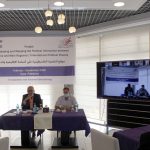
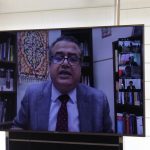
The “Pal-Think” for Strategic Studies institution hosted in its political seminar under the title “Palestinian policies for the coming stage in light of the current challenges” Dr Ahmad Jamil Azm, assistant professor at Birzeit University and political advisor to His Excellency the Palestinian Prime Minister, and Dr Ibrahim Fraihat, professor of international conflicts at the Doha Institute for Graduate Studies and Georgetown University.
Think tanks and the making of wise policies
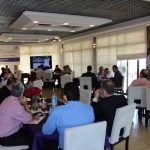
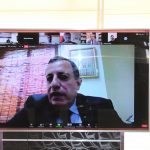
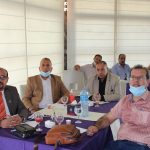
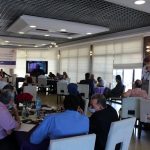
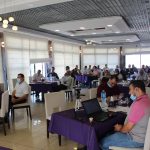
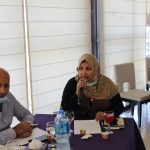
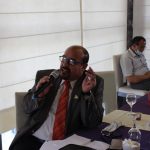
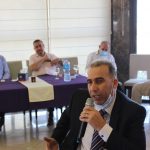
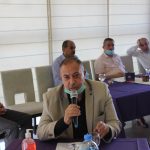
The political seminar, moderated by Mr Omar Shaban, director of the “Pal-Think” institution, was attended by an elite of experts, researchers, academics, and representatives of civil-society organisations, amid effective participation from the attendees in the Gaza Strip and participants from multiple areas via the Zoom programme.
Mr Omar Shaban made clear that the political seminar aims at deepening the discussion under way about the challenges facing the Palestinian project, and aims at presenting recommendations to decision-makers to surpass the current impasse — pointing out that the think tanks and research centres concerned with foreseeing the future aim at presenting recommendations and conclusions that contribute to making decisions of higher quality, and noting that the seminar encourages the culture of constructive dialogue and calm discussion.
From his side, Dr Osama Antar, programmes director of the German “Friedrich Ebert” foundation, praised the efforts the “Pal-Think” for Strategic Studies institution expends in stirring political discussion and constructive thought, encouraging the culture of dialogue, and presenting mature research, intellectual, and political visions through its distinguished guests.
Antar made clear that the German “Friedrich Ebert” foundation cooperates with the “Pal-Think” for Strategic Studies institution in programmes unique of their kind in the Palestinian territories, with the goal of connecting Palestine to the outside world.
“The national project”.. many impasses!
In his turn, Dr Ahmad Jamil Azm, assistant professor at Birzeit University and political advisor to His Excellency the Palestinian Prime Minister — who spoke in his personal capacity — sees that there are immense challenges facing the Palestinian national project, represented in the absence of vision, the Arab normalisation with the occupation, and the state of dispersal and fragmentation across the world's geography (the refugees) from which the Palestinian people suffers, in addition to political, economic, and educational problems, etc.
Dr Azm believes that the exit from the current Palestinian impasse lies in what he called the concept of a “factory reset” of the Palestine Liberation Organization — meaning preserving the institution together with the necessity of repairing the defect in it, so that it can recover its pioneering and vanguard role.
He mentioned that what is required is reforming and activating the Palestine Liberation Organization, which has a historical and legal standing that accumulated by dint of great sacrifices that cannot be surpassed — noting that he does not agree with the political opinions that go toward the necessity of surpassing the Organization or annulling it or finding an alternative to it, since the Organization and the Authority came after great sacrifices and were not presented on a plate of gold.
A lifeline!
He pointed out that reforming the Organization and recovering its pioneering role as an encompassing frame for the Palestinian diaspora requires returning to the Liberation Organization's previous system, or finding a new internal system through which the Palestinian whole can take part in decision-making.
Azm made clear that going to National Council elections under its current system is beset by many problematics, the first of which relates to the electoral system resting on elections according to the “proportional list”, which was approved in 2018 — pointing out that that system impedes the usefulness of pumping in new blood, and impedes the activation and reform of the Organization in the way through which the existing challenges can be confronted; noting that what is required is widening popular and professional participation inside the National Council in exchange for reducing the seats of the organisations inside the National Council.
He pointed out that returning to the previous system of the Palestinian National Council realises great usefulness and value, more than the electoral system resting on elections according to the proportional list, since that current system limits the entry of many of the popular and professional sectors.
He pointed out that the second impediment in holding National Council elections directly is represented in the difficulty of working in many of the arenas outside Palestine.
He made clear that returning to the Liberation Organization's previous system can realise many achievements for the national project, since it can change the age composition inside the National Council and supply the Organization with promising youth energies — which will work to change the weight inside it, and which will guarantee the continued convening of the Liberation Organization's sessions.
He mentioned that the Hamas and Islamic Jihad movements can take part effectively in the Liberation Organization's institutions through engaging in the elections of the popular unions and the professional syndicates.
He pointed out that the call for National Council elections and the activation of the Liberation Organization does not mean that the legislative and presidential elections are unnecessary, since many of the communal issues, such as salaries, the singularity of arms, and taxes, cannot be surpassed except through legislation approved by the Legislative Council.
A contemporary economic and educational system!
In the context, he pointed out that the Palestinian scene suffers from many economic and educational problems, since the Palestinian economy suffers from many distortions, being an economy neither rentier nor pastoral — pointing out that the economy in Palestine requires setting a political, economic, and educational strategy that harmonises with the language of the digital age and the current “age of data”.
Azm called for restructuring education in Palestine to harmonise with the requirements of the digital age and the age of data, pointing out that the world has come to care about competences, skills, and practical experience more than academic certificates.
The absence of vision!
From his side, Dr Ibrahim Fraihat, professor of international conflicts at the Doha Institute for Graduate Studies and Georgetown University, made clear that the Palestinian national project suffers from a real impasse, because of three principal problems, namely (the loss of vision, the absence of strategy, the crisis of leadership).
Fraihat mentioned that the first problem is represented in the absence of “vision”, saying: the Palestinians possessed a vision at the time of the Balfour Declaration, and after it they rejected the partition decision in 1947, and there was a vision represented in preserving the entirety of the Palestinian soil, from the river to the sea, with Arab military intervention as the method for realising that. And in the putting forward of the phased programme in 1947 a transformation occurred in the goal, but there remained a vision that spoke of establishing the state on the part that is liberated, with armed struggle remaining the sole way to liberation. And in 1993, despite its badness, the Oslo agreement represented a vision — regardless of whether we agreed with it or not — providing for establishing the state on the 1967 borders, with negotiations as a way to reach that.”
He added: “The greatest common denominator among the Palestinians is that everyone recognises that the two-state solution no longer stands, but at the same time no one can adopt the idea of the one-state solution, and no one can answer the question: what is the current vision of the Palestinian struggle? And what do the Palestinians want to achieve in this stage?!”.
He pointed out that deliverance from that dilemma is represented in the factions adopting a political programme, considering that the political programme is what formed the ground of the political division, and agreement can be reached on resisting and confronting the Israeli apartheid system.
Strategy.. the fourth model of confrontation!
He pointed out that the second problem is represented in “the crisis of the struggle strategy”, for the Palestinian struggle has passed through three models in which different strategies were used. The first model: the armed struggle in 1965, which was considered during that stage the sole and inevitable way to liberate Palestine; that developed into the second model after the 1982 war until 1987, with the model of the popular liberation war; and after it came the third model in 1993, represented in the negotiations.
He mentioned that the third version, represented in the negotiations, ceased to have effect long ago, for its being mortgaged to the international system and the United States and its reliance on the principle of good intentions — stressing that the current reality needs the fourth version, which is an improved version of (the second version and the third version), one that joins the development of popular resistance and peaceful political work.
He said: the strategy that must be followed is neither the second version nor the third, but merges the two — for if we want popular resistance, it must be accompanied by a negotiating course that reaps and harvests the fruits of the popular struggle work.”
He mentioned that the fourth version invests in every Palestinian individual in whatever place they are present, for it requires of the legal specialist, the media person, the diplomat, the student, and the worker in all their places of work to move to support the Palestinian cause — pointing out that the Palestinian people no longer needs statements dropped upon it from the leadership, recalling how the Palestinian people imposed on the Palestinian leadership the option of “the first intifada”.
He said: “Palestinian society today, with its various strata, is called upon to take the reins of initiative and proceed, in a decentralised way, toward drafting visions and a platform for the Palestinian national project from the base to the summit.”
Diversifying the means of confrontation
He pointed out that the weapons and arenas of the battle in our current age have changed, for the battle no longer turns in the alley of Shujaiyya, or the lanes of Jabalia, or the streets of al-Fawwar camp in Hebron — rather there are now new arenas such as the international and UN arenas and the universities in all the states of the world.
He mentioned that the means of struggle have transformed in the current age from the Kalashnikov to “Twitter” and “YouTube”, and the resounding emotional revolutionary statements have been replaced by the scientific article supported by evidence — pointing out that Israel's convincing of the Arab regimes to normalise was not by the Kalashnikov but was through the various social-media channels.
The crisis of leadership!
As for the third problem, from Fraihat's viewpoint, it is represented in “the crisis of leadership”, for he sees that the leaders of the Palestinian people are divided, and up to this moment no frame joins them — pointing out that the solution of the third rib of the crisis's ribs is represented in rebuilding the Liberation Organization in order to form the future leaderships.
He stressed that the challenges facing the Palestinian cause impose on the Palestinians engagement in a national strategy of clear goals.
Normalisation is not a crushing blow!
As relates to the Arab normalisation, Fraihat sees that normalisation has not formed a crushing blow to the national project, since the normalising Arab states were not presenting support that leads to liberation — recalling that the Arab support was confined to financial and political support, and that neither of the two liberates land or restores a right.
Fraihat called on the Palestinian leadership to think well about working in other arenas and fields inside the states that have normalised with the occupation, and not to impose a rupture with those states, lest Israel monopolise all the arenas and fields.