«Turkey, Iran and Palestine: the politics of interests and its reflections on Palestinian capacities and policies»
The third dialogue session of the project «Building the strategic capacities of institutions in Palestine»: director Omar Shaban affirmed these sessions place Gaza on the map of global dialogue — Gaza is not a city of poverty but of thought and capability.
- Date
- 2019-04-18
The third dialogue session “Project of building the strategic capacities of the institutions in Palestine “
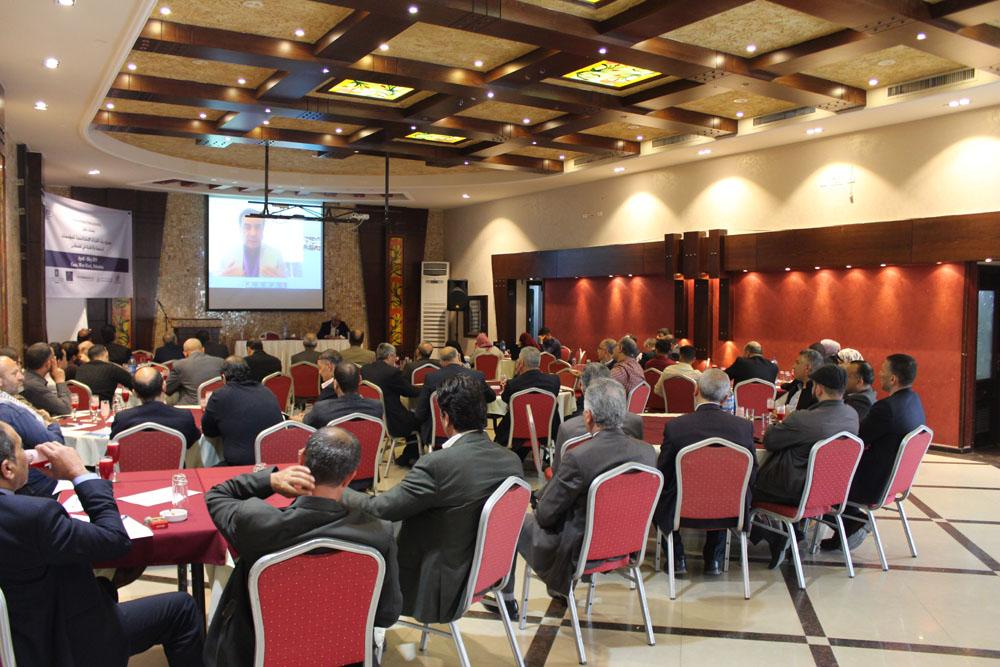
The director of the Pal-Think institution, Mr Omar Shaban, welcomed the attendees and affirmed that the dialogue sessions the institution holds are important in placing Gaza on the map of world dialogue, making clear that Gaza is not a city of the poor, but full of researchers, and has the capacity to contribute to the dialogue not only in the local issues but also in the regional issues.
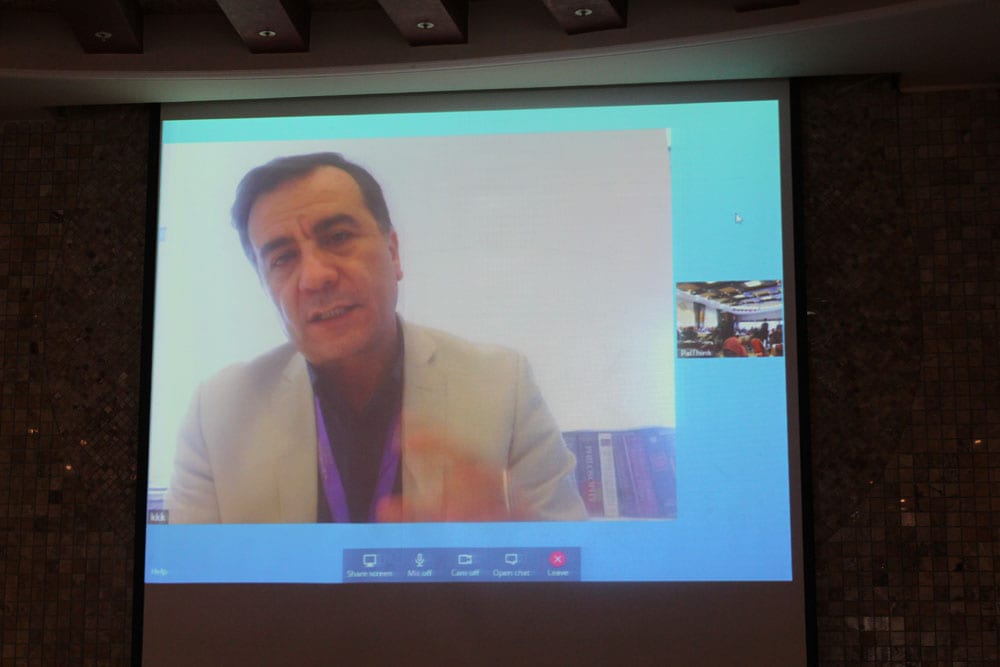
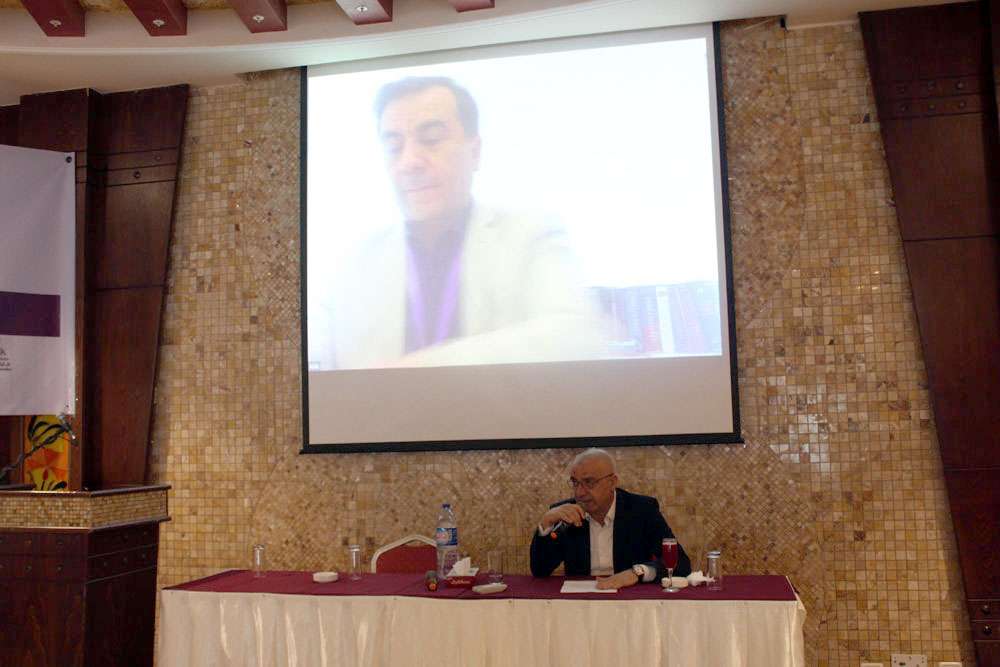
He affirmed that this workshop comes in completion of the policy-papers project that discusses international and regional issues; these papers will discuss the regional and international issues within a project in cooperation with strategic thinking at the level of the Arab homeland and the world. Then Mr Omar Shaban introduced the researcher Khaled Hroub, a Palestinian writer and academic, lecturer at Qatar University and previously at the University of Cambridge, and a specialist in the Islamic movements.
The first paper: the researcher Khaled Hroub
Dr Khaled Hroub began the discussion by welcoming Mr Omar Shaban and the attending researchers of various categories, making clear that the paper does not address all the positions of the regional states and takes up only Turkey and Iran, and there are other papers that take up the position of Egypt, Saudi Arabia, Jordan, and other Arab states. He also affirmed that the paper is still in preparation and completion, and this is merely a first draft, and that the session is a brainstorming to contribute to its development, and to answering the fundamental question: how to transform the interventions of the regional powers imposed upon us, and some of their policies, to the Palestinian interest, and to try to develop a possible and unified Palestinian policy.
The draft examines 3 important parts:
The first part: a brief background and a presentation of the Iranian and Turkish positions and policies toward Palestine and Israel from the date of the emergence of the state of Israel to our present day, in addition to the two principal components in the making of the foreign policy of the regional powers: the ideological component and the national interest.
The questions the first part of the paper takes up:
- To what extent does this ideological component make Iranian or Turkish foreign policy toward Palestine?
- To what extent is the component connected to the Iranian national interest the one that settles the question of the choice between ideology and the national interest?
The second part: it attempts to analyse the prevailing regional scene and the fluctuations in it and the probabilities of its development from the angle of drawing the scenarios — and what is meant by them is not theoretical, but rather an attempt to position Palestine and its cause in the discourse of these scenarios that might develop regionally; in addition to pointing to the existence of a large probability of the occurrence of grand bargains between regional powers and international powers, as these grand bargains stipulate concessions and various pressure cards possessed by the states, among them Turkey and Iran in the region — and to what extent these bargains form a danger or a direct effect on the card of Palestine.
The question this part takes up:
Will Iran and Turkey abandon this card within larger regional bargains, with each of them benefiting separately from what is offered to it by the United States or other regional parties, and in return each of Turkey and Iran presenting various concessions, among them the Palestinian support?
The third part: it pauses at some conclusions and results, and it is worth pointing out that these conclusions and results are not closed but under examination and circulation, and open to discussion and development.
In general the three parts draw attention to several important points:
- Looking at where we fall, as Palestine and as Palestinians, on the agenda of Turkish policy and Iranian policy, and from a regional perspective, not confined to the Palestinian-Turkish relation and the Palestinian-Iranian relation.
- The paper claims that this relation cannot be understood except in the event of understanding the different regional politics
- The difference between change and transformation in Turkish and Iranian foreign policy.
For example in Turkish policy, over a year or more, and with the arrival of Erdogan and the Justice and Development Party to power, there is change and not transformation: transformation is a radical alteration and a grand turn, total or nearly total,
whereas change in policy means an important and noticeable change, but one that also preserves continuity with the previous stage. With Erdogan's entry to power there came to be an important change in Turkey toward Palestine and Israel, but a change with continuity — that is, Turkish-Israeli relations were not severed; the levels of cooperation remained very high, technologically, economically, and militarily — but there is a change we cannot deny.
- Both Iran and Turkey were the subject of an Israeli strategic policy since the mid-fifties: the policy of the alliance with the periphery.
- The policy of the alliance with the periphery: Israel and the Israeli decision-makers saw that they fall in a region surrounded by Arab hostility, in the heart of the Arab world and of the Arabism hostile to Israel — Egypt on one side, Syria and Iraq on another. This heart and centre was hostile to Israel, so Israel resorted to the alliance with the periphery — Iran, Turkey, South Sudan, the Kurds, Ethiopia — where the goal was building relations with the Islamic states, or those mostly Muslim, to press upon the Arab centre that rejects Israel's existence. And the triple alliance of Turkey, Israel, and Iran was strong, organised in treaties and very strong cooperation relations — military first, and intelligence, then economic and technological.
- The alliance with the periphery moves to the alliance with the centre: the new triple alliance that is crystallising and that we see is the alliance of Egypt, Israel, and Saudi Arabia — this is the most dangerous alliance, and in the event of its surfacing it will place us before a very great challenge in Palestine, because it is a central alliance.
- The attention to Palestine came from the perspective of creating an important strategic position for any great state: it served the Turkish Justice Party and the new Turkey on more than one level, as it paves the way for any state to easily penetrate the Arab space; it also supports the position of the Turkish Justice Party internally, as it is an emotional, religious cause, and an occupation — and the people, the conscience, and the general Turkish view are with Palestine.
- The balanced line in relations (Iran – Turkey)
- The change in Turkish policy preserved continuity — that is, there is a permanent continuous line: Erdogan visited Israel in 2005 and met Sharon, and in a later year received Khaled Meshaal in Ankara — that is, there is always this balanced line that opens a new horizon with the Palestinians while itself trying to preserve good relations with Israel.
- Despite the clear Iranian position hostile to Israel, certain secret lines remained open with Israel, represented in Israel's support for arms deals going to Iran without unofficial American approval and without the approval of Congress.
- The alliance with the periphery ended officially with the signing of the Camp David treaty with Egypt.
- Israel's principal concern was destroying any Arab military power, whether in Syria, Iraq, Egypt, or other Arab states.
- The transformations in Iranian policy — relations with Hamas and Jihad
- Iran and the Oslo agreement
- The Iranian-Western-American table and the conflict between two visions: an Iranian vision that supports the Palestinian opposition of Hamas and Islamic Jihad, and an American vision that adopts the policy of military passage.
- The strategy of dual containment – the peace process — the peace process aims at changing the region's shape, not necessarily establishing peace or reaching a solution with the Palestinians — the peace process is more important than peace itself
- The privileges of the extension of the peace-process period and the parties it serves.
- What is Iran's position on the question of the two-state solution? What is the Iranian national interest in Palestine? What does it want for Palestine realistically and not sloganeeringly?
The scenarios expected in the second part during the coming stage:
First: the development and escalation of the various regional confrontations between Iran and Saudi Arabia
Second: the conflicts remaining as they are benefits more than one party, among them Israel — intimidation, requesting support
Third: the gradual cooling of these conflicts.
Fourth: increased cooling reaching regional accords — currently ruled out
The conclusions:
- The first conclusion: the Palestinians must realise that the decisive compass in determining the Turkish and Iranian regional policies is the national interest of each of the two countries, and not the ideological component, as its effectiveness is less than the second component.
- The second conclusion: what the regional parties, whether Turkey or Iran, present to Palestinian parties forms, on one hand, a strengthening of these parties, and on the other hand increases the fragmentation and dispersal in the ranks of the Palestinian people.
- The third conclusion: there is a continuous American escalation in the region, and it may have various bargains.
- The fourth conclusion: Iran has supported the two movements Hamas and Islamic Jihad greatly, militarily and charitably.