A workshop on freedom of opinion: what did the participants discuss?
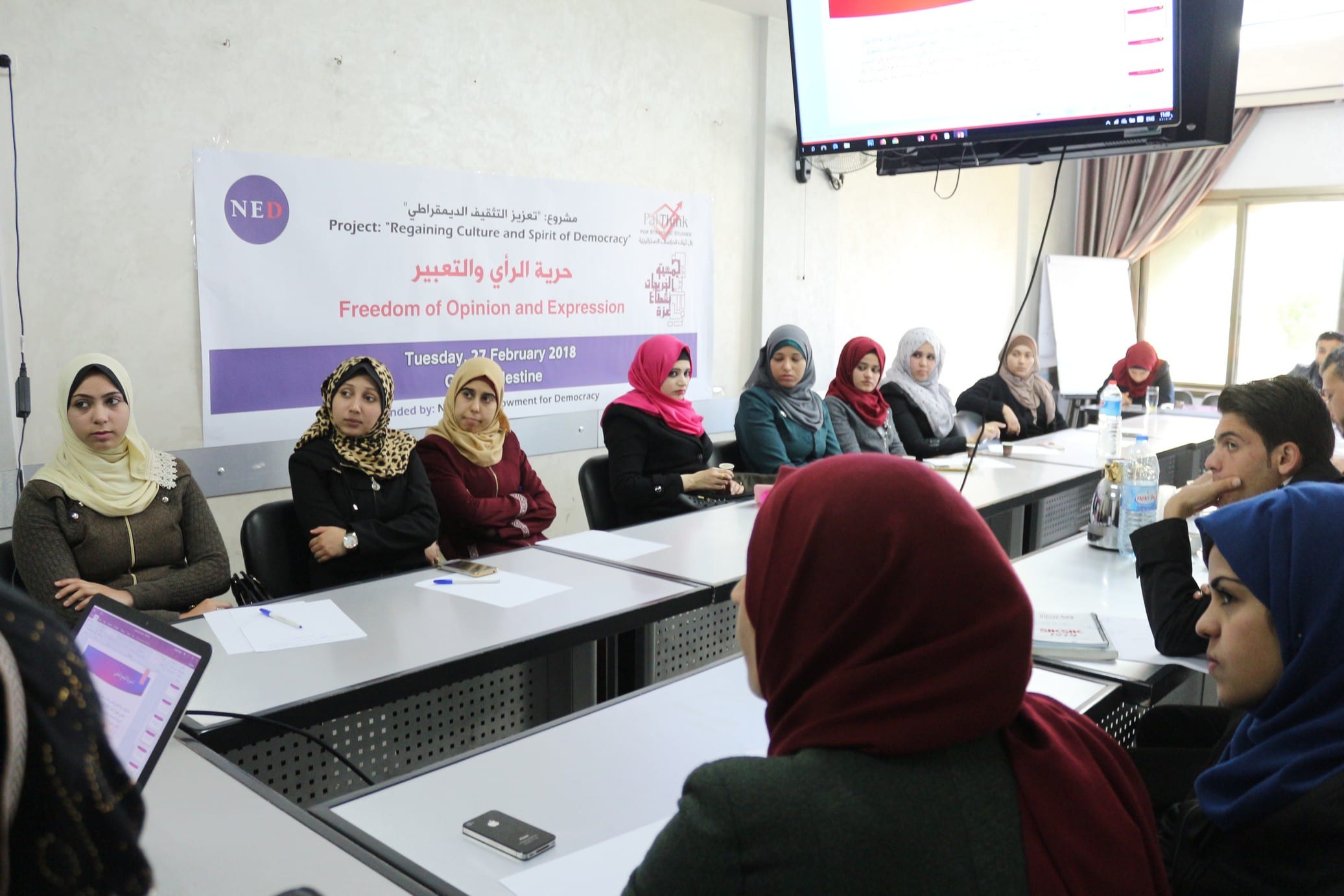
Pal-Think delivered the workshop «Freedom of opinion and expression», under the NED-funded «Promoting democratic education» project, at the University Graduates Association in Gaza — raising young people's awareness of their right to free expression.
- Date
- 2018-02-28
The Pal-Think for Strategic Studies institution carried out a workshop titled “Freedom of opinion and expression”, within the project “Strengthening democratic education” funded by the National Endowment for Democracy (NED), at the Association of University Graduates in Gaza.
The meeting aims at making the youth aware of their right to freedom of opinion and expression and their capacity for change in society, and it was attended by 25 male and female students of different university specialisations.
Rawan Zaiter, a civil-engineering graduate, opened the meeting by welcoming the attendees before asking them about the meaning of a right and its concept, and the classification of rights — affirming that the right to freedom of opinion and expression is considered among the fundamental rights of the human being, given the importance of this right for the individual and society together, which international legitimacy has affirmed and for which it has set the accepted standards for its exercise.
Rawan discussed with the attendees the concept of freedom of opinion and expression, making clear that freedom of opinion is the individual's right to hold opinions without harassment and without subjecting them to exception or restriction, and freedom of expression is the right to convey all the forms of opinions and ideas to others, or to receive those ideas and opinions, through all the channels and means.
The trainee exchanged discussion with the attendees on the importance of freedom of opinion and expression, which is considered a fundamental condition for preserving human dignity, continuing the talk on the manifestations of freedom of opinion and expression, and on the conditions of restricting freedom of expression according to the international standards.
Zaiter concluded her talk by affirming that freedom of opinion and expression is one of the most important human rights, and it is a foundation of the democratic system of any state of the world's states — even if this freedom is restricted by certain controls and measures for the purpose of organising its use and preserving the national laws, public morals, public health, public order, the rights of others, and other matters.