Gaza's painters plead for reconciliation with brush and colour
Painters and artists in Gaza City gave free rein to their imagination, expressing the dreams and pains of the Palestinian people in a mural created in the Rimal quarter — «Youth for Reconciliation» — with dozens of young women and men taking part.
- Author
- The editorial team
- Date
- 2010-03-02
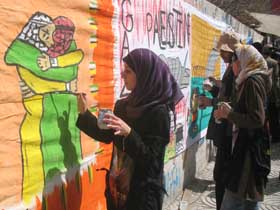
Painters and artists in Gaza City on Monday 8-3-2010 gave free rein to their imagination in expressing the dreams and pains of the Palestinian people, through paintbrushes and colours mixed with touches of beauty, in a mural created in the al-Rimal neighbourhood in the centre of the city.
Dozens of young women and men took part in painting this mural, which carried the title “Youth for reconciliation”, embodying through it their hopes that the various Palestinian factions may be able to reach a genuine national reconciliation.
It is worth mentioning that this mural is considered the first event in the project “Strengthening trust between decision-makers and society”, organised by the “Pal-Think” for Strategic Studies centre with funding from the Swiss Agency for Development and in cooperation with the “Artists for Freedom” team.
One of the paintings witnessed a large gathering of dozens of citizens around it, after they found in it something expressing their dreams whose realisation they have awaited for years: painted on the panel were two men embracing each other warmly, one of them wearing a garment coloured yellow symbolising the Fatah movement, and the other wearing a green garment symbolising the Hamas movement, in an indication that reconciliation has become the greatest dream of the Palestinian people so that they may devote themselves to confronting the continuing Israeli practices.
Through their drawings, the painters and artists participating in the mural called on the leaders of the Palestinian people to unite and to give priority to the general interest, using bright colours in their paintings to instil hope and optimism in citizens' souls that national reconciliation would be achieved.
The caricaturist Muhammad al-Nimnim, known as “Abu al-Noun”, said during his participation in painting the mural: “It is our right as Palestinian artists to convey our message to the political leaderships, a message that includes renouncing division and adopting national unity”, pointing to the importance of addressing the leaderships through the panel, the brush and the colours.
He explained that the mural carries several meanings, the most important of them instilling spirit and hope by embodying national unity, and relieving what citizens suppress in their breasts through these paintings, which have come to express the dreams and aspirations of the Palestinian people.
Notable was the effective participation of women in the mural, as the artist Maysam Saeed expressed to “Falastin” her happiness at participating in the mural, showing the importance of women's role in conveying their voice to decision-makers in an influential way, namely painting.
The artist Maysam painted the Palestinian flag in its beautiful colours, but she wanted to reflect the pain lived by Palestinian citizens in the Gaza Strip, the West Bank and the occupied interior, so she painted shackles and chains around this flag, and made its only key to deliverance from these shackles “national unity”.
On another level, Nadine Fares, who works at one of the civil-work institutions, stressed the necessity of young people's participation in painting the murals, especially since they represent 60% of the Strip's residents, “so that they may have a rational opinion in addressing the issues that concern Palestinian society, in order to form a paper of pressure on decision-makers”.
The mural was able to attract the attention of dozens of passers-by, one of whom, named Muhammad al-Ifranji, expressed his admiration for the mural, which carries a positive aim of conveying the message of national unity, expressing his hope that such events would be repeated “to convey the voice of the members of the people to decision-makers”.
For his part, the head of the Pal-Think for Strategic Studies centre, Omar Shaban, affirmed to “Falastin” that this mural aims to convey the message of national unity to the political leaderships in a civilised manner, represented in holding several events with distinctive methods that attract the people of all age groups so that the message reaches decision-makers.
He said: “We want the Hamas and Fatah movements to take part in the Arab summit conference scheduled to be held in Tripoli, the Libyan capital, as a unified Palestinian delegation expressing all the shades of the Palestinian people”.
Shaban explained that this mural comes within the sixteen events that the Pal-Think for Strategic Studies centre intends to implement, with the aim of entrenching distinctive ideas to deepen national unity through the participation of the divided parties of the Fatah and Hamas movements.