John Ging: despite the acute financial crisis UNRWA will not stop its services — and we hope the Arab states raise their contributions
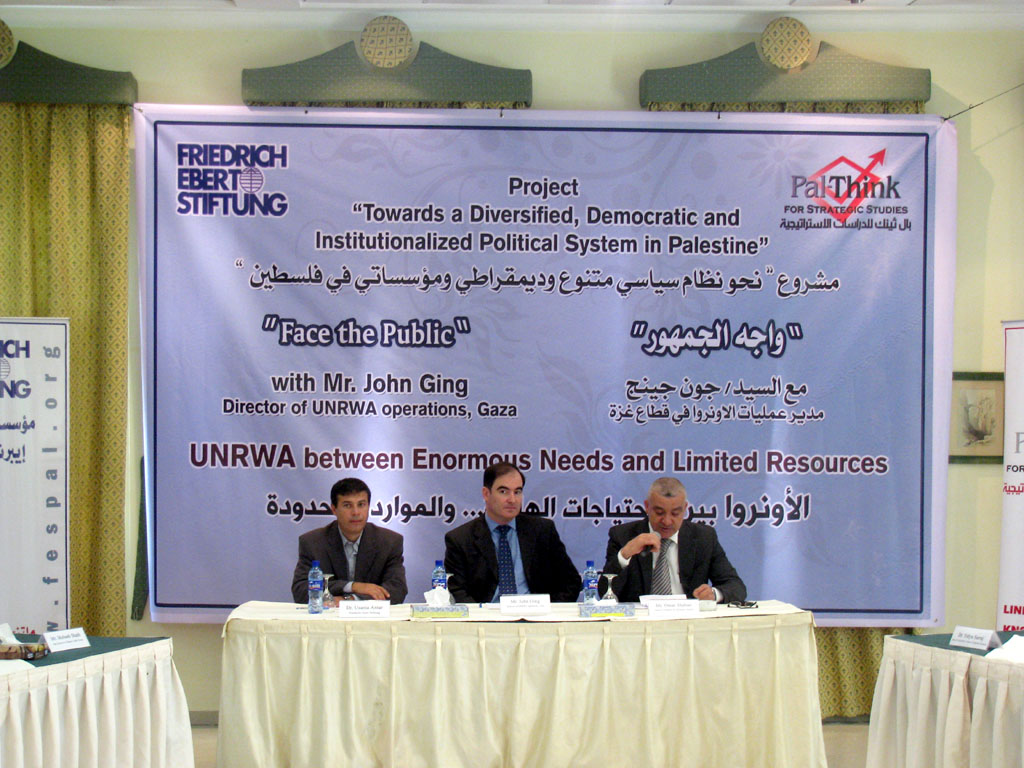
Pal-Think held the first session of «Face the Public» — «UNRWA between enormous needs and limited resources» — hosting John Ging, UNRWA's director of operations in Gaza, under the pluralistic-democracy project.
- Author
- The editorial team
- Date
- 2010-05-19
Wednesday 19 / 05 / 2010
“Pal-Think for Strategic Studies” organised the first of the sessions of the “Face the Public” programme, entitled “UNRWA between enormous needs… and limited resources”, hosting Mr John Ging, director of operations of the United Nations Relief and Works Agency for Refugees (UNRWA) in the Gaza Strip, within the project “Towards a pluralistic, democratic and institutional political system in Palestine” in partnership with the German Friedrich Ebert foundation, with the participation of discussants specialised in this issue and in the presence of a select group of politicians, academics and civil and international institutions.
Mr Omar Shaban, head of Pal-Think for Strategic Studies, explained the aims of the role of the Face the Public programme in discussing the important issues in Palestinian society in a deep and unconventional manner in an attempt to arrive at a pluralistic, democratic and institutional system in Palestine.
Shaban addressed UNRWA's role in serving the Palestinian people, especially the refugees among them, by providing them with a decent living despite all the enormous and great needs society requires and with the limited resources provided to UNRWA.
As for Dr Osama Antar, director of programmes at the German Friedrich foundation in the Gaza Strip, he praised the role of these projects and programmes in shaping a genuine vision of what is going on in Palestinian society, and said that the Face the Public programme is an attempt to bring points of view closer together between decision-makers and society, expressing the hope that these sessions would be a real step towards creating a constructive political system between decision-makers and intellectuals in Palestinian society.
For his part, Mr John Ging, director of operations of the United Nations Relief and Works Agency for Refugees (UNRWA) in the Gaza Strip, reviewed the genuine role for which UNRWA came into being, namely serving the Palestinian people and especially the refugees, as it faces year after year the challenge of responding to the needs of a million refugees, stressing that UNRWA is a non-political institution and does not discriminate between sex, colour or a particular political organisation — “rather it is an institution serving all Palestinian refugees”.
Ging addressed the importance of education in Palestinian society and what UNRWA does for the sake of the continuation of the process of education in Palestinian society, especially in the schools affiliated to it, through “serious attempts at awareness-raising, creating colleges for training and developing teachers' performance and integrating them into society in order to create a coming generation capable of challenge and steadfastness”.
Ging pointed to the role of civil-society institutions in the complementarity of work with UNRWA, noting that he “welcomes hearing all parties, because the civil-society institutions are the leadership of society and their voice in defending society's issues”.
On the deficit in UNRWA's budget, Ging said: “UNRWA faces a very great problem because of the deficit in the budget, as a result of the supporters not honouring their commitments”, explaining that UNRWA's assistance depends entirely on donor support.
He pointed out that the League of Arab States allocated 7.8% to support UNRWA's budget, but the Arab states have so far honoured only 1% of those commitments approved by the League of Arab States in its sessions.
He explained that UNRWA is not concerned with political interference and that it deals cautiously with issues of internal Palestinian affairs because that is not within the framework of its work, calling for the necessity of hastening the reconstruction of the Gaza Strip and lifting the blockade imposed on the Gaza Strip “because UNRWA is affected, like the rest of society, by the blockade imposed on the Gaza Strip”.
He stressed that UNRWA will not surrender and will not stop serving the Palestinian people, because it came into being on the basis of United Nations resolutions and no party has the right to halt UNRWA's work, since that would mean abolishing the refugees' right and marginalising their cause.
During the meeting many questions and opinions were put to Mr Ging by the session's guests, which called for keeping the level of education in Palestine in conformity with international standards, and among them those demanding the activation of the Palestinians' role in solving their problems relating to their basic needs “since the Palestinian people are an educated people and have high capacities, intellectually and physically, to manufacture their basic needs of food and medicine .. were it not for the conditions of blockade that deprive them of the ability to do such a thing”.
It is worth mentioning that this meeting is part of the “Face the Public” programme, which is one of the newly created and distinctive programmes in Palestinian society in terms of content and performance, and which aims to host decision-makers on many issues that concern Palestinian society and to discuss them in depth by hosting discussants specialised in the issue raised, in an attempt to bring points of view closer together between decision-makers and Palestinian society.