Activists and experts recommend activating women's role in the national reconciliation committees
Community activists and experts recommended activating Palestinian women's role and guaranteeing their participation in the national-reconciliation committees, civic gatherings and political-empowerment programmes run by civil society.
- Author
- The editorial team
- Date
- 2010-10-29
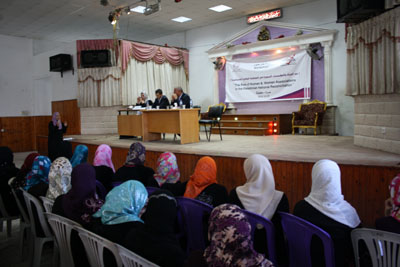
A number of community activists and experts recommended the necessity of activating the role of the Palestinian woman and guaranteeing her participation in the committees of the Palestinian national reconciliation process, in civil gatherings and in the national reconciliation committees, and of joining the political-empowerment programmes implemented by civil-society institutions.
These recommendations came during a workshop organised by the Palestinian Working Woman Society for Development in partnership with the “Pal-Think” for Strategic Studies institution on the role of women and women's institutions in the Palestinian national reconciliation process, at the al-Maghazi club in the centre of the Strip.
The representative of “Pal-Think” and economic expert Omar Shaban addressed the state of internal division the Palestinian people are living through, which has aggravated their suffering and pain, stood as an impregnable barrier before the process of development and building, and has almost put an end to the Palestinian people's efforts to realise their dream of building and declaring the independent Palestinian state.
Shaban pointed to the importance of the Palestinian woman's role in ending the process of internal division and bringing success to the national reconciliation process by joining local civil gatherings and committees and working to spread the spirit of tolerance and cooperation among the sons of the Palestinian people.
He recommended the necessity of encouraging leading and pioneering women active in women's work and in the political parties to take an effective role in the national reconciliation committees.
The member of the reconciliation committees Ismail al-Nims spoke about the efforts made to achieve Palestinian national reconciliation through the formation of the national reconciliation committees, but said that most of these committees have worked unilaterally and not collectively, noting that the assembled committees are about to form a central reconciliation committee including representatives from the West Bank and the Gaza Strip, aiming to unify Palestinian efforts and to stress serious work to achieve reconciliation.
He pointed to the importance of the Palestinian woman's role in the syndicates, unions, local committees and municipal councils, which supports and strengthens her standing in the national reconciliation process, but said that women's presence in the reconciliation process is entirely absent, placing the blame on the parties and factions that have marginalised women and excluded them from participation.
The field coordinator at the Working Woman Society, Hanan Sayyam, spoke about women's standing in the political parties and the shrinking of their role in those parties to seasonal and national occasions and the predominance of their societal role.
Sayyam also spoke about the programmes of the women's institutions that activate women's role in decision-making positions and political participation through various awareness programmes, workshops and trainings, praising the Palestinian woman who has held various posts in civil institutions and government centres and achieved many accomplishments and gains and has had an effective and tangible role within Palestinian society despite the difficult political circumstances she has lived and still lives through, of siege and the consequences of war and internal division.
At the end of the workshop it was agreed to form reconciliation committees from among those present representing the Middle governorate, to be followed up by the reconciliation committee member Ismail al-Nims.