«One homeland, one blood»
The Palestinian Women's Development Association launched a symbolic blood-donation campaign at its Gaza headquarters — encouraging all parts of society to advance reconciliation and unity through symbolic, unconventional initiatives that reject the division.
- Author
- The editorial team
- Date
- 2011-04-10
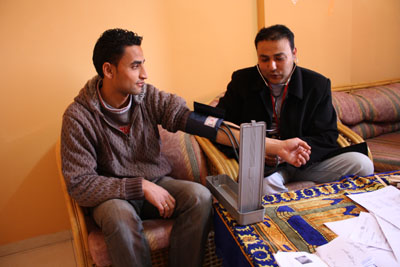
The Palestinian Women's Association for Development launched a symbolic blood-donation campaign at its headquarters located in the Gaza Strip. The campaign aims to encourage all segments of society to put forward and circulate the concept of strengthening reconciliation and unity through symbolic and unconventional initiatives and activities that reject the division and call for restoring internal Palestinian national cohesion.
The coordinator of the Gaza branch of the Palestinian Women's Association for Development, Wijdan al-Bayoumi, stated that “the essential aim of the campaign is to strengthen Palestinian reconciliation and end the division, and to prove that Palestinian blood is one blood of one people, and to recall and entrench social ideas, even if reconciliation is delayed at the political level”, expressing the hope that “this campaign will be an impetus for young women and men to continue realising their dreams of building this homeland”.
Al-Bayoumi added that this campaign comes within the framework of the project of strengthening community partnership for Palestinian national reconciliation, in partnership with the al-Karmel Association for Culture and Community Development, the Labour Resource Centre, the Masar Association for Relief and Development and the al-Najd Developmental Forum, under the supervision of the (Pal-Think) for Strategic Studies institution and with support from the Swiss Agency for Development”.
Al-Bayoumi pointed out that “the proportion of female participants exceeded the male participants in the screening and blood-donation procedures, whose number reached 94 participants, in coordination with the blood bank and the Cystic Fibrosis Friends Centre, which provided the medical teams to carry out the tests, draw the blood, ensure the safety standards for the donors and provide all the information that might be asked about”.