Visions for Palestinian reconciliation: hasten it, shut out foreign interference, strengthen self-reliance, and value Egypt's role
As the reconciliation agreement was signed and the interim government took shape, academics, specialists and civil-society activists joined a Pal-Think seminar on «Visions for supporting Palestinian reconciliation, the interim government and the elections».
- Author
- The editorial team
- Date
- 2011-06-26
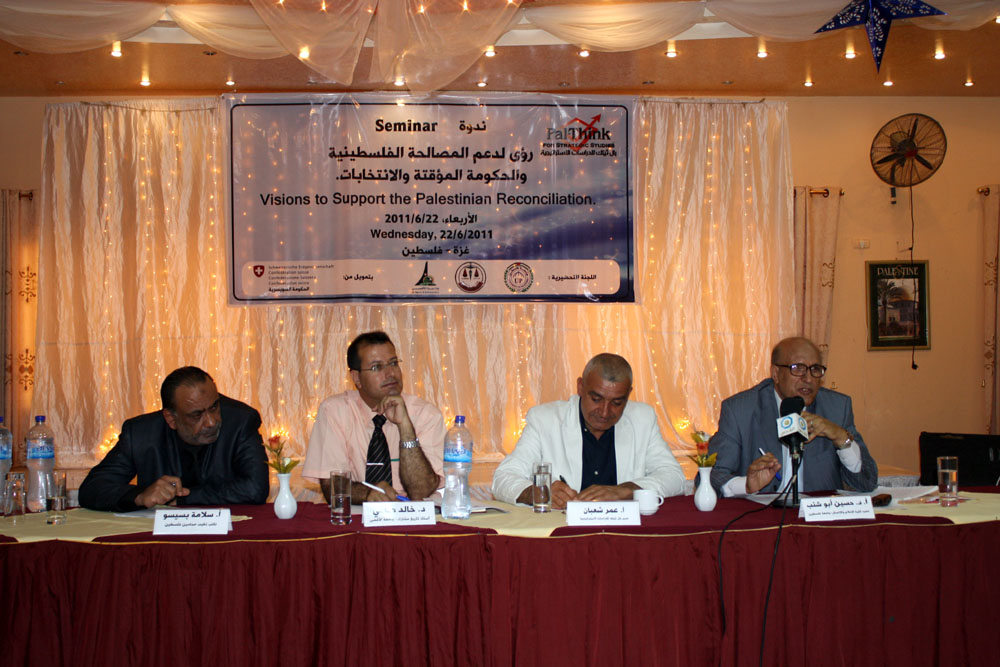
Wednesday 22 June – Gaza – In step with the rapid developments on the Palestinian scene, from the signing of the reconciliation agreement to the start of forming the interim government, a select group of academics, specialists and civil-society activists took part in a seminar organised by Pal-Think for Strategic Studies entitled “Visions for supporting Palestinian reconciliation, the interim government and the elections”, as an initiative that examines and lays out ways of supporting national reconciliation, the anticipated Palestinian government and the coming elections from different aspects.
This seminar comes within the project “Strengthening community partnership for national reconciliation”, funded by the Swiss government, and the preparatory committee included Palestine University, al-Aqsa University and the Palestinian Bar Association. The seminar shed light on ways of supporting Palestinian reconciliation, the interim government and the elections, with three working papers presented dealing with the political, social, legal and media aspects; and those present called for a popular conference bringing together all the political groups and for reactivating popular mobilisation to press the Palestinian leadership on both its sides.
The seminar was opened by Omar Shaban, director of Pal-Think for Strategic Studies, who welcomed those present and valued the efforts of the preparatory committee in preparing the working papers and organising the seminar. He stressed that despite the Palestinian leadership's slowness in applying reconciliation on the ground and the delay in announcing the interim government, a psychological reconciliation has already occurred at the popular level, and the general Palestinian mood has become more positive. But he warned that this development might be lost because of the slowness and procrastination in practical steps. Mr Shaban also stressed the importance of the positive Arab and especially Egyptian role as an incubator for the reconciliation project, as its role has become evident in bringing the points of view of the Palestinian parties closer together.
Dr Khaled Safi, associate professor of history at al-Aqsa University, presented a working paper on the challenges facing Palestinian reconciliation, its obstacles and the expected scenarios for the course of reconciliation. He pointed out that the intervention of Arab, regional and international parties has a great role in obstructing or bringing success to reconciliation, in addition to the Hebrew state through its control of the financial side and tax revenues and its use of the peace agreements signed with the Palestinian side to obstruct any formation of a government. In the course of his remarks on the elements of the success of reconciliation, Safi stressed the necessity of continued popular pressure and the availability of Arab political, media and financial cover to stand in the face of any Israeli or American threat to halt financial support, and of launching a media and diplomatic campaign to promote the agreement and working to create a new societal culture that strengthens social and political democracy. Safi concluded by saying that the most likely of the expected scenarios for the course of reconciliation is that reconciliation will be slow and the announced timetable will not be adhered to, and that it will therefore require popular and Arab pressure and mediations from time to time.
For his part, Mr Salama Bseiso, deputy head of the Palestinian bar association, reviewed ways of supporting reconciliation, the interim government and the elections from the legal side, pointing to the importance of holding a popular reconciliation conference bringing together everyone harmed in the internal fighting of 2007. He called for guaranteeing the integrity and independence of the judiciary by issuing decrees or legislative decisions to correct, from the legal standpoint, the rulings issued in the Gaza Strip during the past four years. In his remarks on supporting the interim government, Bseiso called for forming an independent legal committee to monitor the work of the interim government and the extent of its commitment to its work. Bseiso concluded his remarks by calling for activating the general elections law and setting an immediate date for holding the presidential and legislative elections so that the work of the interim government is not prolonged.
Dr Hussein Abu Shanab, dean of the faculty of media and communication at Palestine University, reviewed the role of the media outlets in supporting reconciliation, saying that the media has become the first power in society since it shapes the criteria of success and failure. Dr Abu Shanab called for setting out towards the gateway of national reconciliation away from external interventions, hatred, incitement, cliquishness and factional and regional interest; and to achieve this goal requires deepening three pillars, namely purity of intention, will, and the absence of external interventions. Abu Shanab pointed out that bigoted media spokespersons inflame the disputes and constitute an obstacle in the path of reconciliation. He called for forming a supreme council for the media of people of judgement, specialisation, competence, experience and national responsibility; a specialised, qualified media administration with credibility and positive action; and the drafting of a charter of honour that regulates freedom without abolishing it.
In an intervention of his, the member of the Legislative Council for the Fatah movement Dr Faisal Abu Shahla affirmed that the national will and popular mobilisation are the decisive factor, and that the Palestinian people who came out to celebrate reconciliation must also come out to protest against the delay in forming the government; as well as strengthening the role of civil society in political participation and bringing it out of the circle of marginalisation.
Dr Suhail Skaik, director general of the Gaza Electricity Company, also pointed out that development projects in Gaza do not exceed 5% and that there are many projects that have stopped because of the delay in implementing reconciliation and forming the government.
Wijdan al-Bayoumi, coordinator of the Gaza office of the Palestinian Working Woman Society, said that there are many seminars, conferences and meetings that have been held to present proposals but their results have not been taken into consideration, and she called for unifying these efforts and working to turn them into tangible reality.
Walid al-Awad, member of the political bureau of the Palestinian People's Party, also called for popular mobilisation to make reconciliation the property of the Palestinian people, and for the search for a broad social-democratic coalition of intellectuals and various groups to press towards the implementation of reconciliation.
Recommendations:
– Holding a popular conference in which all the political and youth frameworks mobilise to form a paper of pressure and support for Palestinian reconciliation.
– Gathering the efforts of institutions, organisations and individuals and formulating them in a unified mould and working to apply them on the ground, since there are many practical efforts, proposals and recommendations that have been put forward and ignored.
– Unifying the national goals, and strengthening positive values and the culture of accepting the other, tolerance and mutual trust.
– Searching for an alternative to American support in order to emerge from American pressure and dominance over the Palestinian decision, and removing all external interventions whether Arab, regional or European.
– The return of popular and youth mobilisation once again to press the Palestinian leadership on both its sides.


To view the working papers: https://www.palthink.org/?p=257