Going to the United Nations matters and has decades of history — but expectations must stay measured and Israeli reactions anticipated
At a seminar on the September entitlement, Dr. Nasser Al-Kidwa affirmed by video-conference from Ramallah: going to the United Nations matters and has continued for decades — but expectations must not be raised, and Israeli reactions must be prepared for.
- Author
- The editorial team
- Date
- 2011-08-03
At a seminar on the coming September bid, Dr Nasser al-Qudwa affirms from Ramallah by videoconference with Gaza:
Going to the United Nations is important for Palestinian work and has continued for decades, but expectations must not be raised and there must be preparation for Israeli reactions!!
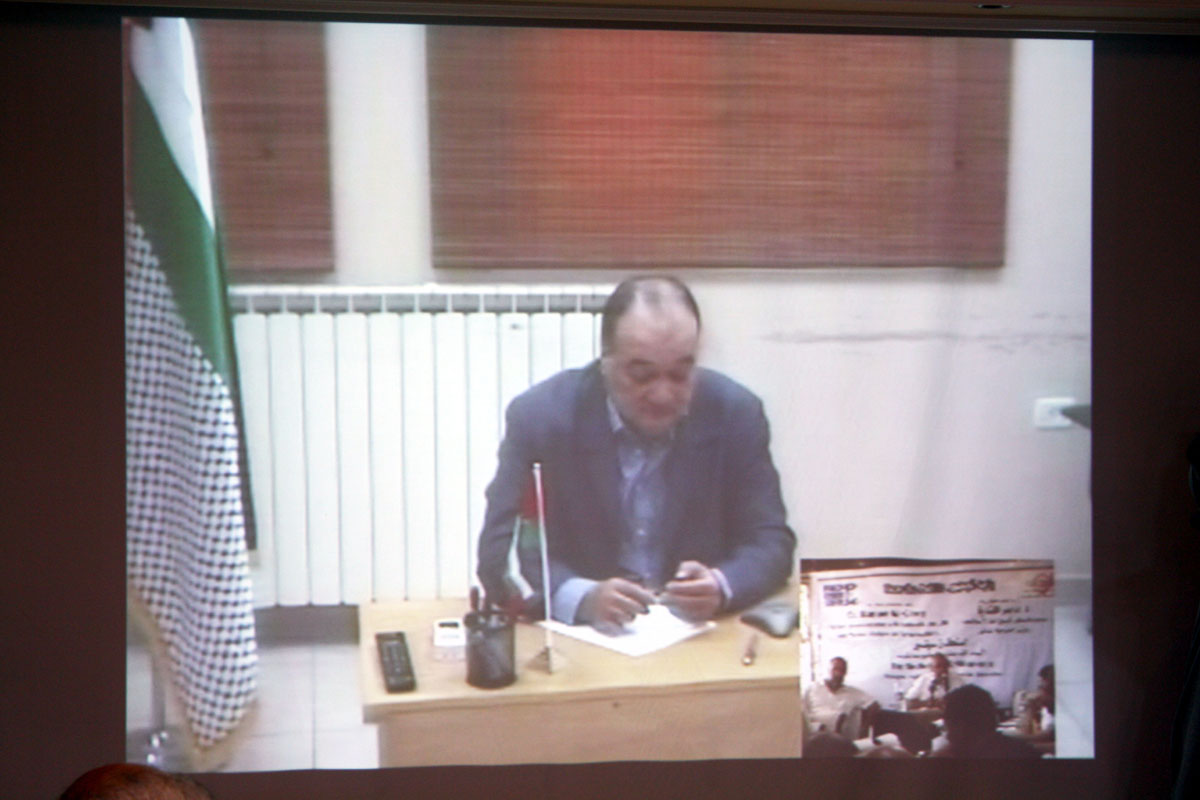
Gaza – 2 August – Pal-Think for Strategic Studies, in cooperation with the German Friedrich foundation, organised the third seminar of the “Face the Public” programme, entitled “The September bid: the causes, the repercussions and the expected scenarios”, as a contribution by the centre to enriching constructive discussion of the central issues that concern Palestinian society. The seminar hosted Dr Nasser al-Qudwa, former foreign minister and former envoy of Palestine to the United Nations, via videoconference technology from the city of Ramallah.
The founder and director of Pal-Think, Omar Shaban, welcomed Dr Nasser al-Qudwa and those present, who represented a cultural, media, academic and political elite. Shaban pointed out that the aim of holding this seminar is essentially to reach answers to the many questions preoccupying the Palestinian street about the coming September bid, referring to the most prominent questions, which revolve around how the idea of going to the United Nations took shape and what the expected repercussions and scenarios are.
For his part, Dr al-Qudwa expressed his great happiness at speaking to his people in the Gaza Strip. In the course of his reply to the questions, Dr al-Qudwa affirmed that the essential motive behind the Palestinian leadership's decision to go to the United Nations to obtain membership for the state of Palestine is the decline in the likelihood of achieving progress at the level of negotiations and the hardline Israeli position towards the issues of settlement and other issues.
Dr al-Qudwa stressed that political struggle at the United Nations is not new and must continue, and pointed out that there are many resolutions issued by the United Nations that establish the state of occupation and stress that the Israeli military presence in the Palestinian territories including Jerusalem is an illegitimate occupying presence, and that these resolutions express an asset that must be made use of in international forums and must not be forgotten or passed over. Dr Nasser al-Qudwa drew attention to the fact that the matter will not be settled in September, because the meetings will begin to convene at the end of September and will extend into the month of October. He also referred to the many Palestinian diplomatic achievements and to the depth of Palestinian experience in diplomatic work, particularly in the corridors of the United Nations, and that these experiences must accumulate and be exploited in the process of diplomatic struggle. He also stressed that the Palestinian presence at the United Nations is a historic and deep-rooted presence, recalling the speech of the late President Yasser Arafat in 1975 at the United Nations and the strong Palestinian presence resembling that of the great powers. Dr al-Qudwa pointed out that in the past there were many attempts by some international parties to halt Palestinian work at the United Nations, but the Palestinian side refused because peace had not yet been achieved, and therefore there was no room for halting work within the framework of the United Nations.
He also drew attention to the obligation not to raise expectations and to prepare for multiple scenarios, and stressed that diplomatic struggle is a deep-rooted struggle and must continue, but at the same time this struggle must be within a complete national system working in an integrated manner and not at the expense of one another. Dr al-Qudwa offered many recommendations, among them the necessity of balancing effort at the international and local levels; the necessity of appropriate arrangements in the Palestinian house in step with this move, foremost among them unifying the political system, working seriously to achieve national unity, achieving a reconciliation equal to a genuine restoration of the unity of the homeland, restoring the unity of the Authority's bureaucratic apparatus, and the entry of all the components of the Palestinian political field into the Palestine Liberation Organisation. Dr al-Qudwa stressed that the transformation from an authority into a state has its grounds and considerations, the most important of them the level of the legal relationship with all the factors and players surrounding the newborn state, foremost among them the relationship with Israel. He also pointed to the necessity of thinking about a set of internal measures at the Palestinian level in the event that membership is obtained, whereby the Authority would turn into the government of the state of Palestine, and then there would be many questions that must be raised, the most important of them those relating to the legal status of the new state, the status of the Oslo agreement, the nature of the relationship between the government of Palestine and Israel, the status of the settlers and many other issues. Dr al-Qudwa stressed that it is essential to examine and think long and hard about the new obligations and relationships with all the surrounding parties and elements, and the necessity of working seriously to achieve an accomplishment that benefits the Palestinian people and their cause, stressing the importance of diplomatic struggle and serious work at the level of international forums. He also stressed the necessity of preparing for the Israeli scenarios and for what the Palestinian step may entail in the way of Israeli positions and steps on the ground.


