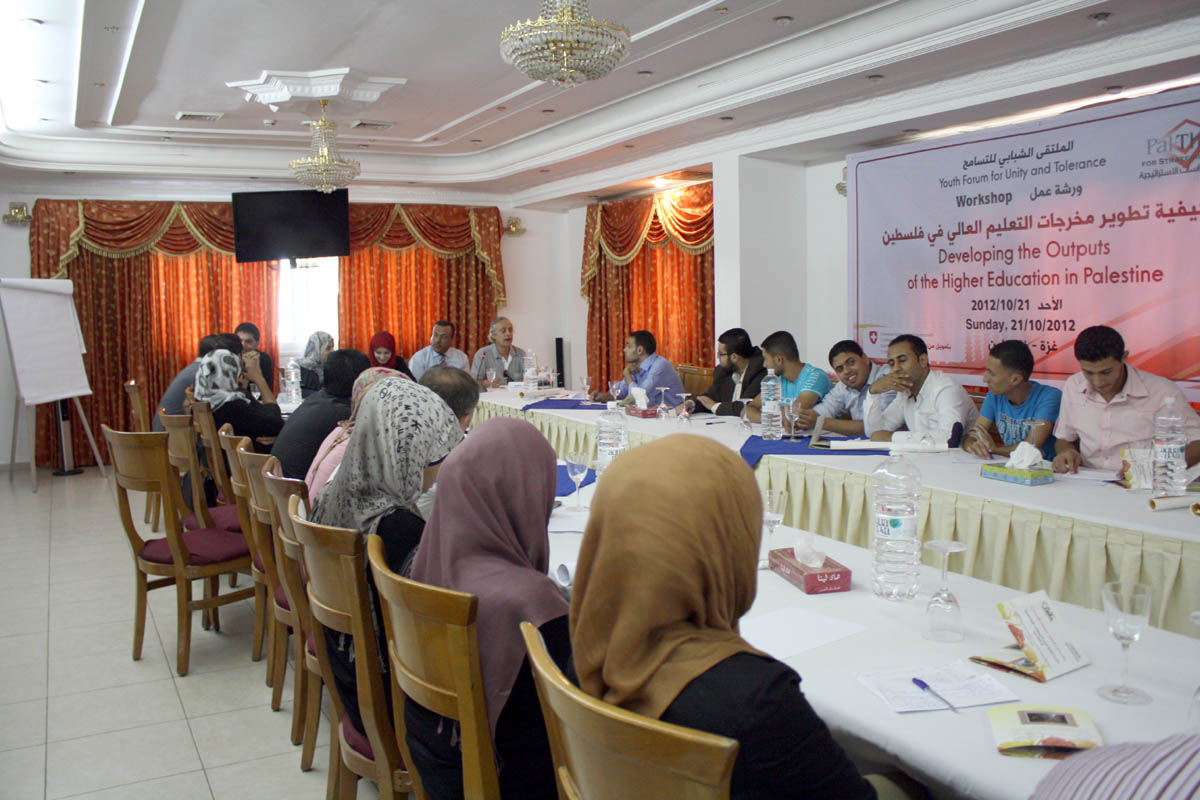
Workshop: «How to improve the outcomes of higher education in Palestine»
Specialists and academics stressed rethinking teaching methods and activating courses and activities to serve information technology, the labour market and quality assurance in higher education — at a discussion held by the Youth Forum for Tolerance.
- Author
- The editorial team
- Date
- 2012-10-22
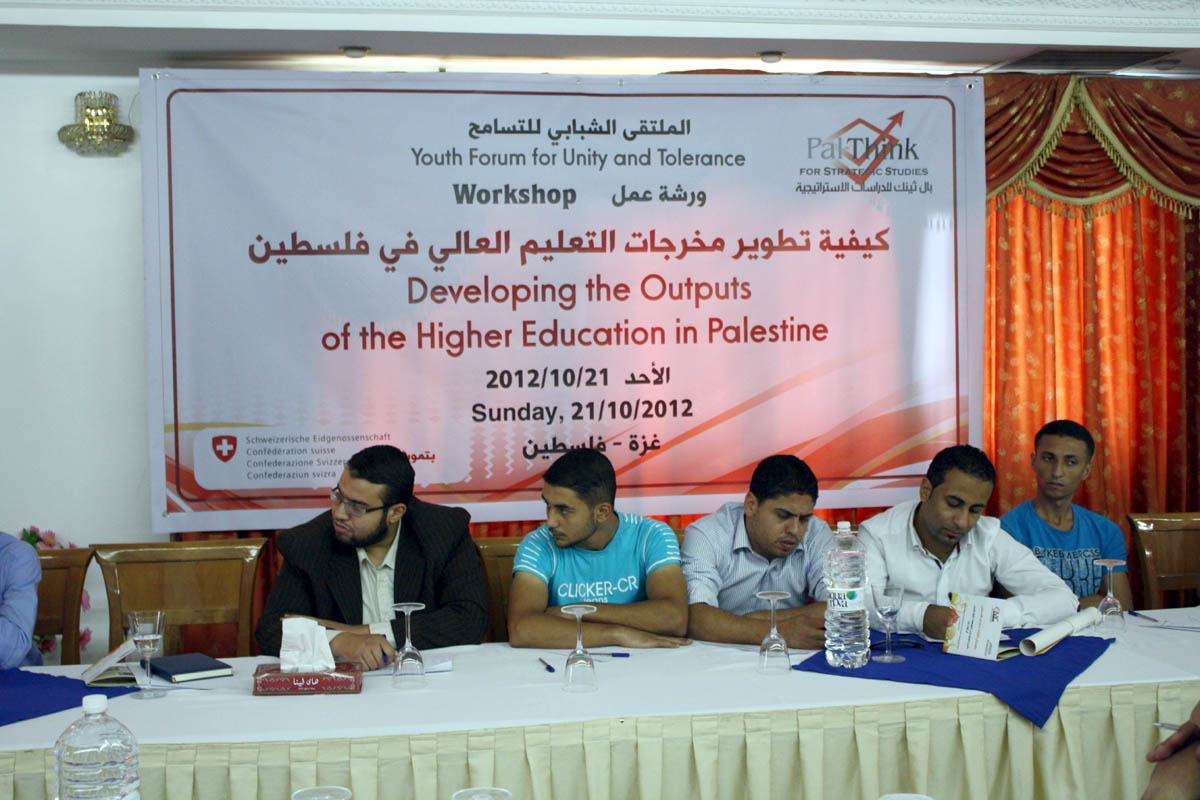
Specialists and academics stressed the importance of reconsidering educational methods and teaching approaches and of activating the role of courses and activities in a way that serves the requirements of information technology and the labour market and ensures quality in higher education. This came during a discussion session organised by the Youth Forum for Tolerance, the framework affiliated to the Pal-Think for Strategic Studies centre, on how to develop the outputs of higher education in Palestine, attended by a number of specialists and students, in the hall of the Grand Palace Hotel in Gaza.
At the beginning of the session the expert Omar Shaban, director of the Pal-Think centre, gave an introductory outline of the Youth Forum for Tolerance, which was founded some months ago to enable young people to discuss their issues, among them the issue of higher education, away from any kind of partisanship or ideology, with the aim of promoting purposeful intellectual work.
For his part, Dr Khalil Hammad, director general of university education at the Ministry of Education and Higher Education, said that quality standards depend on several factors, among them educational facilities, tools and books, the future of the graduate and his relation to the labour market, and the extent to which skills are acquired. He pointed out that the Ministry has established the Scientific Research Council, the Accreditation and Quality Department and the committees for the equivalence of degrees, and that 5 new master's-degree programmes, 45 bachelor's specialisations and 101 specialisations for the diploma programme have been accredited. He explained that some specialisations in the universities are close to one another despite differing in name, such as the specialisation of technology, or technological education, or educational computing and teacher technology, stressing that the new curricula require new specialisations — for example, the subject prescribed for both the literary and scientific streams, the subject of management and economics, where teachers are appointed from the specialisation of management or of economics but there is no combination of the two in the universities; just as with the subject of contemporary issues, where the nearest available teachers are appointed, but it requires the introduction of some new specialisations so that there is no separation between general and higher education. Hammad stressed the necessity of reconsidering educational methods and teaching approaches, intensifying workshops for students and making use of pass rates, because they are an indicator and evidence of the quality of activities and curricula, while taking into account the importance of lecture halls, laboratories, training workshops, computer centres and libraries, because this contributes to the student's personality, communication, performance and acquisition of skills.
For her part, Dr Samar Abu Shaaban, official for administrative quality at al-Azhar University, addressed the bases for introducing new programmes in accordance with the needs of the labour market and in keeping with the needs of the information-technology age, pointing out that most of the main references for the courses at the university are of the modern type where available, though the teaching methods are both modern and old. She said that the most important requirements of the graduate in the age of technology and information rest on self-learning, English, computing, self-awareness, methods of self-directed professional and scientific development, scientific research and communication; while there are some obstacles in the labour market connected with favouritism, the low economic level, weak investment and the scarcity of fields of voluntary work for graduates.
As for the researcher Khalil Shahin, director of the economic unit at the Palestinian Centre for Human Rights, he addressed the vision of human-rights institutions regarding quality standards in education and took this up from the perspective of
the right to education as one of the human rights, and considering this from the point of view of international human-rights law as contributing to enabling the person to learn about the other rights. He said that this right appeared in Article 26 of the Universal Declaration of Human Rights and in Articles 13 and 14 of the International Covenant on Economic and Cultural Rights, which gave an additional dimension to the concept of the right to education.
For his part, the youth activist Arafat al-Hajj considered that students see the universities as treating education as a commodity for sale offered by the educational apparatus to the student, and not as a social investment aimed at serving the needs of society and the labour market, stressing the necessity for the educational process to play the required role towards national and social goals.
The session, which was moderated by Taghreed al-Arabeed, a member of the Youth Forum for Tolerance, included the presentation of many proposals that would contribute to the quality of higher education in Palestine.