A call to activate youth's role in political participation and decision-making
Speakers called for activating youth's role in Palestinian society — enabling them to shape policies and strategies and exercise oversight of government, legislative and institutional work — at a workshop held by the Labour Resources Centre with the Youth Forum for Tolerance.
- Author
- The editorial team
- Date
- 2012-12-23
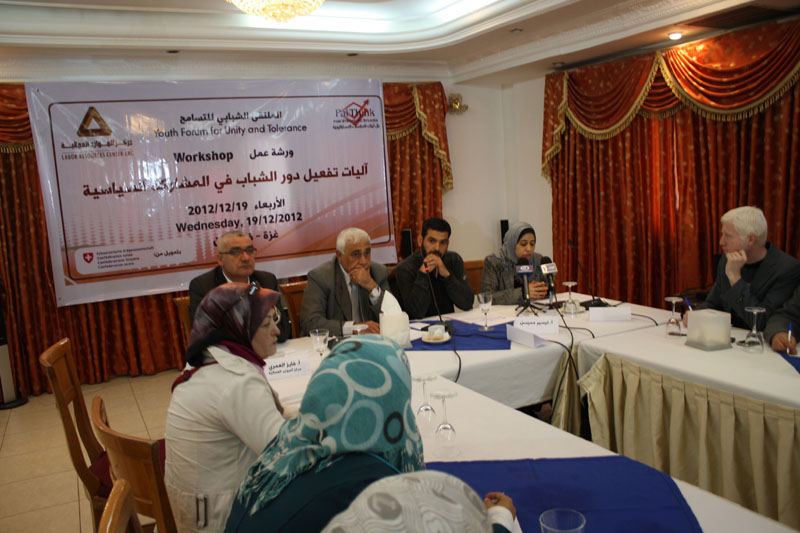
Gaza – Thursday 20/12/2012
Speakers called for the necessity of activating the role of youth in Palestinian society by enabling them to set policies and strategies and activating their oversight role over governmental, legislative and institutional work.
This came during the workshop organised by the Labour Resource Centre in partnership with the Youth Forum for Tolerance at Pal-Think for Strategic Studies, entitled “Mechanisms for activating the role of youth in political participation”, at the Grand Palace Hotel in Gaza, with the participation of a select group of those concerned with youth affairs, heads of associations and representatives of youth unions and civil society.
Omar Shaban, head of Pal-Think for Studies, opened the discussion, welcoming the attendees and reviewing the most prominent achievements Pal-Think has made at the youth level during the past period. He put forward a set of questions concerning the ways of advancing youth and their genuine and effective participation in Palestinian decision-making, and placed them in the hands of the participants to answer.
The youth activist Shadia al-Ghoul stressed the necessity of certain essential prerequisites for activating the role of youth in political participation, the most important of them being an understanding leadership that moves youth from the rank of participation to that of decision-making, a political system capable of moving youth out of the passive role, and the support of the media because it is the guarantee for forming the opinion of young people.
She called on the Palestine Liberation Organisation and all Palestinian political parties to move quickly to hold elections so that Palestinian blood and vision may be renewed, pointing out that national work had a general political resonance when it was led by youth in the past, whereas now, with the absence and exclusion of youth, it no longer has any resonance.
She called for the necessity of reconsidering the laws, legislation and internal regulations of the political parties and making some amendments to these regulations, especially with regard to the age of candidacy for elections, in addition to the necessity of the Palestinian factions practising democratic life.
For his part, Jamil al-Majdalawi, a member of the Legislative Council, affirmed that a leadership that remains at the head of its work for long years does not deserve to be a leadership and is incapable of providing an alternative, or else it prevents an alternative from being raised and provided, and in both cases it must depart.
Regarding the reasons that have prevented youth mobilisation within Palestinian society, he affirmed that attempts at containment by the political forces and factions were among the most important reasons, pointing out that this does not mean leaving the parties but rather the necessity of agreeing with them on a common struggle banner and rallying around it, in addition to attempts at corruption by some factions so that no youth movement or activity turns into a prize to be seized, and the appearance of certain early leadership tendencies among some young people and their love of prominence.
Al-Majdalawi called on youth to wrest their democratic right and their right to employment on equal terms with everyone, to be an instrument of oversight over the Authority's institutions, to insist on the periodic holding of party conferences and to struggle for more struggle.
He pointed out that there are many obstacles impeding the role of youth in Palestinian political life, represented by the occupation and the social heritage, and the shortcomings of some articles of the law with regard to the rights of youth such as the age of candidacy and voting, warning against the domination of intellectual terrorism within the universities. He noted the necessity of opening horizons of democracy in Palestinian relations, especially among youth and university students, and the necessity of young people taking up the programmes, laws and policies put forward by the parties in order to confront everyone with the obligations entailed by these programmes.
For his part, Dr Muhammad Abu Matar, a lecturer at al-Azhar University, said that the role of youth is confined only to the grassroots role and has not reached the leadership role, and that the Palestinian elections, whether presidential or legislative, have not witnessed the presence of youth elements. He pointed to the decline of the role of the universities at the national level and their closing in on themselves, as the universities have become a place for education and obtaining degrees only, in addition to the absence of programmes and courses that qualify students for political participation, stressing the necessity of adopting new plans and mechanisms to transform the stereotypical images of the universities so that they become more effective at the social level.
Abu Matar called for the necessity of forming youth frameworks that make room for a multiplicity of roles, accommodate all energies and enhance the emergence of youth, in addition to youth realising the importance of separating political participation from the compulsions of political affiliation, and reconsidering the role of the student frameworks so as to consolidate their national role, since they were an important instrument in entrenching the Palestinian division. He called on the Palestinian media to act responsibly, given its great role in highlighting leaderships and marginalising the role of youth.
Fayez al-Amri, chairman of the board of the Labour Resource Centre, said that there is a set of obstacles that limit the participation of youth in decision-making, the most important of them being customs and traditions, the spread of unemployment and poverty and young people's search for work to secure the basic necessities of life, in addition to the absence of democracy as a practice in the institutions of society, which entrenches hierarchical leaderships and limits the possibility of involving youth and unleashing their energy; for democracy, being a political system, is also one of the instruments of change and renewal. He explained that young people who have suffered from unemployment and poverty must try to shake off the dust of the crises clinging to their bodies and move in a unified and joint manner through the instrument of the social movement in order to contribute to confronting their problems collectively and on a democratic basis.
At the end of the workshop, the participants agreed on the necessity of ending the state of division, restoring political cohesion and rebuilding the institution on foundations of participation and democracy; confronting the narrow partisan culture and replacing it with a national culture and loyalty to the homeland, the people and identity; activating the democratic process that has been disrupted in most of the parties without justification; putting in place systems that allow renewal in the leadership bodies of the parties; and giving attention to spreading political culture among young people and encouraging them.