Workshop: «Activating youth's role in trade-union work»
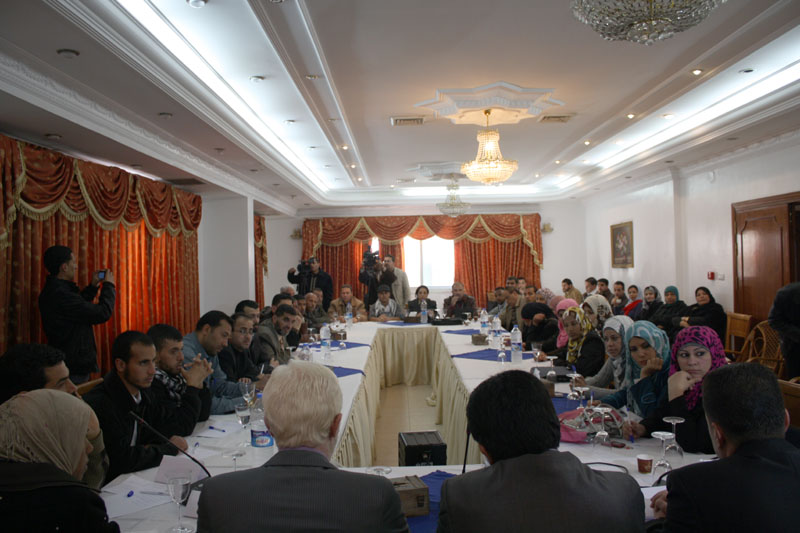
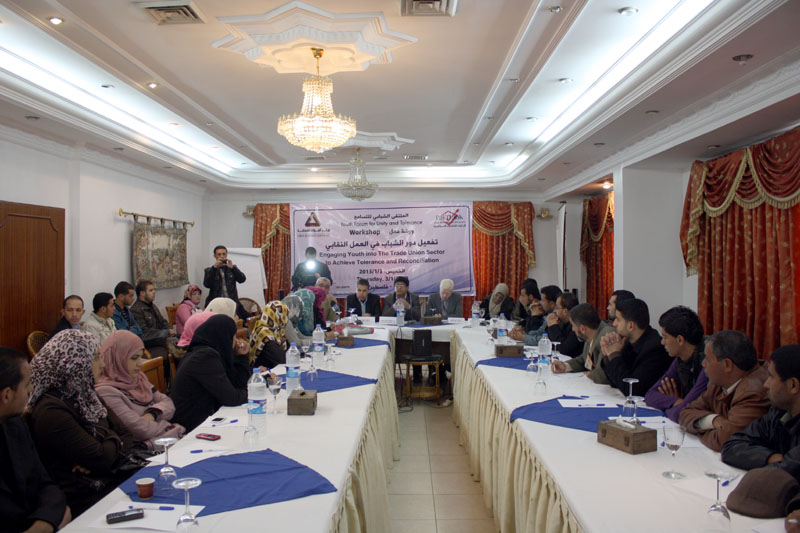
The Youth Forum for Tolerance and the Labour Resources Centre held the workshop «Activating youth's role in union work», with more than eighty union and rights activists and representatives of unions, student blocs and youth institutions.
- Author
- The editorial team
- Date
- 2013-01-03

The Youth Forum for Tolerance at Pal-Think for Strategic Studies, in cooperation with the Labour Resource Centre, organised a workshop entitled “Activating the role of youth in trade-union work” on Thursday 3/1/2013, with the participation of more than eighty trade-union and human-rights activists and representatives of unions, student blocs and youth institutions.
The workshop was opened by Mr Omar Shaban, head of the Pal-Think centre, who spoke about the importance of the role of youth in shaping public policies and engaging with them in a way that secures a bright future for them. He stressed the importance of there being a role for youth during the coming stage, the stage of reconstruction and building, and recommended encouraging trade-union work among young people and supporting youth trade-union initiatives consistent with the unions' orientations.
Shaban called for developing the laws and legislation governing trade-union work in a way that guarantees genuine and effective participation by youth in taking decisions related to trade-union and social work, as well as encouraging young people to create union programmes and campaigns that target them and develop a spirit of belonging and initiative in them
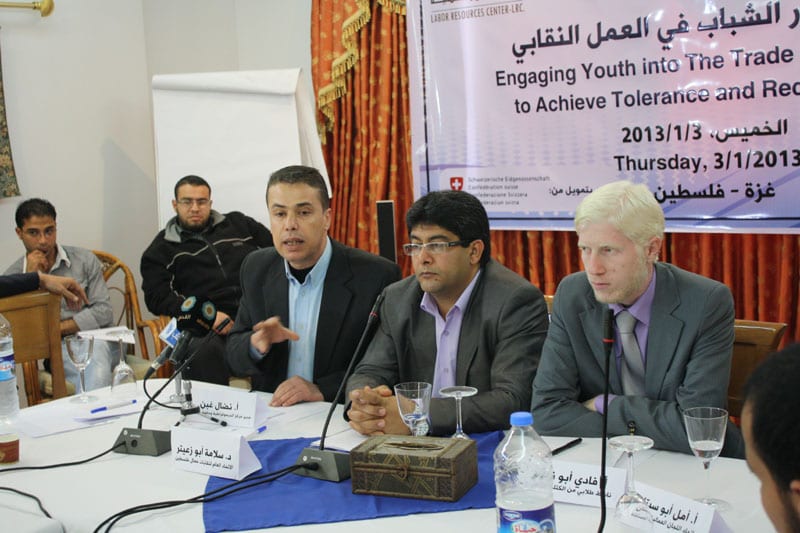
Dr Salama Abu Zuaiter of the General Federation of Trade Unions of Palestinian Workers explained that the rate of youth participation in union membership, particularly in administrative and leadership positions with influence, is almost non-existent. He attributed this to their not being given the opportunity and to the absence of programmes targeting them, which weakened and limited their rate of participation. Abu Zuaiter pointed out that the labour and professional unions suffer from a state of stagnation and decline in performance as a result of many circumstances and factors that have affected them and turned them into elderly, ageing bodies that move very slowly, in addition to the weakness of their social and service role.
Abu Zuaiter spoke about the obstacles facing the social participation of youth, both internal and external, foremost among them the prevailing economic conditions and the high unemployment rate, in addition to the entrenchment of some outworn notions from the culture prevailing in society that belittle young people and discriminate between men and women, as well as the weak awareness among union leaderships of the benefits of youth participation in trade-union and demand-based work.
For his part, Nidal Ghabin, director of the Democracy and Workers' Rights Centre in Gaza, said that trade-union work is marred by many problems because there is no law regulating it.
He added that trade-union work is no less important than political work, and criticised the interest of citizens in the Gaza Strip in political work at the expense of trade-union work, considering that trade-union work is far more important than political work because it is the foundation of any other work.
.He spoke about some of the gaps that exist in trade-union work, foremost among them the absence of independence and democracy, pointing out that elections have not been held in many unions for many years, which has contributed to the deterioration of their condition.
For her part, the activist Amal Abu Isbaitan of the Union of Independent Workers' Committees called for benefiting from the prevailing Arab situation, integrating youth into trade-union and political work and achieving and supporting the interests of young people, pointing out that strengthening and empowering trade-union work lies in giving youth a greater role commensurate with their importance and their proportion in society.
She held the occupation partly responsible for the weakness of trade-union work through the disruption of union activities and the closure of institutions, in addition to the imposed blockade that limits the ability to communicate.
For his part, Fadi Abu Nasser, an activist in the Islamic Student Bloc, affirmed that trade-union work is a right and that everyone is obliged to facilitate it.
In a speech, Abu Nasser attributed the weakness of trade-union work to young people's reluctance to work in it, calling on youth to engage in youth and trade-union work and to strengthen their role in it. He criticised excessive partisan interference in trade-union work, considering it an important reason for its disruption, and called for putting in place mechanisms to develop trade-union work rather than settling for holding workshops and programmes to diagnose the problem.
He also called for reconsidering the systems of work in the unions as well as defining the objectives of these institutions in order to attract more young people, stressing the importance of reviving youth institutions.