Pal-Think consultations: act fast to save the nascent national accord, and convene the Legislative Council at once
The outcome of consultation sessions held by Pal-Think: move fast to prevent the collapse of the nascent national-accord process, and summon the Legislative Council to convene immediately.
- Author
- The editorial team
- Date
- 2014-07-03
The outcome of consultation sessions organised by Pal-Think for Strategic Studies:
There must be swift movement to prevent the collapse of the newborn national-consensus process, and the Legislative Council must be called to convene immediately.
Gaza — 1/7/2014
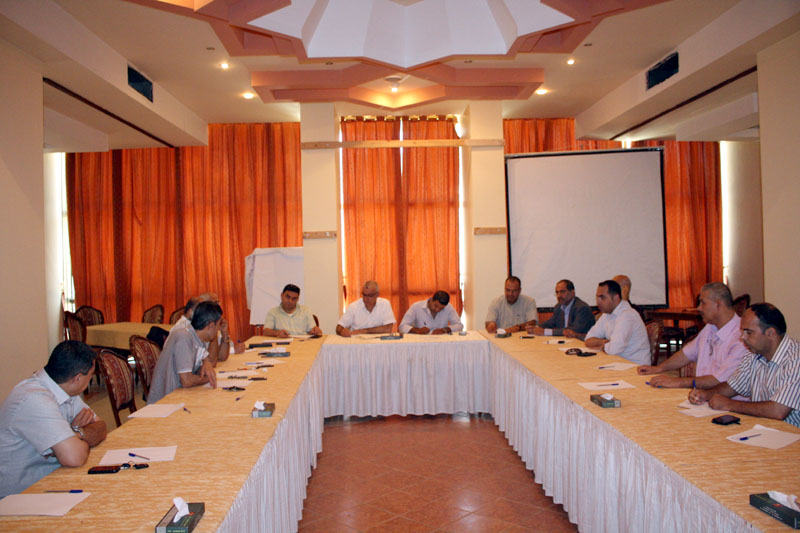
Setting out from the philosophy of Pal-Think for Strategic Studies as an independent Palestinian think institution aiming at strengthening discussion about the strategic issues that concern the Palestinian affair, Pal-Think for Strategic Studies organised a number of discussion and brainstorming sessions titled “How to strengthen the national-consensus process and overcome the impediments in its way”, which aimed at coming out with a work plan to strengthen the course of the national consensus. Taking part in these were a number of representatives of civil-society organisations, politicians, media people, academics, and the private sector.
These sessions were moderated by Mr Omar Shaban, founder and director of Pal-Think for Strategic Studies, who summed up the goal of these sessions by saying: the catastrophic situations the Palestinian territories are passing through — whether in the northern governorates, of arrests, raids, and the separation of the cities, or in the governorates of the Gaza Strip — require hastening the solidifying of the national-consensus process and the unification of the Palestinian ranks to confront those challenges. Likewise the humanitarian crisis worsening in the Gaza Strip because of the blockade's continuation, the prevention of the entry of raw materials, the closure of the Rafah crossing, the occupation's prevention of the communication of the national-consensus government's ministers, and the Israeli threats to the Strip — which have no doubt added more restrictions on the consensus government's work; but these threats must represent a national stimulus to hasten the implementation of its articles.
The participants pointed out that the street's trust in and support for the consensus process is retreating for its not realising concrete achievements felt by the citizen, who has suffered the bitterness of the division and waits for the consensus government to perform its duties toward its citizens. The participants agreed that the national-consensus process moves with an extreme, unjustified slowness, in contradiction with the timetable agreed between the reconciliation's two parties — despite the tens of hot issues that require urgent movement to prevent the explosion and failure of the reconciliation process; reminding that the consensus government has duties it must adhere to toward its people in the Gaza Strip as in the West Bank. The latest developments were likewise touched on as relates to the consensus government's work and the administrative and financial problems it faces — especially the crisis of the salaries of the Gaza Strip's employees and the closure of the banks, the crisis of the Rafah crossing, the electricity, security, and the pollution of the Gaza Strip's sea, which is the important outlet for the besieged inhabitants of the Gaza Strip for recreation.
The participants likewise spoke of the necessity of activating the role of the Palestinian Legislative Council according to what was agreed, which provided for activating the Legislative Council a month after the formation of the national-consensus government. The participants likewise focused on the importance of activating the forces of civil society and the youth in monitoring the implementation of the reconciliation agreement, clarifying the responsibility of the parties signing it, and demanding of them disclosure to Palestinian society of the agreement's articles and the reasons for the slowness in implementation.
The participants concluded with the necessity of beginning popular events at the level of the homeland and practising all kinds of popular pressure to hasten the implementation of the reconciliation agreement.