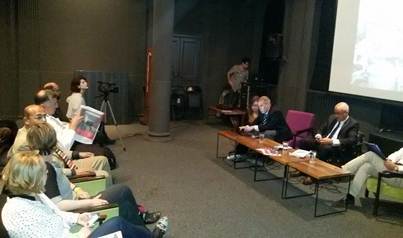
The Pal-Think delegation concludes its visit to Croatia
A Pal-Think delegation of civil-society activists concluded its visit to Croatia: two societies, two conflicts — and a shared will to achieve reconciliation, continuing Pal-Think's years of work for national reconciliation by every means.
- Author
- The editorial team
- Date
- 2015-05-16

The delegation of Pal-Think for Strategic Studies concludes its visit to Croatia:
Croatia and Palestine: two societies, two conflicts — and a shared wish to realise reconciliation
In continuation of Pal-Think for Strategic Studies' approach over the past years in strengthening the national reconciliation in Palestine by various means and in all fields, a Palestinian delegation composed of a number of civil-society activists made a visit to Croatia that continued 6 days, with the goal of studying and benefiting from the experience of the Balkan states in general and Croatia in particular in the process of national reconciliation and surpassing the traces of the past. The visit comes within the cooperation project between the Pal-Think for Strategic Studies institution and the Centre for Peace Studies in Croatia, with support from the Croatian Foreign Ministry.
The project aims at exchanging expertise and strengthening the capacities of Palestinian civil-society organisations to increase their focus on building civil peace in Palestine, through increasing their efforts to target the democratic transitional processes and the protection of human rights during the reconciliation. As Omar Shaban, director of the Pal-Think institution, who headed the Palestinian delegation, pointed out: “Although we are not at the reconciliation stage yet, we need to be prepared for it, as Palestinian civil-society organisations play a very important role in strengthening the reconciliation process and rooting it and guaranteeing the non-return of internal fighting in the future.
The visit comprised meeting a number of civil-society organisations and senior Croatian experts from the Centre for Peace Studies and the official institutions that have worked in the national-reconciliation programme since the end of the civil war in Croatia in 1994. Over the 6 days of the visit, tens of meetings and a number of educational seminars on the Palestinian cause were organised, and the Palestinian delegation met a warm welcome from the strata of Croatian society. One of these meetings was inside the Croatian parliament, where the delegation was received by a number of the Croatian parliament's deputies, and the role of the legislative and oversight institutions in strengthening the national reconciliation in Croatia was discussed. It is worth mentioning that Croatia contains 22 ethnic and religious minorities, among them Islam. The Croatian parliament was asked to recognise the State of Palestine as has happened with many of the European states — which would give an important indicator of Croatia's political role in the Palestine issue, and such a recognition would work to improve the relations of cooperation between Croatia and the Arab world. The Croatian Foreign Ministry was likewise visited and the ministry's director-general for international cooperation met, and the ways of Croatian–Palestinian cooperation were touched on. It is worth mentioning that the Croatian government took part in the donors' conference held in Cairo on the past 12 October concerning the reconstruction of the Gaza Strip..
The peoples of Yugoslavia passed through a bitter civil war and the road before them is still long to treat the repercussions of the fighting on all walks of life. Croatia was within the Yugoslav union in the era of the Soviet Union, and announced its independence in 1991 — which pushed the Yugoslav army, whose majority the Serbs represented, to suppress the Croatian people's wish for independence. Croatia's population is only 4 million, the majority Catholics, and the formerly Yugoslav army, which the Orthodox Serbs controlled, worked to prevent them from independence. Despite the bloody conflict between them for four years, there are great efforts from the two sides to surpass the past and cooperate for a better future. Four years of fighting may need forty years of efforts to surpass their repercussions. Despite the particularity of the Croatian experience, it can be benefited from in the Palestinian reality.