With Friedrich Ebert Stiftung, Pal-Think holds a dialogue on European and German policy towards the Israeli–Palestinian conflict
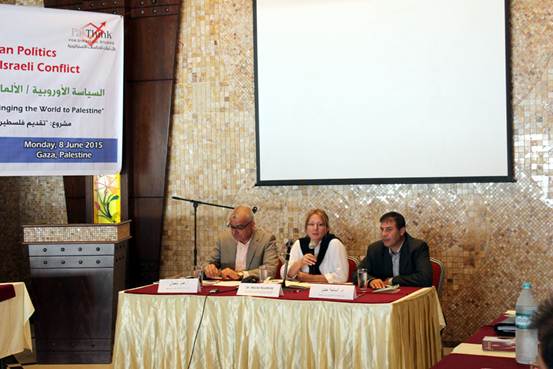
Pal-Think and the Friedrich Ebert Foundation held the dialogue «European/German policy towards the Palestinian–Israeli conflict», hosting Dr. Muriel Asseburg, senior Middle East researcher at the German Institute for International and Security Affairs.
- Author
- The editorial team
- Date
- 2015-06-10

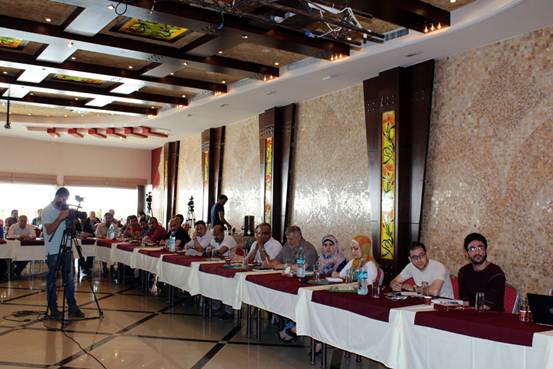
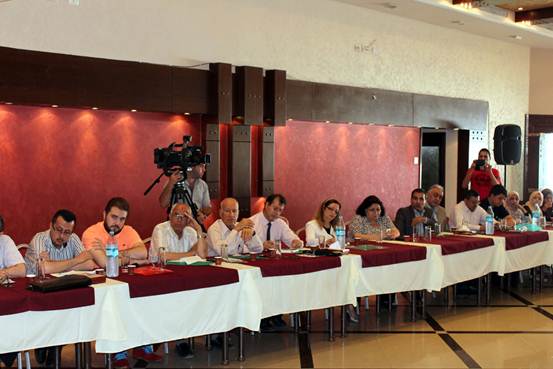
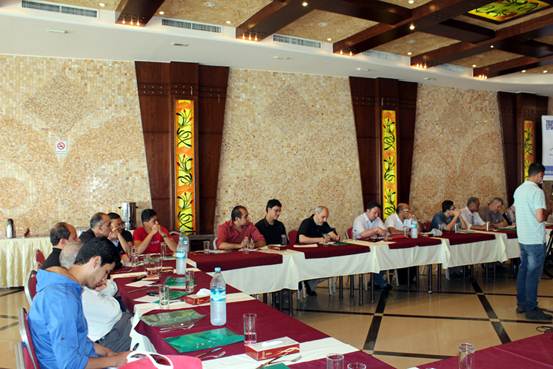
Gaza — 8 June 2015. Pal-Think for Strategic Studies, in cooperation with the German Friedrich Ebert Foundation, organised a dialogue session titled “European/German policy toward the Palestinian–Israeli conflict”. The session hosted Dr Muriel Asseburg, a senior researcher on the Middle East and Africa / the German Institute for International and Security Affairs, with dense participation from the various strata of society — researchers, academics, politicians, businessmen, and young activists.
The dialogue session focused on the possible means of influencing the European Union's policies, to place the Palestinian cause on the ladder of priorities of the European Union's policy agenda — for the absence of the Palestinian cause from the agenda of the politicians in the European Union is prominent. In the same context, Dr Asseburg affirmed that the Palestinian reconciliation will facilitate the strengthening of the European Union's role toward the Palestinian cause.
Dr Asseburg took up in the session several principal points, among them the general European position toward the Palestinian cause, the approach of the European Union's current policies toward the Palestinian–Israeli conflict, and the possible ways of influencing the European Union's policies to place the Palestinian cause in its calculations. In the same context Dr Asseburg made clear that the Palestinian cause cannot return to the European Union's ladder of priorities without the reconciliation, and added that it is of great importance that there be Palestinian representation of the Palestinian cause in Europe — for the absence of Palestinian representation is prominent compared with the clear Israeli presence in Europe. On this point Dr Asseburg made clear her understanding of the difficulty of travel from the Gaza Strip and of actual representation embodied in the presence of persons, and proposed the social-media means as an alternative solution. Finally, she affirmed from her side the importance of searching for international and regional alliances that have shared concepts and interests, as a means of pressing Israel from one side, and of mobilising international support for the Palestinian cause from the other side.
On the other hand there were interventions and questions from the participants, which centred on Europe's current policy and this policy's contradiction with its nature as states that support human rights; Europe's position on the conflict's deviation from its moral basis to become a conflict of a radical religious character; the role Europe might play in the Palestinian reconciliation and the reconstruction of Gaza; the possible probabilities of possible changes occurring in European policy toward the Palestinian cause; and many other matters.
At the session's conclusion Pal-Think thanked Dr Asseburg for her attendance and her cooperation with the Friedrich Ebert Foundation and her contribution to shedding light on the important issues that could contribute to making the Palestinian cause present in the European political scene. It is worth mentioning that Dr Asseburg is a researcher and does not represent any political body.