Seminar: Turkish foreign policy towards the Middle East and the Palestinian question
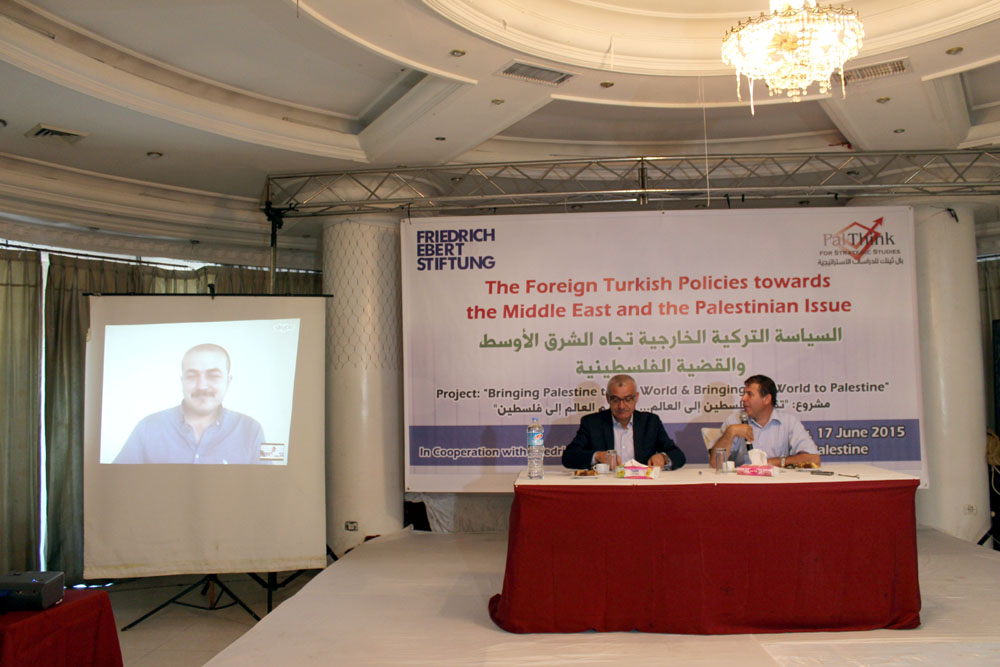
Pal-Think and the Friedrich Ebert Foundation held a seminar on «Turkish foreign policy towards the Middle East and the Palestinian question», hosting by Skype Dr. İsa Arslan, professor of political science and international relations at Fatih University.
- Author
- The editorial team
- Date
- 2015-06-22
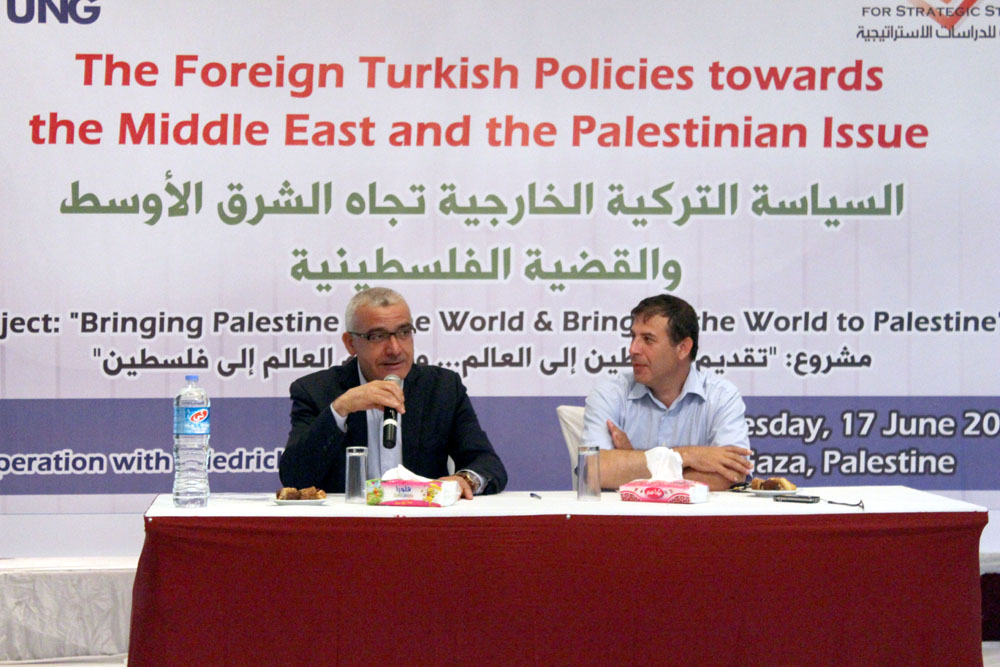
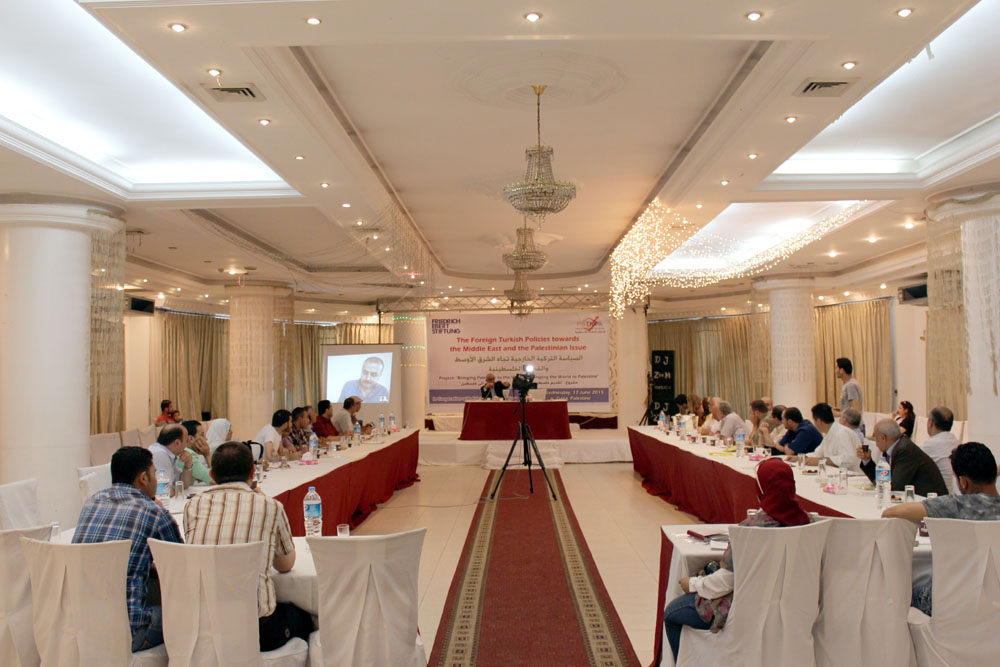
Pal-Think for Strategic Studies, in partnership with the German Friedrich Ebert Foundation, organised a seminar on “Turkish foreign policy toward the Middle East and the Palestinian cause”, on Wednesday, 17 June 2015, in the Gaza Strip. The meeting's guest via Skype was Dr Isa Arslan, professor of political science and international relations at Fatih University in Turkey, the specialist in Turkish foreign policy, with the attendance of an elite of politicians, businessmen, researchers, and interested youth. The session was moderated by Omar Shaban, director of Pal-Think for Strategic Studies, and Dr Osama Antar, programmes director of the German Friedrich Ebert Foundation in Gaza. The discussion in the seminar centred on three principal issues: the current Turkish elections, their results and their effects; Turkey's foreign policy toward the region; and Turkey's foreign policy toward the Palestinian cause.
As relates to Turkey's foreign policy, Dr Arslan pointed out that Turkey's foreign policy is determined by its alliance with the West, and described this alliance as a permanent strategic alliance. In the same context Dr Arslan spoke of Turkey's policy “calm in Turkey and calm in the region” or the “zero-problems policy” of which Ahmet Davutoğlu spoke in his book on Turkey's foreign policy.
As relates to Turkey's policy in the region, Dr Arslan described it as idealistic more than realistic, since its military and economic capacities do not enable it to play a regional role as it aspires. In the same context Dr Arslan declared that Turkey has problems with various states of the region, so it must redo its calculations in dealing with these states — and Dr Arslan expected Turkey to be, in the coming stage, more pragmatic as relates to dealing with the region's issues.
As concerns the questions about the “zero-problems policy” and the Palestinian cause, he pointed out that the “zero-problems policy” failed because it caused many problems for Turkey with various states, and declared that this principle does not apply to the Palestinian cause — since Turkey is concerned to have relations with Israel, so that it can press it and play the role of mediator.
He pointed out that Turkey is very concerned with relations with Russia, for what is in that of economic and security interests that return benefit to Turkey. As concerns the economic relations between Turkey and Israel, Dr Arslan pointed out that the Turkish people is unaware of the strength of the economic relations between Israel and Turkey; at the same time he noted that it is in Turkey's interest to have alliances in the region so that it can play the role of mediator.
Dr Arslan criticised the Turkish government's having relations with some parties in the region outside the frame of the state, and pointed out that Turkey has followed this approach not only in Palestine — rather in Syria and Iraq too it has good relations with some parties — and affirmed that this policy does not contradict Turkish foreign policy.