Dialogue: «Palestinian reconciliation — the universities as the starting point»
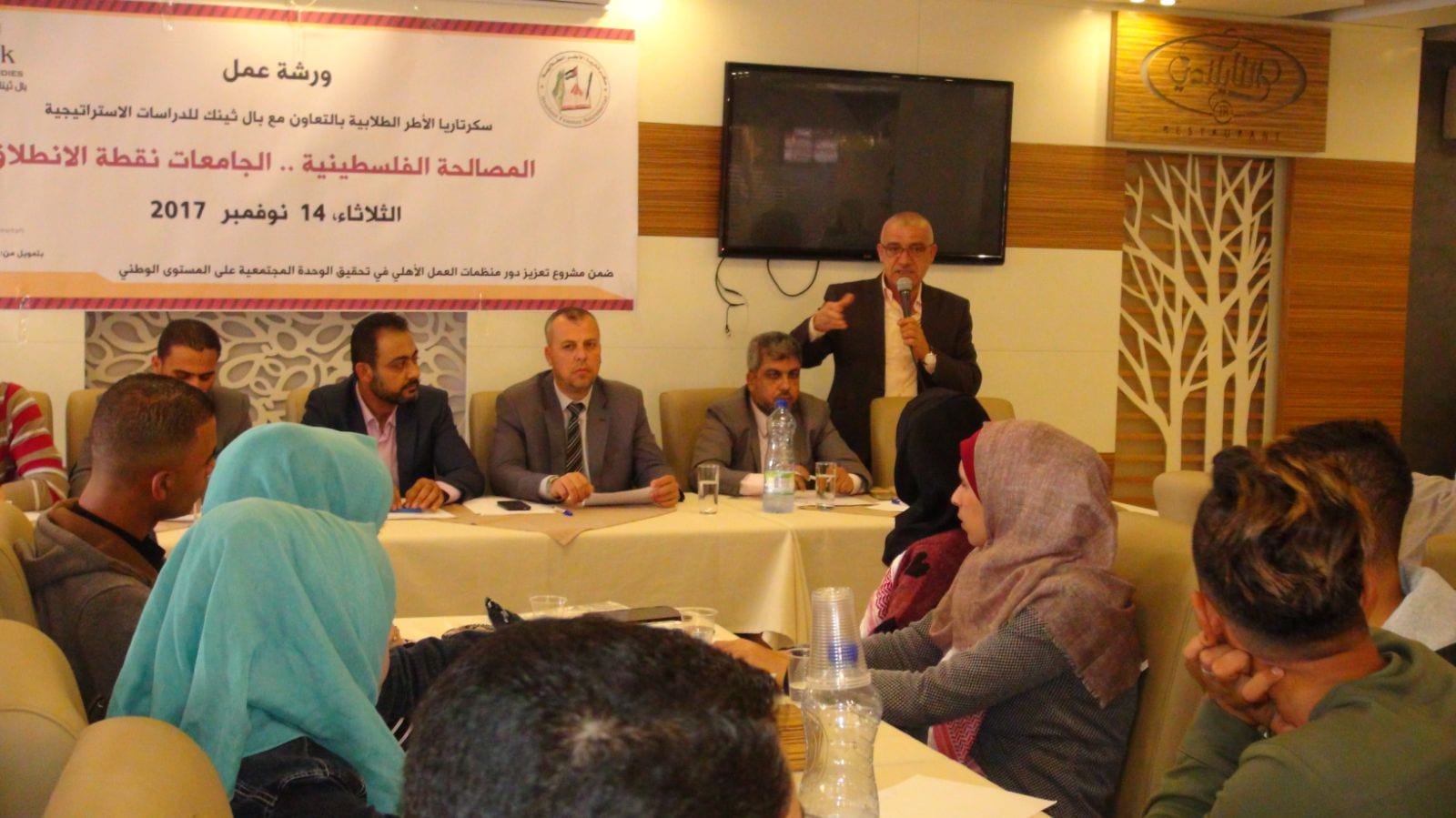
The student-blocs secretariat, with Pal-Think, held the dialogue «Palestinian reconciliation: the universities as a starting point» in Gaza, with university professors, students, student blocs and a Swiss delegation attending.
- Author
- The editorial team
- Date
- 2017-11-20
The Secretariat of the Student Frames organised a dialogue meeting titled “Palestinian reconciliation… the universities are the starting point”, in cooperation with Pal-Think for Strategic Studies, in Gaza City, with the attendance of a group of university professors, a number of university students and student blocs, and a Swiss delegation.
The meeting was opened by Mr Ahmed al-Qeeq, member of the Secretariat of the Student Frames, welcoming the attendees, praising the role of the Secretariat of the Student Frames, and offering thanks to Pal-Think for its continuous engagement and constant cooperation with the Secretariat of the Student Frames through contributing to sponsoring a number of meetings and workshops within the axes of student work — particularly those that concern the student movement in the universities of the Gaza Strip.
For his part, Mr Sufian Thabet affirmed in his word on behalf of the Secretariat of the Student Frames the chain of continuous joint work between the Secretariat of the Student Frames and Pal-Think, which has years within the frame of joint work that held a prominent role in laying down the policy of students' awareness of the issues that concern student and syndical work inside the universities. Thabet added the importance of Palestinian reconciliation as a lever for Palestinian society in general and for the student project in particular, through restoring the atmospheres of democracy inside the universities — embodied in holding the university elections in the Gaza Strip, which have stopped in the great majority of Gaza's universities — with the importance of students' engagement in the events of supporting and strengthening the reconciliation through students' participation in the events the Secretariat of the Student Frames will hold in this frame.
For his part, Dr Omar Shaban, head of Pal-Think for Strategic Studies, spoke of how work with youth holds great importance within Pal-Think, and the Secretariat of the Student Frames counts among the partners of years with whom we work together on topics that concern the student sphere — which counts as a tributary of the Palestinian project while we are in the stage of liberation, particularly as the universities held a prominent role in supplying many of the national leaderships in the Palestinian arena. For his part, Dr Hani al-Jazzar, professor of history at Al-Aqsa University, spoke of the importance of such meetings that contribute to strengthening unity and reconciliation — considering that youth are the most able to obtain their rights on the basis of wresting rights, not being gifted them; rights being wrested by reason, logic, and unity.
Dr al-Jazzar affirmed that the universities count as the incubator of the national project, being the frame of reference of this project — such that the prime minister was chosen from a university; the universities hold a great role in ordering the Palestinian file, although the universities of late have held a negative, uninfluential role in the reconciliation — which requires making good the previous stage with all its negatives and setting out toward activating the universities' role in strengthening the reconciliation and fortifying it through strengthening students' awareness.
For his part, Dr Kamal al-Shaer, professor of media at the University of Palestine, spoke of the importance of the universities and youth, and how important it is to survey the models of the other countries that attend to youth and the universities and consider the universities a frame of reference in choosing the states' leaderships, and the importance of scientific research that contributes to strengthening and fortifying society. Dr al-Shaer added that the university counts as an oasis of student work, intellectual diversity, and the spread of the values of tolerance and dialogue; and it is important that the universities launch the policy of dialogue among the mass of students, considering that a strengthening of the values of the culture of accepting the other and of not being bigoted in opinion — for experience has confirmed to us that bigotry in opinion leads to a sea of blood; therefore what is required of the universities is to be a lever for Palestinian reconciliation. For his part, Dr Osama al-Akhras, professor of law at Al-Israa University, said the Palestinian division has affected all walks of life, and perhaps on the student side it affected the students who wish to complete their university studies. If we speak of the universities, the universities have graduated many of the Palestinian leaderships and were the best tributary of society; likewise the General Union of Palestine Students held a prominent role in strengthening the national project. At the level of the Arab and international model, students count as the source of awareness, vigour, and liveliness, holding the capacity to change the internal politics of states.
Dr al-Akhras added that our Palestinian scene alone turns around certain secondary issues in which the youth are lost. What is required is that the universities, the students, and the youth leave the corridors of sedation and suffering and advance toward engagement and integration with the reconciliation, for it represents the last passage of the lifeline for our Palestinian cause. Even the jurists in the universities have regrettably offered no law that forbids and criminalises the division. What is required is that the universities and the students hold a role in strengthening the reconciliation and standing against all the features of the division. The door of discussion was opened with the students to raise proposals and recommendations,
and after the discussion's end, Mr Amjad al-Ghazali read out the recommendations:
• The Secretariat forming a creative team and laying down a plan for the problems facing student work inside the universities.
• Holding meetings continuously, like these meetings that contribute to strengthening the state of awareness and dialogue among students.
• The necessity of addressing the universities that still ban student activities, to dissuade them from this decision, for the importance of student activities in planting the value of dialogue and acceptance of the other.
• The importance of cultural exchange among the Palestinian universities through holding meetings attended by students from all the universities.
• Laying down a plan to press the universities to hold the university elections, considering that this forms a strong factor in strengthening Palestinian reconciliation.