Ten initiatives delivered under the Philosophy & Culture of Nonviolence project
Gaza's economic and social conditions under the tightened blockade — with frightening poverty and unemployment figures — have helped violence spread through society. Pal-Think played its community role by launching a set of initiatives under the culture-of-nonviolence project.
- Author
- The editorial team
- Date
- 2018-03-25
Palestine – Gaza
The economic and social conditions in the Gaza Strip have helped the spread of violence after their worsening as a result of the blockade clamped on the Gaza Strip, where frightening figures of poverty and unemployment have been recorded passing over the Strip — reflected on living conditions and helping the spread of violence in society.
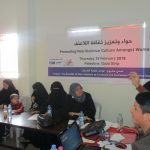
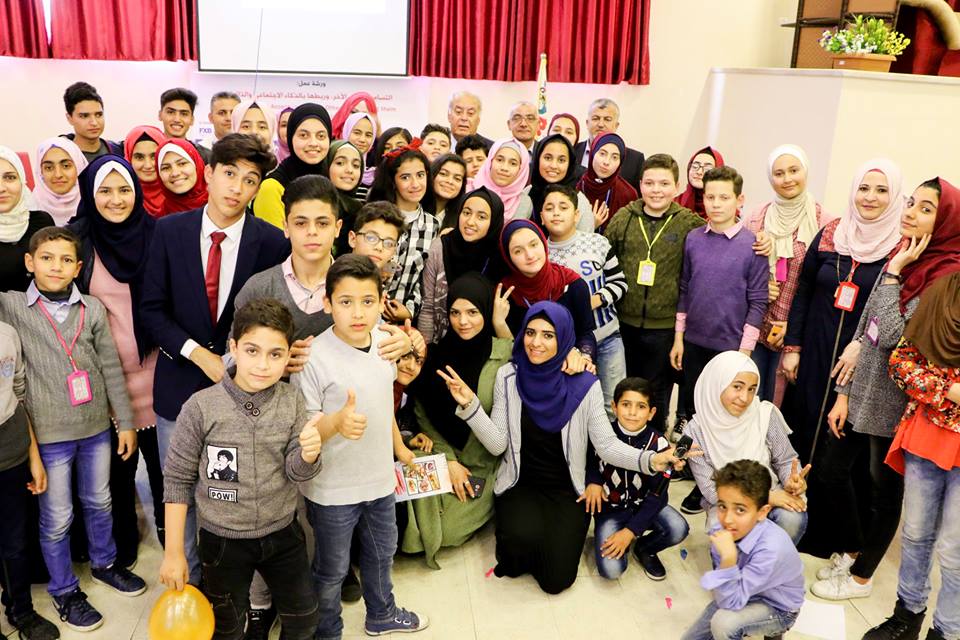
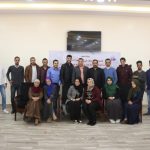
Pal-Think performed its communal role by launching a set of initiatives within the project of the culture of non-violence and its benefits in society, funded by the FXB institution, across all the governorates of the Gaza Strip. The project targeted 22 young men and women among the university graduates in the Gaza Strip, through training courses titled “The philosophy and culture of non-violence” over ten days.
The course took up several topics, foremost non-violent communication, peacebuilding, tolerance and acceptance of others, and lobbying and advocacy and their role in resolving disputes — by recounting models of non-violence in Palestinian history and other topics in the same context.
The project's team now works to spread the culture of non-violence in society through more than 25 awareness, educational, and creative activities in cooperation with important institutions in the Strip's governorates.
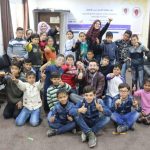
The trainee Raneen al-Zaaneen (23 years), a master's student of economics, worked to spread the culture of non-violence among the children of the Beit Hanoun area — a border area lacking many of the activities that strengthen the concepts of tolerance and affection — in cooperation with the Ataa Charitable Association, with the attendance of 25 boys and girls from the area. Through it she helped give the children skills enabling them to restore their self-confidence, and to plant the concept and values of non-violence and put them into practical exercise through the lively components of the activities focusing on certain values such as social justice, voluntary participation, and the resolution of disagreements by peaceful means away from violence.
This qualifies the participating children to activate their role in bringing about change in their families and schools by peaceful means away from violence, to be an effective element in their schools and their society — amid positive atmospheres and interaction among the participants, after strengthening the concepts of the self and linking them to the core of non-violence and the mechanisms of tolerance, dialogue, and the effective ways of contact and communication.
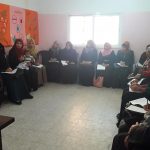
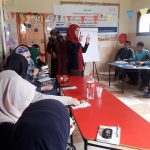
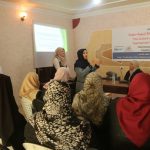
The trainers Ibrahim Elyan (26 years), a sociology graduate, and Ahmed Hamad (27 years), a psychology graduate, likewise set about carrying out their activity titled “Eve and the strengthening of the culture of non-violence in the children”, in cooperation with the Pioneers Association for Palestinian Youth in Khan Younis, with the attendance of more than 25 women, most of them mothers.
They took up at the meeting's start the importance of spreading the concept of non-violence and tolerance among the family's members, the importance of sound family upbringing of the children, and the methods and skills of strengthening non-violent practices among the women on one side, and among their children and their society on the other.
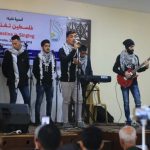
In context, the trainer Mohammed Labad (29 years) headed to carry out the initiative “Palestine Sings”, with the attendance of more than 100 people in the city of Deir al-Balah — an initiative that centred on music, for its capacity to leave a good trace in souls and refine them, whether through listening or through taking part in producing it.
The initiative invited a group of singing artists and musicians of the young generation at the start of their artistic path, to adopt the culture of non-violence at the start of their artistic course and their future works — to offer a beautiful artistic singing scene of certain songs reflecting the reality of life in Palestine, calling for freedom and peace, with the attendance of different groups of society, within the message of peace to the world from Palestine.
The singing troupe offered artistic numbers of a set of national and heritage songs, and a round of the Palestinian popular dabke to a heritage piece.
The trainer Abdel Salam Murtaja (24 years) moved to carry out an initiative different from the previous initiatives, heading to cancer patients, helping them face the disease with the culture of non-violence — with the attendance of 30 women among cancer patients, in cooperation with the Basma Amal Association for the Care of Cancer Patients in Gaza City.
Abdel Salam began his meeting by speaking of the cancer disease as a kind of psychological violence that must be faced with a non-violent method helping to overcome the disease and engage in life naturally and effectively.
He added: “The disease must be faced with positive thinking and meeting violence with non-violence, using music to treat the mind and the body to reach psychological ease, to overcome the disease and engage in life naturally”
Murtaja mentioned during the meeting many success stories of women cancer patients who faced the disease with non-violence, amid positive and interactive atmospheres.
In context, the trainer Duha Shaat (23 years) set out to carry out her initiative titled “The philosophy of non-violence and its merging with social and self intelligence”, in the city of Rafah, in cooperation with the Multiple Intelligences Academy, with the attendance of officials in UNRWA and the director of Pal-Think Mr Omar Shaban.
Shaban affirmed during the initiative's opening the necessity of linking Gaza with the outside world, the necessity of focusing on the new generation of Palestinian youth, and the importance of deepening the culture of non-violence, tolerance, and mutual dialogue.
Shaat focused in her activity with the children on employing social and self intelligence in spreading the philosophy of non-violence in their society, strengthening the values of citizenship, coexistence, social participation, tolerance, and acceptance of the other, and merging social and self intelligence with the two concepts — through recreational activities centring on collective work, in addition to analysis and inference, and other musical numbers.
As for the trainer Nevin al-Ghoul (24 years), she took up in her initiative facing extremism with non-violence, with the attendance of community activists, writers, youth, and artists. She said extremism is the first step toward violence and the hardline thought that begets anger, and it must be faced with a non-violent method.
Nevin said: “We must begin with ourselves when we believe we are able to change toward the better; its beginning lies in managing the relation with the children and containing the youth's outbursts”.
The meeting included exercises on the culture of tolerance and the control of anger, the showing of a silent play titled (Justice and Benevolence in Fighting Extremism), and discussion of the conditions of youth, children, and the family regarding violence and the attempt to treat them — interspersed with a musical performance, to spread the culture of tolerance and affection.
In the same context, the trainer Mohammed al-Tahrawi (24 years) carried out his initiative titled “The culture of non-violence for facing gender-based violence”, in the Nuseirat camp — introducing the foundations, pillars, and tools of gender, pointing to the national and international protection mechanisms for protection from violence, especially in what relates to violence against women.
He took up the causes and forms of this violence during the meeting, discussed with the attendees gender-based violence and its kinds, and the important methods of strengthening the culture of non-violence in treating such a negative phenomenon, and presented the international agreements for protecting individuals from violence.
The initiative of Imtithal Abu Zbeida (22 years) and Ahmed Hamad (27 years) centred on strengthening the culture of non-violence in society through behaviour modification, and how to positively reinforce the desired behaviour in the future.
The two trainers listened to the mothers' stories with their young children, and discussed the ways of solving the problems, correcting certain undesired and negative behaviours, and strengthening positive behaviour — affirming the importance of spreading the culture of non-violence within the family and among the children, which strengthens the language of dialogue among individuals at the level of family and society.
For their part, the trainers Amal al-Sammak and Nour Abu Taqiya headed to carry out the initiative “The culture of non-violence: peaceful educational ways”, with the attendance of 25 women among the mothers of adolescents. In it they spoke of the importance of strengthening the culture and philosophy of non-violence in Palestinian society, how the mother deals with the adolescent in a non-violent method, and peaceful educational methods for dealing with the adolescent in this critical stage.
The two trainers took up the parents' role in helping the adolescent obtain good mental health, interspersed with an open discussion aiming to reach teaching the mothers to use a constructive, positive method of dialogue with adolescents, and dealing with the adolescent's demands in what serves this stage in positive, sound ways, to reach results serving the mother and her adolescent children, reflecting positively on society.
The trainer Maram Abu Harbid (23 years) likewise carried out her activity, heading to strengthen the language of dialogue among university students and graduates, with the attendance of 25 male and female graduates of different specialisations. The trainer opened the meeting by speaking of stories mirroring the experiences of some of the targeted youth.
Abu Harbid affirmed taking dialogue as a tool through which we overcome violence and its consequences, in addition to definitions of dialogue and its patterns with the rules of mastering dialogue to avoid the problems that lead to flare-up and violence — by spreading the culture of dialogue in Palestinian society.
Pal-Think works within its future plan on many educational and creative initiatives to be carried out by the project team of the “philosophy and culture of non-violence” course, which will extend over a full year targeting civil-society institutions, which will have an effective role in carrying out the initiatives and spreading the culture of non-violence and communal peace.