Research paper: Empowering persons with disabilities in Gaza — prospects and challenges / young researcher Taghreed Jabr Najm
Persons with disabilities are a natural and familiar presence in Palestinian society, as in every society — their numbers grown by wars, conflicts and natural disasters alongside illness, congenital causes and accidents — and their rights demand full engagement.
- Author
- The editorial team
- Date
- 2017-05-22
Introduction: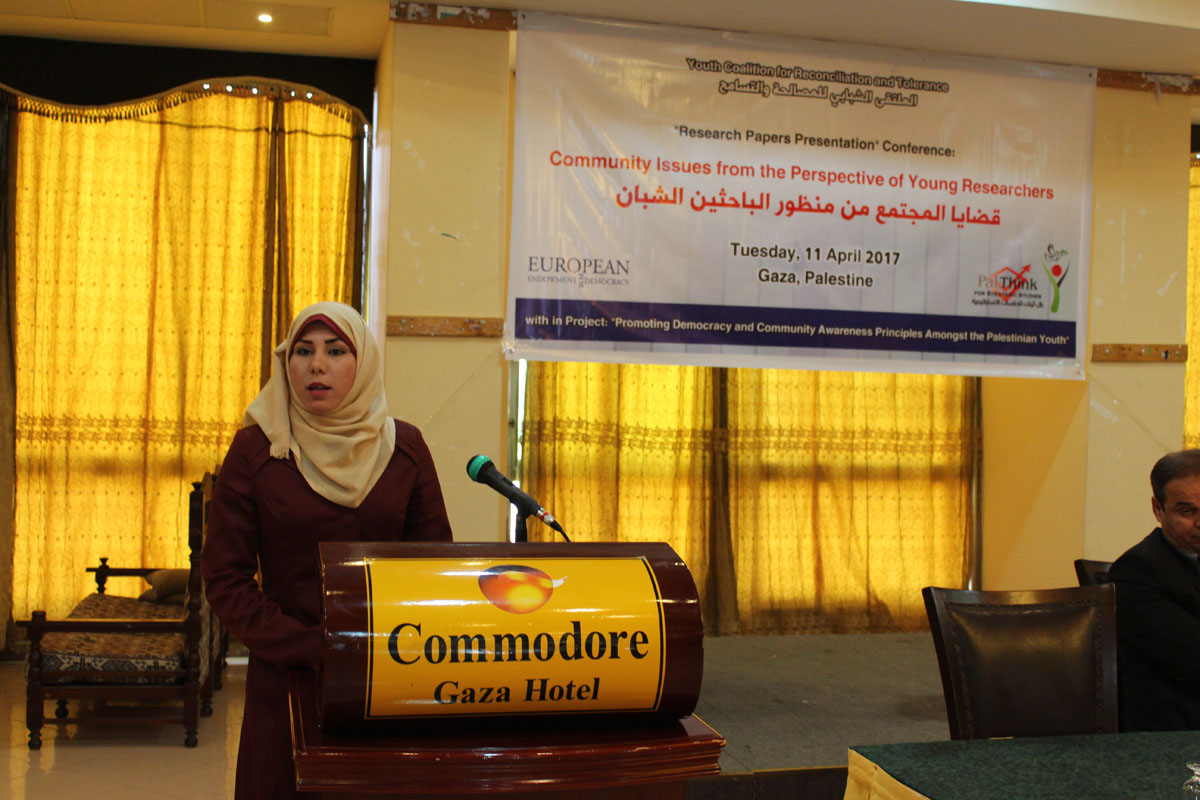
The presence of persons with disability in Palestinian society, like other societies, has become a natural and familiar phenomenon that must be dealt with in all its details — given the rapid changes and transformations in societies, where wars, disputes, and natural catastrophes have multiplied, not to mention the medical and congenital causes and the accidents behind which are many people who become persons with disability in need of care and attention.
Palestinian society — which suffers the catastrophes of the occupation, which has caused many disabilities to individuals by its repressive practices — was perhaps among the pioneering societies in enacting the laws and legislation specific to those with disability. The research's idea rests on the process of empowering and activating the role of persons with disability within their local community: the problem of those with disability lies in the different social conditions and contexts that place unjustified restrictions and obstacles, resting on no scientific views, before the participation of those with disability in the events of social life. The concept of those with disability, made clear by the Declaration on the Rights of Disabled Persons of 1975, indicates that the person with disability is “any person unable to ensure by himself or herself, wholly or partly, the necessities of a normal individual and/or social life, as a result of deficiency, either congenital or not, in his or her physical or mental capabilities”.
Alongside shedding light on the roles of society, its institutions, and its systems in empowering persons with disability, and the responsibility laid on their shoulders toward these persons. Much research indicates that the life and adjustment problems of those with disability do not go back to the injury or the disability in itself, but go back fundamentally to the way society looks at them — without neglecting the physiological causes.
This reflects on persons with disability in their societal marginalisation. Here it is required of us to activate their role and strengthen the culture of empowerment in them, by which we mean: giving those with disability the different knowledge, orientations, values, and skills that qualify them for positive, effective participation in the different activities and events of human life to the utmost limit their means and capacities qualify them for — as a substitute for the culture of marginalisation.
In this context there are pioneering experiences in European states and Arab states that enriched their attention to those with disability by activating their societal role and giving them their right to work and to take part in all fields of life — such as Colombia and the Kingdom of Saudi Arabia — which proved their efficacy in the process of empowering persons with disability.
To view and download the full paper:
 Empowering persons with disability in the Gaza Strip: prospects and challenges
The views contained in the paper express only the view of their author, and do not necessarily express the view of Pal-Think for Strategic Studies