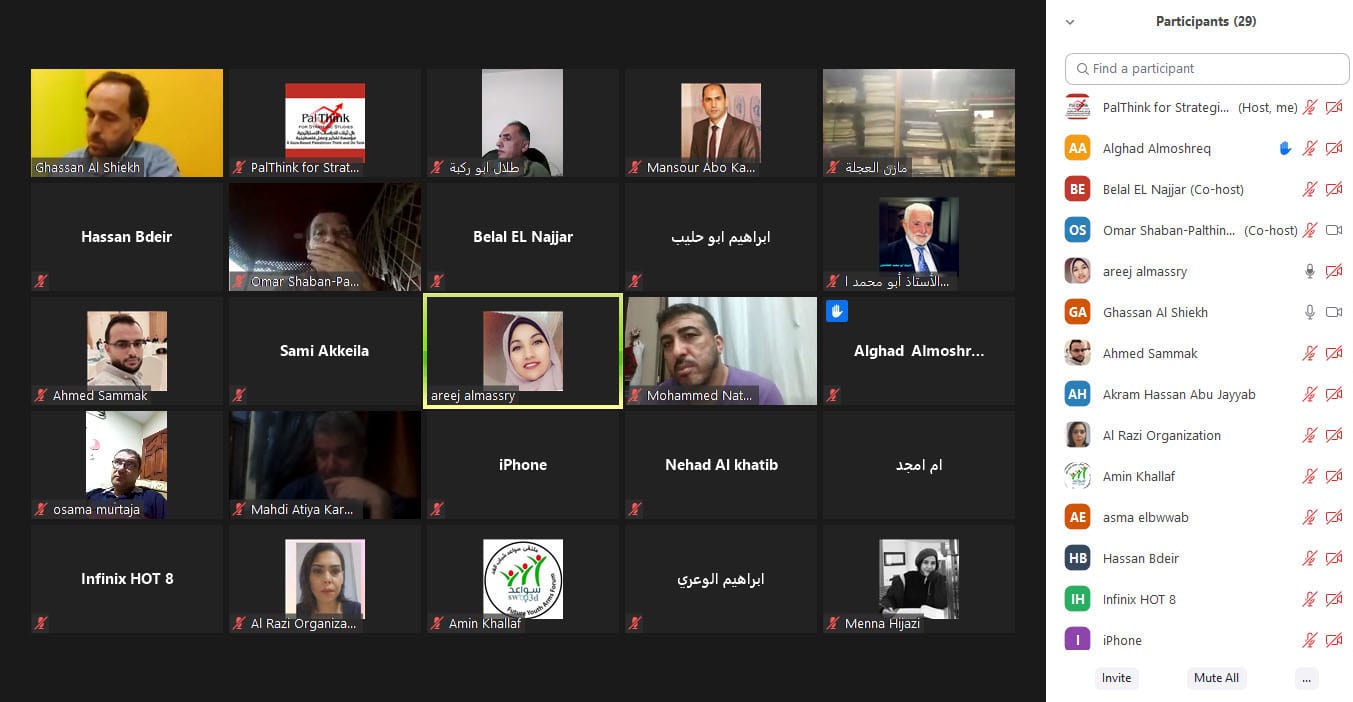
Digital session: nonviolent experiences and their lessons for the Palestinian case
Pal-Think held a digital dialogue over Zoom, «Nonviolent experiences and how to draw on them in the Palestinian case», discussing two research papers — on Rwanda's experience and on peaceful Palestinian models of facing internal crises.
- Author
- The editorial team
- Date
- 2020-09-24
Pal-Think for Strategic Studies organised yesterday, Wednesday, a digital dialogue session over Zoom titled “Non-violent experiences and how to benefit from them in the Palestinian situation”, during which two research papers were discussed — on the Rwandan experience, and on peaceful Palestinian models in confronting internal crises — with the participation of an elite of intellectuals and researchers and a number of civil-society institutions from the West Bank and the Gaza Strip. This came within the project “Strengthening the culture of non-violence”, which the institution has implemented for years to spread and strengthen peaceful conduct and the language of dialogue toward achieving comprehensive societal reconciliation.
The projects coordinator at Pal-Think, Ms Sally al-Sammak, said in opening the session: “This meeting comes within the project of strengthening the culture of non-violence, on which Pal-Think works with 57 partner institutions in both halves of the homeland to reach the widest possible constituency. We have targeted children, university students, housewives, and patients; painted murals; organised campaigns on social media; and delivered dozens of episodes on local radio stations. We want to make this culture part of daily conduct. Strikingly, we have found acceptance from society's different groups, and demand from local institutions to implement these activities in the marginalised areas.”
For his part, the director of Pal-Think, Mr Omar Shaban, said: “At Pal-Think we believe in genuine partnership with civil-society institutions and work with the largest possible number of them. We try to use our available resources in a participatory way with all the institutions from Rafah to Jenin, passing through Jerusalem the capital. This partnership has continued for years, with varied activities — from awareness initiatives to research papers, to radio episodes, to sessions of political reflection in which we have distinguished ourselves.”
He added: “Rwanda is distinguished by its experience, and it has also achieved the highest economic growth in the world, becoming one of Africa's tigers; it will have great standing in the years ahead. We took up this experience to say that far better is possible. Nor are we the only people to have fought internally — on the contrary, the Palestinian infighting was neither the longest nor the largest in casualties compared with South Sudan, South Africa, Colombia, or even Ireland with its crueller civil fighting. We want to disseminate the results of international experiences to the Palestinian political leadership, to the supporters of the Palestinian parties, and to all the spectra of civil society — to say that better than what has been is possible.”
For his part, researcher Dr Talal Abu Rokba, in his paper titled “Non-violent models and how to benefit from them in the Palestinian situation”, reviewed historic moments of the peaceful Palestinian way, saying: “First I want to extend abundant thanks to Pal-Think for taking up precise Palestinian issues and for its constant effort to press toward educating society about what has happened and is happening in Palestinian society, searching for solutions by reviewing the experiences of other countries in all their variety — as if to say that the Palestinian division is not the end of the road, and can be overcome.”
He added: “This paper aims to bring out the culture of non-violence in Palestinian society as the true expression of this society, marked by tolerance and non-violence across its long history — and how Palestinian society succeeded in treating all its internal disputes, especially the societal ones, and confronting all its problems with a non-violent culture that always preserved its social fabric and civil peace. The Palestinian people was among the first peoples on earth to take up peaceful resistance toward the occupier, embodied during the British Mandate, the first intifada, and the marches of return.”
Abu Rokba pointed to historic Palestinian models embodying the culture of non-violence, such as: the Palestinians' adoption, through the different epochs of occupation, of arbitration and mediation in the face of violence as an alternative to the coloniser's laws, to guarantee civil peace; and the Palestinians' faith in the culture of dialogue in confronting the structural dysfunctions of society — dialogue succeeded early, directly after the division, through local initiatives, and Pal-Think was among the first institutions that succeeded in bringing the division's two sides together, and succeeded in presenting a paper to treat the employees file, known as “the Swiss Paper”.
The researcher noted that Palestinians took art as a means of confronting violence and expressing their crises — through songs, drawings, and poetry; the victory of the Palestinian singer Mohammed Assaf was proof of art's importance in restoring the bond between the homeland's two halves.
He continued: “Palestinians also succeeded in deploying sport to dispel the stereotyped image of the other Palestinian that emerged after the division — an image the occupation contributed greatly to drawing by preventing contact between the West Bank and the Gaza Strip. Through football matches such as the Palestine Cup final between Ahli al-Khalil and Shabab al-Shuja'iyya, the mutual warmth and honouring between the two teams and the crowds in the home and away legs were a golden opportunity to correct this negative image left by the division and the occupation together.”
Abu Rokba concluded: “What Palestinian society needs now is faith in its capacity to succeed and to cross to the shore of safety — which is what many civil organisations are trying to do, believing in the importance of strengthening the culture of non-violence and tolerance as the right gateway to restoring hope in unity and ending the division.”
The second paper was titled “The Rwandan experience and how to benefit from it in the Palestinian context”, by lawyer Bilal al-Najjar, who thanked Pal-Think for conveying the experiences of other countries to draw on toward ending the division.
The researcher reviewed the history and causes of the conflict between the Hutu majority and the Tutsi minority and its effect on Rwanda. He set out the essential pillars of ending the civil war and rebuilding, among them: the traditional and communal courts, strengthening unity and reconciliation, reforming the institutions, reparation of harm, and unifying the fighting militias within the Rwandan army.
He concluded: “I want to say that reconciliation does not mean — as first comes to mind — effacing the truth and turning the page without reading it; rather it is a goal achieved through accomplishing all the components indicated above.
As for the Palestinian reconciliation process, it has many gateways and paths, political and legal among them. Among the most important means: creating mechanisms for dialogue, and strengthening a shared identity between the divided Palestinian parties — in addition to shaping a shared societal strategy that society is bound to defend.”
The participants' questions and observations turned on the necessity of setting agreed methodologies for strengthening peaceful conduct, the importance of devising educational lessons for children aimed at instilling the culture of non-violence, organising curricular and extracurricular activities to acquaint citizens with their rights and duties, and how far the division's two sides can be bound by Palestinian law.