What future for the Gaza Strip in the next five years?
Since the division of June 2007 the Gaza Strip has been a territory with a political and legal context distinct from the West Bank — small in size, enormous in its problems: an unrecognised administration, a comprehensive blockade, and four long devastating wars.
- Author
- Omar Shaban Ismail
- Date
- 2021-09-29
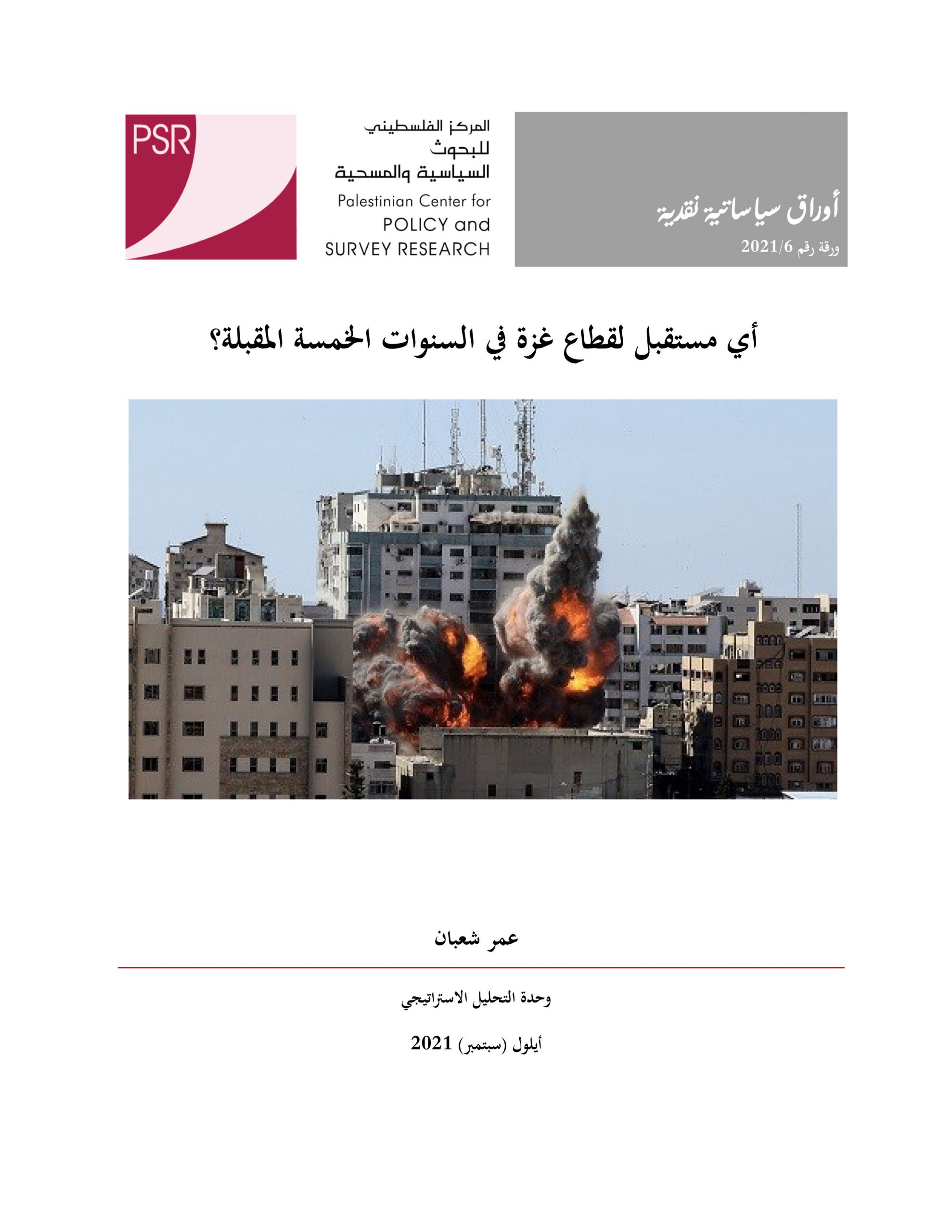 Since the Palestinian division of June 2007, the Gaza Strip has become a geographic area with a political and legal context distinct from the West Bank. Gaza is a small territory in size but large in its problems. The Strip is governed by Hamas, a rule recognised neither in the Arab world nor internationally. Israel imposed a comprehensive blockade on the Strip after Hamas took control of it, and over 14 years the Strip has endured four long, devastating wars and dozens of limited armed confrontations. The suffocating blockade Israel imposes, together with the repeated wars and military attacks, has created an unprecedented humanitarian crisis and produced enormous destruction in infrastructure and across all economic sectors and activities. [1] The Gaza Strip is supposed to be an inseparable part of the Palestinian Authority's territory and of the hoped-for state under international resolutions and the Oslo accord signed between the PLO and Israel. Yet its geographic disconnection from the rest of the Palestinian territories, and the division continuing since 2007, have placed it outside the Palestinian Authority's control. The failure of every attempt at reconciliation and unity has re-posed the great question: what is the future of the Gaza Strip in the coming five years? That is the focus of this paper.
Four givens:
This paper proceeds from the assumption that the following four givens will not change over the coming few years:
The persistence of the Palestinian division and of Hamas's control of the Strip: The many attempts to achieve reconciliation and return the Authority to governing the Gaza Strip have failed — the last being the formation of the consensus government in June 2014 pursuant to the Beach (al-Shati) reconciliation agreement signed in April of that year. After a break of several years, rounds of dialogue between representatives of Hamas and Fatah resumed in meetings hosted by the regional capitals Istanbul, Cairo, and Doha in September 2020, [2] yet they did not succeed in achieving reconciliation. The failure of the reconciliation rounds means Hamas remains at the helm in the Gaza Strip. Among all the regional powers, Israel does not conceal its pursuit of preventing national reconciliation and the Palestinian Authority's return to governing the Gaza Strip.
The persistence of the Palestinian–Israeli conflict without resolution: The optimism that prevailed in Palestinian and international circles with President Joe Biden's assumption of office in the United States soon faded, as the new American administration took no step to restore the negotiation track between the Palestinian Authority and Israel. The first contact between Presidents Biden and Mahmoud Abbas came about because of the latest war between Israel and the factions in Gaza in May 2021. The American intervention, somewhat belated, was set in motion by the war on Gaza, but was confined to economic interventions and financial assistance far from any political track. Likewise, the first meeting between President Abbas and the Israeli government (his meeting with minister Benny Gantz) in August 2021 addressed only security, economic, and humanitarian issues aimed at strengthening the Authority, reinforcing security coordination, and preventing collapse. Israeli media carried prime minister Naftali Bennett's statements affirming that “there is no political process with the Palestinians, and there will be no such process”.[3] So — no hope of a political track in the foreseeable term.
The persistence of the blockade and closure: With the end of the latest round of war (May 2021) between Israel and the Gaza Strip, the new Israeli government declared its clear position of continuing the blockade of the Strip, blocking the reconstruction process, and tying all facilitations to the file of the Israeli captives presumed to be held in Gaza.[4] The obdurate Israeli position saw some concession regarding the blockade: under the mediators' pressure, and to avert a new war, the new Israeli government was compelled to offer certain facilitations — allowing the transfer of part of the Qatari grant funds, permitting the entry of raw materials including construction materials, expanding the fishing zone, and allowing thousands of Gazan workers into Israel. These facilitations of course fall far short of lifting the total blockade imposed on the Gaza Strip. [5]
The persistence of the current regional environment without change: The paper assumes, finally, that the regional environment remains as it is without qualitative change. This environment comprises the principal players: Egypt, Iran, Jordan, Turkey, and Qatar. These states that make up the region share no unified position toward Hamas and the Gaza Strip. While the relations of Iran, Turkey, and Qatar are marked by openness to Hamas, humanitarian assistance, and a measure of political recognition, the relationship of Egypt and Jordan with Hamas sees much ebb and flow, dominated by a fait-accompli relationship and no more. The disagreements of the region's states are clearly reflected in their relations with Hamas; they are states preoccupied with their internal affairs, with no intention of effecting qualitative change in their relations with and positions on Hamas in particular and the Gaza Strip in general.
Looking ahead: what awaits the Gaza Strip in the coming five years?
Under these givens, this paper examines the options available and possible before the Gaza Strip in the coming five years. It rests on a reading of the positions of the relevant parties and the degree of their interaction with the internal environment. It also draws on the debate running within Hamas over the available alternatives and which paths to take out of the crisis that has run for 14 years. In an attempt to anticipate the Gaza Strip's future over the next five years, three available options can be identified:
The first option: completing reconciliation — the Authority's return with Hamas sharing in government:
This scenario assumes national reconciliation is fully achieved. Since the division occurred, attempts to reach that goal have never ceased; despite the many reconciliation agreements (Aden 2008, Cairo 2011, Doha 2012, al-Shati 2014, and Cairo 2017), all failed to achieve reconciliation. The presidential decree of January 2021 [6] calling legislative and presidential elections for May and July 2021 revived hope of national reconciliation. That hope soon dissipated with the President's decision to postpone the elections on the grounds of Israel's refusal to allow them in the city of Jerusalem. This had been preceded by a series of many attempts at national reconciliation between Hamas and Fatah, the last on 24 September 2020 in Istanbul, which produced a shared vision on the files outstanding between the two sides — reforming the PLO, the position on the occupation, and the use of popular resistance as a confrontation strategy — not yet implemented. [7] With the postponement of the elections and the war on Gaza in May 2021 — which raised Hamas's popularity considerably, and which was accompanied by a sharp deterioration in the Palestinian Authority's standing against the background of the killing of activist Nizar Banat, the spoiled-vaccines deal, and more — the gulf between the two movements widened, putting reconciliation far out of reach. The opinion poll conducted by the Palestinian Center for Policy and Survey Research indicates the Palestinian president's popularity fell sharply after the Israeli assault on the Gaza Strip, dropping from 47% in March 2021 to 27% in June 2021. The same poll indicates that 53% say Hamas is the more deserving of representing and leading the Palestinian people, against only 14% for Fatah under President Abbas's leadership.[8]
Shortly after the tripartite meeting of the Palestinian and Egyptian presidents and the Jordanian king in Cairo in September 2021, President Mahmoud Abbas declared the necessity of “Hamas recognising international legitimacy — and if it recognises that legitimacy, we can form a national unity government immediately”.[9] A position Hamas and some Palestinian factions had previously rejected.
There is no consensus among Hamas's leaders on reconciliation with the Palestinian Authority and Fatah; statements have issued from Hamas leaders inconsistent on reconciliation and the extent of the concessions to be offered. The same holds within Fatah's frameworks and some factions allied with it, each side convinced it would not be the biggest winner. Many thorny issues also block reconciliation, among them: Hamas's insistence on keeping its weapons and its military and security apparatus, against the wish of President Mahmoud Abbas, who stipulates one law and one gun and rejects a version of the “Hezbollah-in-Lebanon model” in Gaza. A further difficulty lies in the administrative and security integration of the employees working with the Hamas government, and in revenue collection, the judiciary, land, and the lifting of sanctions.
A belief prevails within Hamas that time works in its favour, as it accumulates ever more experience and support in the region — as happened with the latest war. Hamas likewise believes reconciliation's chances will be better should the Palestinian president depart the scene. Set against this is the continuing deterioration in the popularity of its rival, President Mahmoud Abbas, and the eruption of the struggle over his succession within Fatah's frameworks and the Authority itself. For all this, Hamas is in no hurry to go to reconciliation.
The second option: reaching a long truce with Israel
Since taking control of the Gaza Strip in 2007, Hamas has been tense in its conduct toward Israel, oscillating between the need to define its position as the party responsible for the population and its drive to affirm its capacity to govern; the desire to preserve its standing as leader of the armed struggle against Israel; and its concern to rebuild the Strip whose infrastructure was destroyed in the wars. Hamas signed numerous calm agreements with Israel shortly after each war (2009, 2012, and 2014), but they were short-term. Hamas runs a near-continuous dialogue with Israel through Egyptian, Qatari, and UN mediation to obtain a set of economic and material improvements — opening the crossings, issuing workers' permits, and so on. With every conflict Israel withdraws these facilitations, and they are then renegotiated anew.
Hamas affirms from time to time that it wants no further wide military engagements with Israel; rather it seeks de-escalation on condition the blockade is eased — yet without abandoning the principle of armed struggle against Israel. Hamas sees its rule of the Gaza Strip and its continued discourse of resistance and struggle against the occupation as elements essential to shaping its identity, securing the ranks around it, and commanding the attention of outside parties — its allies (Qatar, Turkey, and Iran) and its adversaries (Israel, Egypt, and the Palestinian Authority) alike. At the same time Hamas bears the burdens of governing and realises it needs some relationship with the occupation as the principal controller of the Gaza Strip.
Hamas cannot go so far as to recognise Israel and sign a peace agreement with it — for ideological reasons, and in the awareness that such recognition would strip it of its very being (as a resistance movement) and cost it official and popular support. The movement therefore prefers to speak of a long-term truce, enabling it to keep its identity as a “resistance” movement while at the same time obtaining economic facilitations that strengthen its capacity to govern the Strip (combining resistance and governance). Hamas's equation rests on obtaining facilitations and humanitarian improvements, circumventing the blockade, and opening to the outside world — in exchange for Israel enjoying quiet on the border for a long period. Hamas oscillates between its past as a resistance movement, which it partly left behind in June 2007, and its present as a government bearing the obligations of caring for 2 million Palestinians — a level it has not yet reached. Hamas thus stands at a midpoint between armed organisation and government.
The third option: the scenario of an independent Gaza entity:
This option means the Gaza Strip becoming a small entity enjoying sovereignty, whereby it and the West Bank become two areas enjoying two different levels of sovereignty — the West Bank comprising an area of cantons growing smaller with time than it is now, with the present cast of administrative self-rule. The West Bank would be nominally linked to the Gaza entity, in which governance is represented more broadly in independence. What puts this scenario forward — and forcefully — is of course the continuation of the internal Palestinian division over a long period with no prospects of remedy, and the deepening of the gulf of disagreement between Hamas and Fatah.
Because of the long years of division, a feeling has grown among some segments of Palestinian society that reconciliation is impossible and that the Gaza Strip must think seriously about finding exits from the humanitarian crisis. The division has produced further societal, political, and economic transformations that have in turn deepened the separation between Gaza and the West Bank. Supporting this scenario are the wishes of Israeli national security for strategic separation between the West Bank and Gaza, championed by General Giora Eiland, author of the Gaza-expansion project, who called on Israeli governments to break out of traditional caution and complete a comprehensive deal with the Gaza Strip including a prisoner exchange — leading to the de facto “consecration of the emirate of Gaza”, turning Gaza into the centre of the Palestinian state, with the West Bank cantons as its dependencies.[10]
The Palestinian Authority, the Fatah leadership, and many opinion writers have accused Hamas of seeking to establish an independent entity in the Gaza Strip.[11] This accusation found fertile ground in the measures and decisions Hamas has taken since assuming the reins of government in the Strip — among them: forming an administrative committee to run Gaza as a fait accompli; the shuttle visits of many of its leaders to certain states as representatives of the Palestinian people; and the presentation of its political document in May 2017, which aimed to issue the second amended version of Hamas and to market itself as a political movement more flexible and adaptable to the international community's requirements.[12] Hamas — movement and government — has often declared that the Gaza Strip contributes to the Palestinian Authority's budget and that Gaza could prosper were it to receive its own clearance revenues. Hamas also knows the Gaza Strip has natural resources such as natural gas, a frontage on the Mediterranean, and a reasonable fishery — all potentials encouraging the thought that Gaza could rely on its own resources. Hamas has never ceased repudiating this option (establishing an independent entity), always affirming that there is “no state in Gaza and no state without Gaza”. By contrast, a different position can be read in President Mahmoud Abbas's statements to the Egyptian magazine Rose al-Yusuf, in which he accused Hamas of security coordination with the occupation under an old calm agreement, involving direct negotiations between the two sides in the era of the deposed Egyptian president Mohamed Morsi, for the sake of establishing a state in Gaza. Dr Mousa Abu Marzouk replied: “Hamas, Mr President, wants a state not in Gaza alone but in all of Palestine — and it is not permissible to evade your responsibilities toward blockaded Gaza with these pretexts.”[13]
The positions of the relevant and influential states:
The positions of the states and parties with influence over the course of the situation in the Gaza Strip diverge. The declared Israeli position is to keep the Palestinian division in place, thereby exempting Israel from beginning a negotiation track with the Palestinians. By contrast, the Palestinian Authority's constant position comes down to preventing the Gaza Strip's separation and keeping it under its control so as to strengthen its negotiating cards with Israel, the United States, and the region. Egypt and Jordan concur with this position, both taking an ideologically hostile stance toward Hamas. Egypt and Jordan pursue a fait-accompli policy in dealing with Hamas as a force present on the ground — but without allowing it to become an internationally recognised entity; nor do they wish at all to neighbour an independent entity governed by a movement that is part of the Muslim Brotherhood. Reviewing the three scenarios makes plain the sharp divergence among these states' positions on the Gaza Strip's future. Israel prefers the holding-pattern option until conditions ripen enough for the separation option to mature. The proposal of Israeli foreign minister Yair Lapid, presented at the Herzliya conference this week, can be placed within this scenario — consistent with the strategic Israeli position of keeping the Palestinian division, capping the capabilities of Hamas and the other armed factions, while offering Hamas enticing facilitations.
Conclusion
What is clear from all the foregoing options is that the Gaza Strip's future can hardly be drawn without Hamas as an essential actor. As for Israel — the principal decider in the course of the situation in the Gaza Strip — it has no interest in signing a peace agreement with Hamas; it inclines rather to the second option, going to a long truce (15–20 years). This option accords with its strategic interest in keeping the Palestinian division and preventing the Authority's return to the Strip. Likewise, keeping the current state of enmity serves both parties, Israel and Hamas: each employs this enmity to justify its existence and its policies. Israel therefore strikes the Strip from time to time, sometimes resuming the policy of assassinations and arrests, while at the same time conducting indirect negotiations with Hamas to cap its strength and confine its function to that of an “internal police”. It is a balanced equation with carefully calibrated outputs that supports the holding-pattern scenario. Immediately after the latest round of war between Israel and the Gaza Strip, the coalition government led by Naftali Bennett returned to brandishing “security for quiet” with limited economic improvements — in the context of affirming the division's continuation and preventing the collapse of Hamas's rule. Israel's successive governments have succeeded in convincing the Israeli public that the continued separation of the West Bank and Gaza serves Israel and is the solution that suits it best. Israel of course understands Hamas's need and desire to continue governing Gaza.
There is no doubt the ideal option is achieving reconciliation between Ramallah and Gaza — the option that preserves the two-state solution the world has recognised. Yet the holding-pattern option is the likeliest to materialise in the coming five years. It is an option that does not anger the Palestinian Authority, will meet no broad objection from Egypt and Jordan, and has become the familiar option for the region.

Source: http://www.pcpsr.org/ar/node/857
[1] covid-19 crisis, https://bit.ly/3lDxior
[2]Al-Quds al-Arabi: Upcoming rounds and contacts between Fatah and Hamas on entering the elections with a joint list https://bit.ly/3CtddrY
[3]Al Jazeera Net: After the Abbas–Gantz meeting, Bennett denies any political process with the Palestinians; Hamas and Islamic Jihad denounce https://bit.ly/3CtAycH
[4]RT Arabic: A dispute over Israeli captives held by Hamas holds up Gaza's reconstruction https://bit.ly/2ZfXXjT
[5]Madar: Naftali Bennett's strategy and options toward the Gaza Strip — is there a radical change? https://bit.ly/3lHvOcX
[6]Wafa: The President issues a presidential decree setting the date of the general elections in three stages https://bit.ly/3kmd6bd
[7] Anadolu Agency: Fatah and Hamas conclude the Turkey talks with agreement on a “vision for dialogue” https://bit.ly/2XsOYLh
[8] Palestinian Center for Policy and Survey Research: Results of public opinion poll No. (80) https://bit.ly/39ky7wQ
[9] Rose al-Yusuf magazine: Palestinian president Mahmoud Abbas in an interview with Rose al-Yusuf: the peace initiatives “have died” — and there is no alternative to reconsidering all the agreements with Israel https://bit.ly/3zmPvvo
[10]Press Briefing by MajGen Giora Eiland- Head of the IDF Operation Branch- on the Tenet cease-fire agreement-14-Jun-2001, https://bit.ly/3Cn7Fz5
[11]Sama News: The making of the state of Gaza — Prof. Ibrahim Abrash, https://bit.ly/2Z5ZxVb
[12] Document of general principles and policies (Hamas), https://bit.ly/3zkHpDl
[13]Palestine Today: Abu Marzouk: Hamas wants a state over all of Palestine, not in Gaza alone, https://bit.ly/2Xut3TG