Policy paper: Condemnation and its considerations — the Palestinians' delicate balance on the war in Ukraine
After the first shock of the war subsided and the world largely grasped that it would not spill beyond Ukraine, Russia signalled it might settle for the minimum that preserves its national security — neutralising Ukraine through negotiations under fire. The paper reads the war's global fallout.
- Author
- The editorial team
- Date
- 2022-03-28
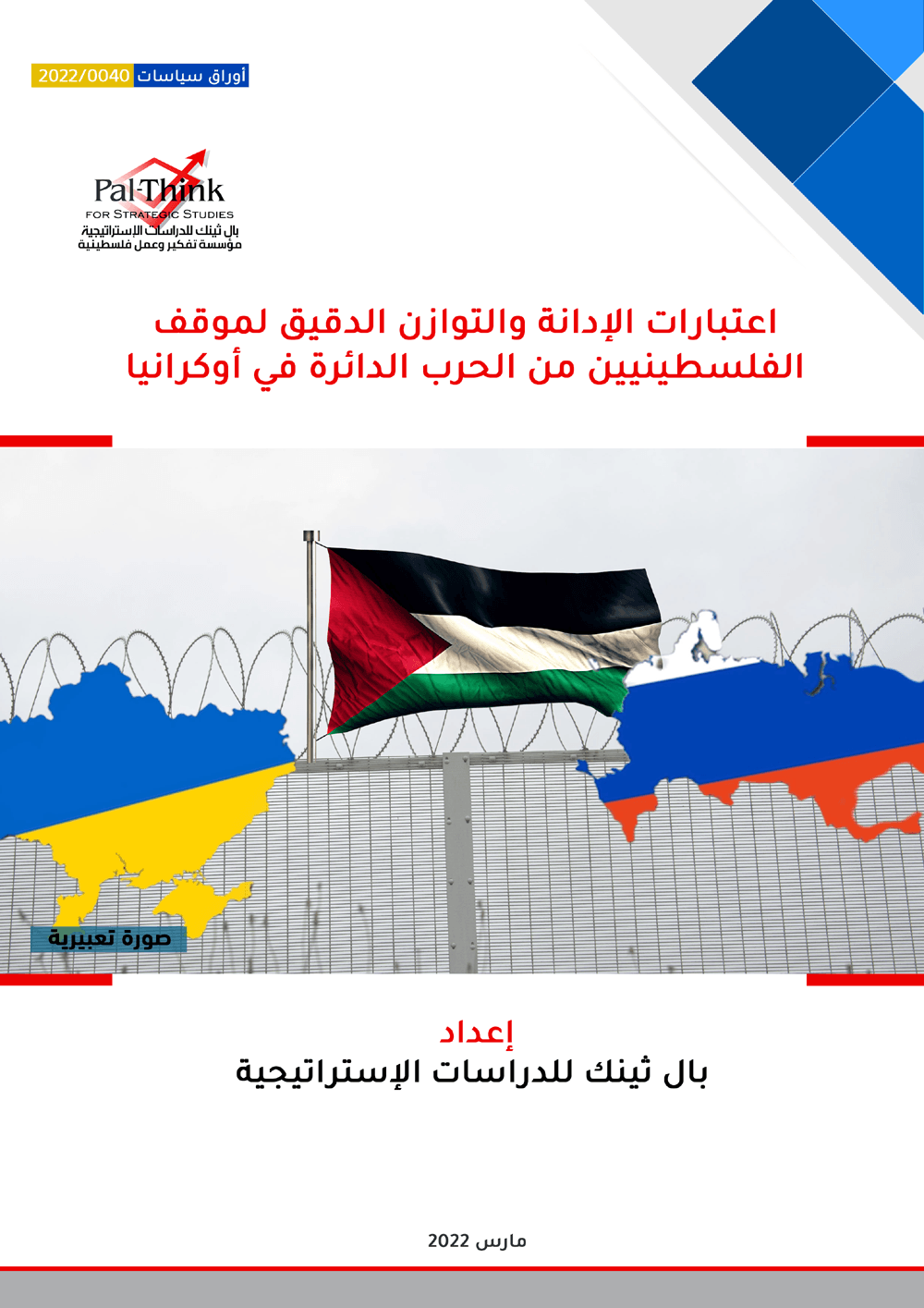 Introduction: After the first shock of the war subsided and the world largely realised the war would not spill beyond Ukraine's borders, Russia signalled that it might content itself with the minimum objectives that safeguard its national security — neutralising Ukraine by keeping it out of NATO through negotiations under fire. The growing global anxiety over the war's consequences, whether it continues or stops, cannot be concealed — especially in light of the announced American and Western sanctions.
In this context, aid-dependent states are among the entities most harmed by the current Russian–Ukrainian conflict. The political, security, and economic repercussions of this conflict upon these states are manifold, since their positions will determine their alignments — particularly as these states try to preserve their survival, under political realism, through the standing the international community has accorded them rather than through their own strength; that is, they can hardly survive alone without traditional international support.
The Palestinian leadership remains silent at the diplomatic level. This assessment looks at the consequences of the Russian–Ukrainian conflict for the Palestinian position, as Palestinians come under diplomatic pressure to take a stance on the Russian–Ukrainian crisis. It appears that the possibility of issuing a Palestinian position is determined by the horizon the European Union and the United States may afford the Palestinians — either the necessity of their neutrality, or compelling them to a stance under the imperatives of alignment, depending on how far the wave of war widens beyond Ukraine's borders, and on the possibility of international shifts.