New release: youth policy papers
A new release: Pal-Think launched a book of research papers from a youth perspective, written analytically to the IMRAD methodology, crowning the second year of the Civic Education training programme that prepared 25 young men and women.
- Author
- The editorial team
- Date
- 2022-07-06
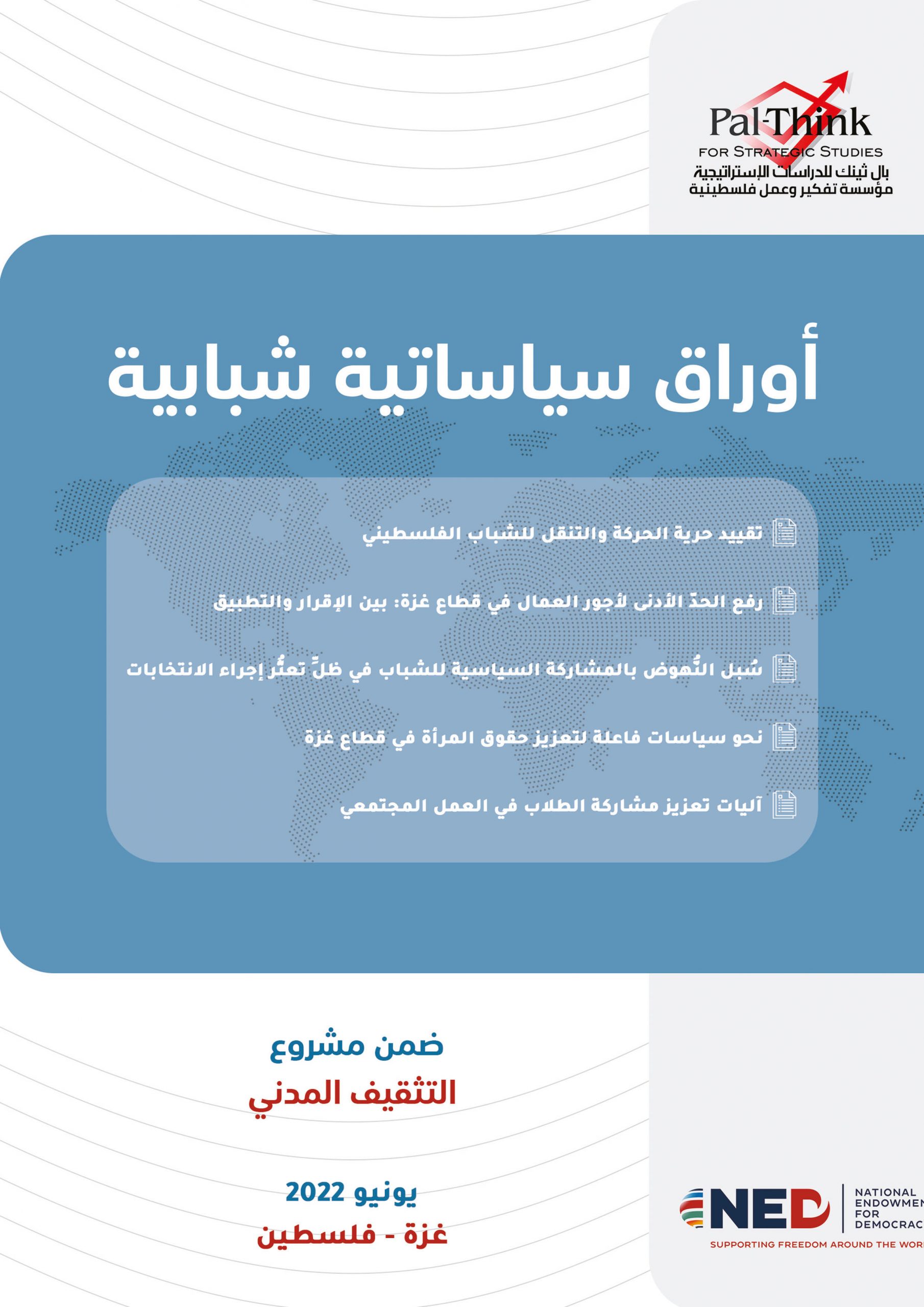 New publication — Pal-Think has launched a new book gathering a set of research papers from a youth perspective, addressing multiple topics, with the aim of strengthening democratic values, justice, human rights, and the concepts of dialogue among the youth of Palestinian society, in an analytical form following the “IMRAD” methodology.
The book crowns the “Civic Education” training programme for the second year running, which targeted (25) young men and women — preparing them methodologically and through training, then sending them out to the community, enabling them to hold awareness meetings and discuss their issues through radio episodes, and finally producing five research papers by the trainees. The papers addressed the following topics:
(The first paper) addressed the restriction of freedom of movement and travel for Palestinian youth, focusing principally on the restrictions imposed on their freedom of movement. International human-rights law guarantees Palestinians freedom of movement and travel like other peoples, securing the minimum of human dignity. The paper documented the reality of freedom of movement in the Palestinian territories, which still faces complications imposed by Israel as an occupying state through restrictions on youth movement, aiming to limit their mobility within the Palestinian territories. The paper also discusses the procedures of movement and travel in light of the Palestinian division, and put forward a set of mechanisms that help ease the restrictions imposed on Palestinian youth's freedom of movement.
(The second paper) examined the decision to raise the minimum wage for workers in the Gaza Strip, and the political authority's pursuit of building a Palestinian economy amid the difficulty of disentangling from dependence on the Israeli economy — which drove the Authority to raise the minimum wage more than once to help workers meet their essential needs amid the general rise in prices. The paper discusses the Authority's decision to raise the minimum wage in a dependent economic reality, suffocating financial crises, and political complications, set against low workers' wages, especially in the Gaza Strip, and severe price inflation. Against all that, the paper put forward a set of mechanisms for activating the minimum-wage decision in Gaza, notably improving the economic structures and supporting local produce.
The third paper took up the ways of advancing youth political participation amid the faltering of elections. Political participation is one of the means by which young people express their aspirations and their desire to work in the service of their community — especially in the Palestinian reality, which faces challenges standing in the way of the advance of Palestinian youth participation in political and social life. The postponement or suspension of elections is perhaps the foremost of those challenges, together with the Palestinian division, whose first victims were the young — deepening their suffering and weakening their political participation in society and in union work. In those contexts, this paper examines the possibilities and the path of advancing the political participation of Palestinian youth and how to activate their energies.
(The fourth paper) examined a set of policies that could strengthen women's rights in the Gaza Strip — the most marginalised of energies, who to this day do not enjoy the same rights as men, as the UN reports have noted, calling for their role and standing to be strengthened. At the local level, many Palestinian laws and decisions have called for supporting and empowering women, such as raising the “women's quota” to 30% — and though that is not just, Palestinian women have not yet even reached that share; which points to a genuine crisis in the representation of Palestinian women in political, social, and economic life. And where women are represented and participate, that participation tends to be nominal, not real as it should be. It was therefore necessary to examine policies that strengthen and support women's participation across all Palestinian fields and frameworks — for women are one of the principal components of Palestinian society.
(The fifth paper) discussed the mechanisms of strengthening student participation in community work, especially in the universities, which are supposed to be at the forefront of engaging youth in community work — yet their attention to involving young people in community activities, especially extracurricular ones, has lately receded. The paper proposed working mechanisms that raise the capacity of higher-education institutions to strengthen students' community participation.
Pal-Think for Strategic Studies is pleased to present the new youth publication at the link (Arabic)