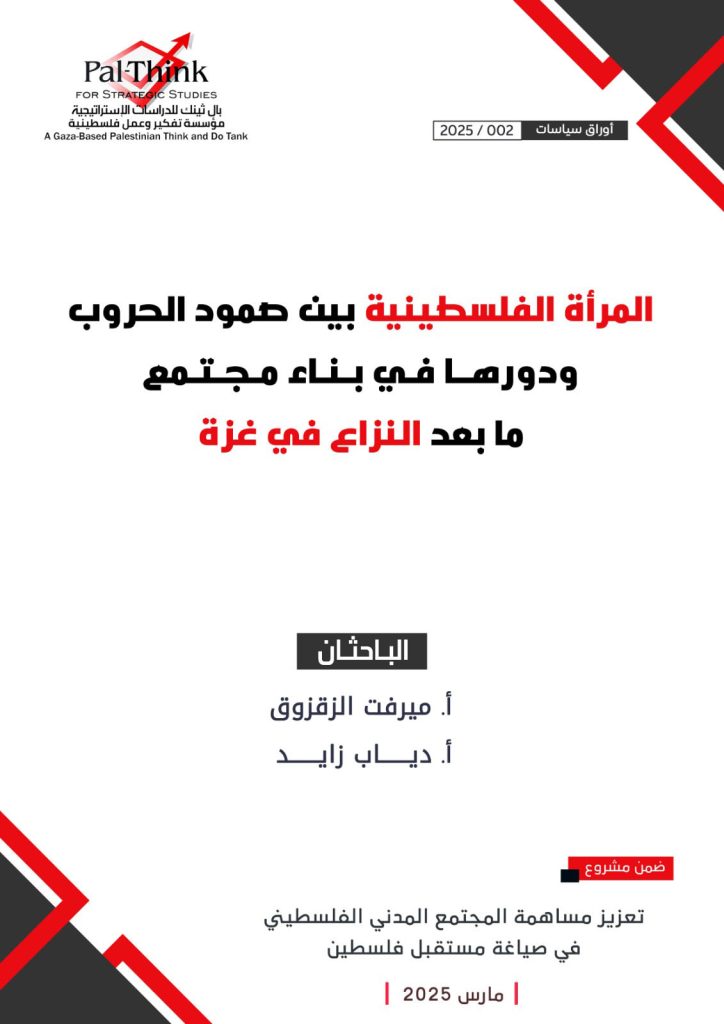
Policy paper: Palestinian women between wartime resilience and their role in building Gaza's post-conflict society
Women make up 49% of the population according to the Palestinian Central Bureau of Statistics, yet their share of public life remains far below their numbers: only 19% of the labour market in 2023, and far less in decision-making positions.
- Author
- The editorial team
- Date
- 2025-04-07
Women form 49% of the total population according to the reports of the Palestinian Central Bureau of Statistics, yet their contribution to public life remains far below their share of society. Women made up 19% of the labour market in 2023, according to the Bureau's reports. In decision-making centres, women's participation remains low — among the lowest rates in the region — despite being one of the most important indicators of gender equality: data for 2021 showed that women constituted about 23% of the members of the Central Council, 19% of the National Council, and 12% of the cabinet. One woman holds the post of governor out of 15 governors, and 1% of the heads of local authorities in Palestine are women. In the boards of the chambers of commerce, industry, and agriculture, women reached only 1%; women judges stand at about 19%, and women members of the public prosecution at 18%. These figures reflect a marked exclusion of women from public life, which harms their standing, deepens gender-inequality gaps, and at the same time deprives society of women's capacities and their contribution to public life. This will inevitably affect society's development and feed internal conflicts, especially the gender conflict. The exclusion of women in Palestine amounts to a social tendency to keep them away from significant public positions in the economy and politics, to prevent them from voicing opinions, and to limit their public presence. And despite the vital role women play in crises — such as their steadfastness through the recent war on the Gaza Strip, in which every type of munition was used, including those internationally prohibited, coming after years of blockade imposed on Palestinian men and women that deepened the suffering — the general tendency remains one of excluding women.
Download the paper (Arabic): click here