The economy of shared opportunity: shaping a united future for Jerusalem, Gaza and the West Bank
The Palestinian economy is a cornerstone of national unity and sustainable development, yet it faces complex challenges from Israeli restrictions and the internal division — leaving it fragile, aid-dependent, and marked by deep gaps between the West Bank, Gaza and East Jerusalem.
- Author
- The editorial team
- Date
- 2025-04-09
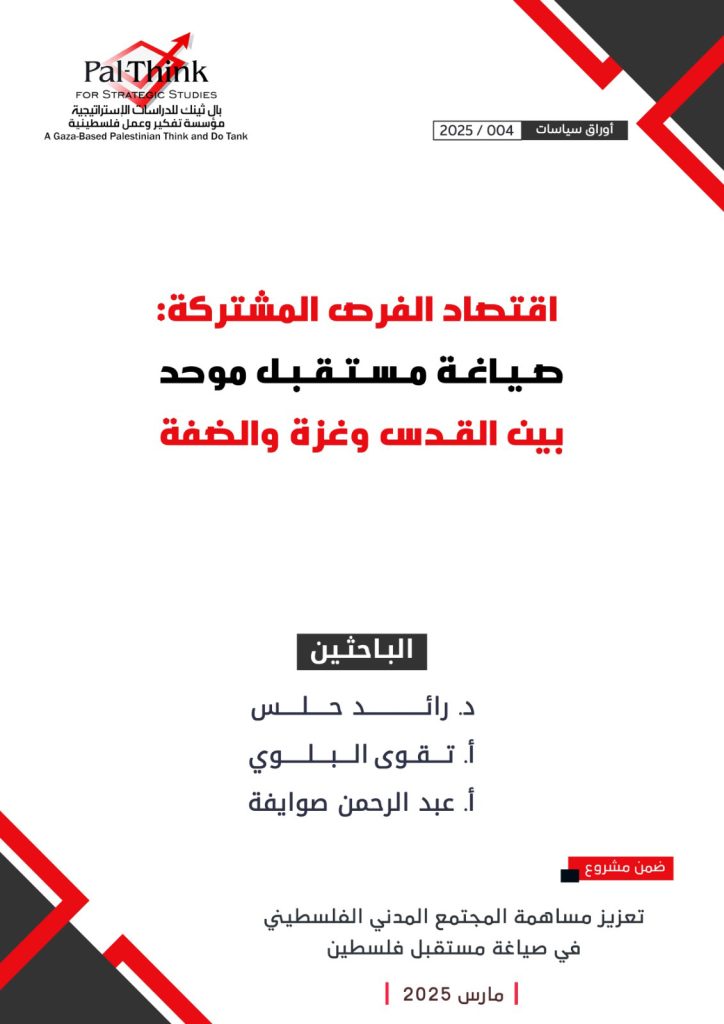
The Palestinian economy is a fundamental pillar for strengthening national unity and achieving sustainable development, yet it faces complex challenges from Israeli restrictions and the internal division, which have left it fragile and dependent on external aid. The Palestinian territories suffer economic gaps between the West Bank, the Gaza Strip, and East Jerusalem, produced by political and geographic restrictions, Israeli violations, and the blockade imposed on Gaza, alongside weak infrastructure and the internal division — all obstructing stability and growth.
This paper seeks to answer a central problem: how to achieve effective economic coordination that guarantees a fair distribution of resources and opportunities, and to examine the policies and reforms required to strengthen economic integration despite the challenges, in addition to leveraging international support and attracting investment to achieve sustainable development.
The paper aims to narrow the economic gaps between the Palestinian regions by strengthening economic coordination, to propose practical reforms confronting the restrictions of occupation and division, to develop strategies for attracting investment and leveraging international support, and to offer policies that limit the effect of Israeli policies and strengthen the resilience of the Palestinian economy.
The paper follows a participatory-research methodology and descriptive analysis of the economic indicators, through interviews with economists and a round-table discussion to evaluate the findings and propose policies, using a purposive expert sample and thematic analysis of the qualitative data.
Download the paper (Arabic): click here