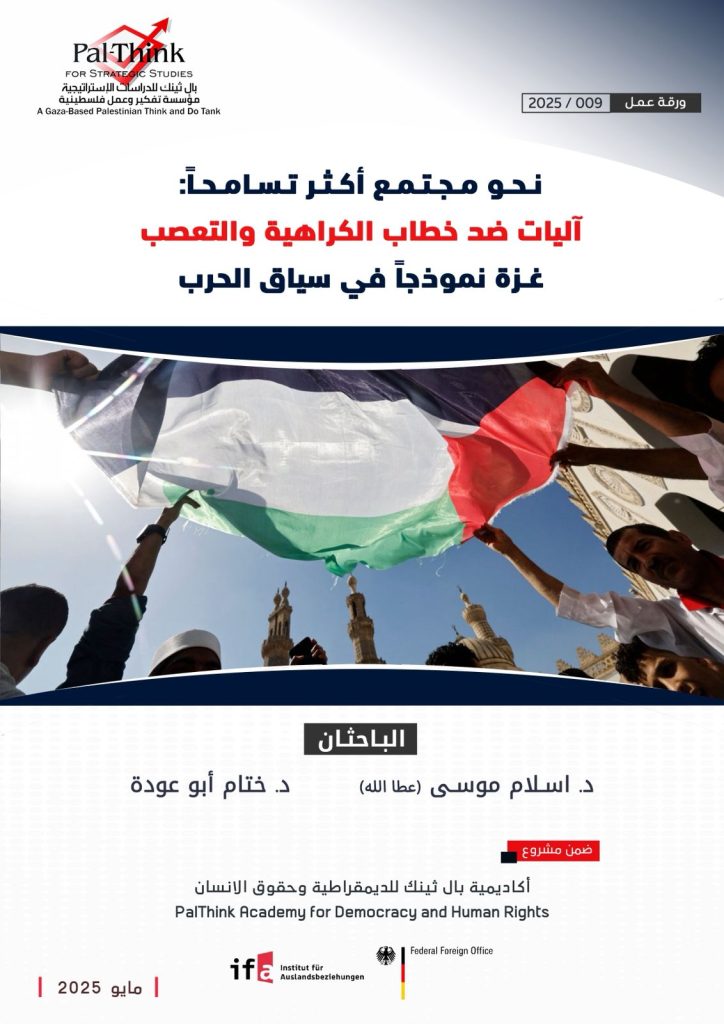
Working paper: Towards a more tolerant society — mechanisms against hate speech and bigotry, Gaza as a wartime case
In wars and catastrophes, destruction is not limited to material and human losses: it reaches into society's moral and social structure, breeding new tensions and multiplying negative tendencies.
- Author
- The editorial team
- Date
- 2025-06-15
Introduction:
In times of war and disaster, the effects of destruction are not limited to material and human losses; they extend to the moral and social structure of society, generating new forms of tension, multiplying latent negative tendencies, and inciting divisions that may persist for decades after the guns fall silent. Hate speech and intolerance are among the foremost threats facing the Palestinian social fabric in times of crisis, and their presence has escalated sharply during the continuing Israeli war on the Gaza Strip. Amid the vast destruction, the legal vacuum, mass displacement, the loss of security, and exclusion and symbolic and moral violence, hate speech feeds on feelings of anger and despair and finds fertile ground in an environment socially and politically exhausted. The danger of this discourse lies in the fact that it does not merely express a passing tension: it reproduces structural divisions and deepens social fractures along familial, regional, or political lines.
Within the Palestinian context, hate speech cannot be separated from the general structure of the long conflict — whether with the occupation or internally among the components of society. Palestinians themselves, despite their collective suffering, have for years faced mounting challenges of weakened social cohesion, divided political authority, and eroding trust between citizens and their institutions. As the war on Gaza intensified and the humanitarian tragedy multiplied, discourses of accusation, treason-branding, and exclusion appeared — on the basis of political affiliation, family origins, geography (between those displaced from the north of the Strip and those settled in the south), or even economic and social standing — revealing a latent crisis in the cultural and social structure that goes beyond the effect of the war itself.

Download the paper (Arabic): click here