With Friedrich Ebert Stiftung, Pal-Think holds the third dialogue of «Enriching the Political Debate»
Pal-Think and the Friedrich Ebert Foundation held the third dialogue session of «Enriching the political debate» at the Grand Palace Hotel, presenting two papers — on the new American administration and on the effects of international funding.
- Author
- The editorial team
- Date
- 2009-06-19
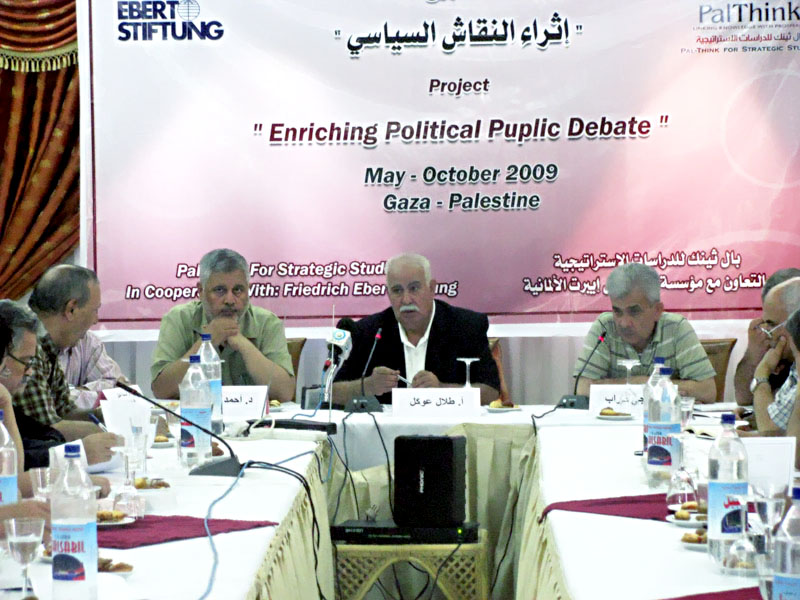
Gaza – Saturday 11/7/2009 – Pal-Think for Strategic Studies, in cooperation with the German Friedrich Ebert foundation, organised at the Grand Palace Hotel the third dialogue session within the project “Enriching political discussion”, attended by a select group of economists, politicians, researchers, intellectuals and interested parties. The session dealt with the presentation of two working papers, “The new American administration and the chances of achieving peace in the Middle East” and “Turkey .. a new role for an old player”, and the meeting was moderated by the political analyst Mr Talal Okal.
The session opened with an address by Mr Omar Shaban, head of Pal-Think for Strategic Studies, in which he spoke of the necessity of activating the role of reason in discussing essential issues, pointing to Pal-Think's role in discussing issues and putting them forward in different ways aimed at deepening and conveying the messages to decision-makers. Shaban stressed the importance of transcending internal Palestinian disputes and advancing with a unified position on regional and international changes, and warned of the danger of the internal Palestinian division to the chance of recovering Palestinian rights or even negotiating over them amid the state of Palestinian division.
For his part, Dr Osama Antar, director of the Friedrich Ebert foundation in the Gaza Strip, addressed the role of research centres in producing essential ideas and discussing them in depth, stressing the necessity of implementing the recommendations, otherwise they will remain on paper as others do.
As for Dr Naji Sharab, professor of political science at al-Azhar University, he presented the first paper entitled “The new American administration and the chances of achieving peace in the Middle East”, in which he pointed to the political significance of President Obama's victory and affirmed that American policy plays a decisive role in determining the direction of the course of political events and its role with regard to the peace process in the region and settling the Arab–Israeli conflict.
He went on to mention the priorities of American policy, which are represented in securing the arrival of Arab oil without threat or obstacle, preventing the growth of a regional power that could threaten this goal, and guaranteeing Israel's security and survival.
Sharab mentioned the prospects for peace under the new American administration, which are represented in wider participation by the American administration and a balance in political positions, and direct pressure on Israel to abide by the two-state solution and halt settlement.
In the second paper, presented by Dr Ahmed Yousef, undersecretary of the Ministry of Foreign Affairs and former adviser to Prime Minister Ismail Haniyeh, which was entitled “Turkey .. a new role for an old player”, he affirmed that the cadres and leaderships of the Justice and Development Party represent an ambitious Turkish generation from which qualitative leaps in Turkey's regional role are expected.
Yousef pointed out that everyone at this time faces a new strategic vision resting, at the level of internal policy, on raising the level of democracy, and at the external level on a drive to formulate an equation in foreign policy that qualifies it in the near and medium term to play more effective roles at the level of the international political system.
Yousef added that Turkey today is working with all its strength to settle the file of its historical crises and enmities with some of the countries surrounding and neighbouring it, and to rid itself of all the manifestations of its isolation and achieve communication with its European and Western dimensions.