Pal-Think closes «Enriching the Political Debate» with Gaza's reconstruction and the interplay of Hamas the movement and Hamas the government
Pal-Think and the Friedrich Ebert Foundation held the closing workshop of the «Enriching the political debate» project at Gaza's Museum Hotel, with dozens of academics, intellectuals, researchers and civil-society representatives.
- Author
- The editorial team
- Date
- 2009-08-19
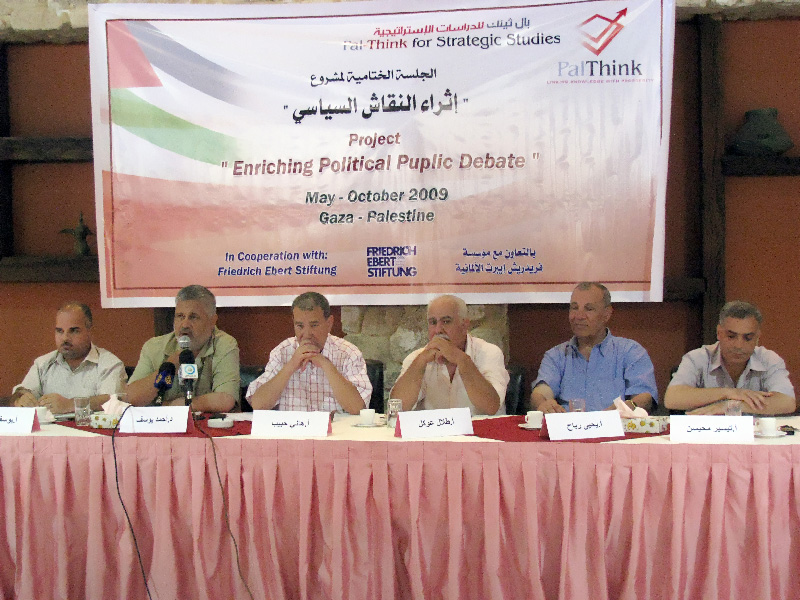
Gaza – Saturday 1/8/2009 – Pal-Think for Strategic Studies, in cooperation with the German Friedrich Ebert foundation, held a closing workshop for the project “Enriching political discussion”, held in the hall of the Museum Hotel in Gaza City, attended by dozens of academics, intellectuals, researchers and representatives of civil institutions and civil society. This project began in the month of May and aims to strengthen public discussion of essential issues that concern Palestinian society and the region and to contribute to the efforts made to achieve a sustainable national reconciliation. The closing workshop included two dialogue sessions: the first, moderated by the writer Hani Habib, in which the writer and political analyst Talal Okal presented an outline of the project in addition to a summary of two working papers that had been presented at previous workshops entitled “The presidential and legislative elections 2010” by Dr Ibrahim Abrash and “The new American administration and the chances of achieving peace in the Middle East” by Dr Naji Sharab, since they were unable to attend. The researchers participating in the project also presented summaries of their working papers, as the political analyst Yahya Rabah presented a paper entitled “Between Hamas and Fatah .. the prospects for the emergence of a third current”, and Dr Ahmed Yousef discussed a paper of his entitled “Turkey .. a new role for an old player?”; the researcher and analyst Taysir Muhaisen also presented a paper entitled “The new Israeli government .. is there still a chance for peace”, and a paper entitled “The effect of international funding on the Palestinians” was presented by Mr Yusuf Shaath.
The second session, moderated by Ms Asmaa al-Ghoul, also included the presentation of a working paper entitled “The reconstruction of Gaza .. a deepening of the division or a mending of the rift”, presented by the development researcher Mr Mazen al-Ajla, in which he pointed out that the reconstruction process has contributed to deepening the division rather than treating it, since the Palestinian Authority has come to have its own conditions for the course of the reconstruction process, and likewise the dismissed government has set its conditions, and thus a dispute has emerged over the body that will carry out the reconstruction. Al-Ajla also added that the international and regional political conditions have led to the freezing of the reconstruction process, and stressed the necessity of putting in place a comprehensive plan that guarantees the interests of the Palestinian people and of not allowing the interference of any other external party in the reconstruction process.
As for the member of the Legislative Council Huda Naim, she explained through a working paper she presented entitled “Hamas the movement and Hamas the government: the mutual influence”, on behalf of Dr Ghazi Hamad who had excused himself from attending, that the subject of reconciliation is a strategic and important matter for the Hamas movement and that the movement is behind every step to strengthen reconciliation, pointing out that there is integrated and high-level coordination between the government and the movement and that the government is the implementation of programmes drawn up by the movement.
For his part, Mr Omar Shaban, head of Pal-Think, thanked, in an evaluative session at the end of the workshop, those present and the researchers participating in the project, and affirmed Pal-Think's role as a centre for intellectual discussion through its addressing of sensitive and bold subjects that no one had dared to discuss, and that the project “Enriching political discussion” succeeded in establishing Pal-Think's philosophy of discussing the future, pointing out that the state of intellectual stagnation that has afflicted the Palestinian people recently must be shaken off.
For his part, Dr Osama Antar, director of Friedrich Ebert programmes, thanked everyone and all those who contributed to the project, and affirmed the important role played by research centres as intellectual factories for formulating public policies and influencing the course of events.