At Pal-Think's conference on rebuilding Gaza: reconstruction must not be politicised, and an independent committee should oversee it
Rain did not stop dozens of academics, specialists and civil-society activists from joining Pal-Think's Gaza reconstruction conference — «Two years after Sharm El-Sheikh: the reconstruction of Gaza has not yet begun».
- Author
- The editorial team
- Date
- 2011-04-04
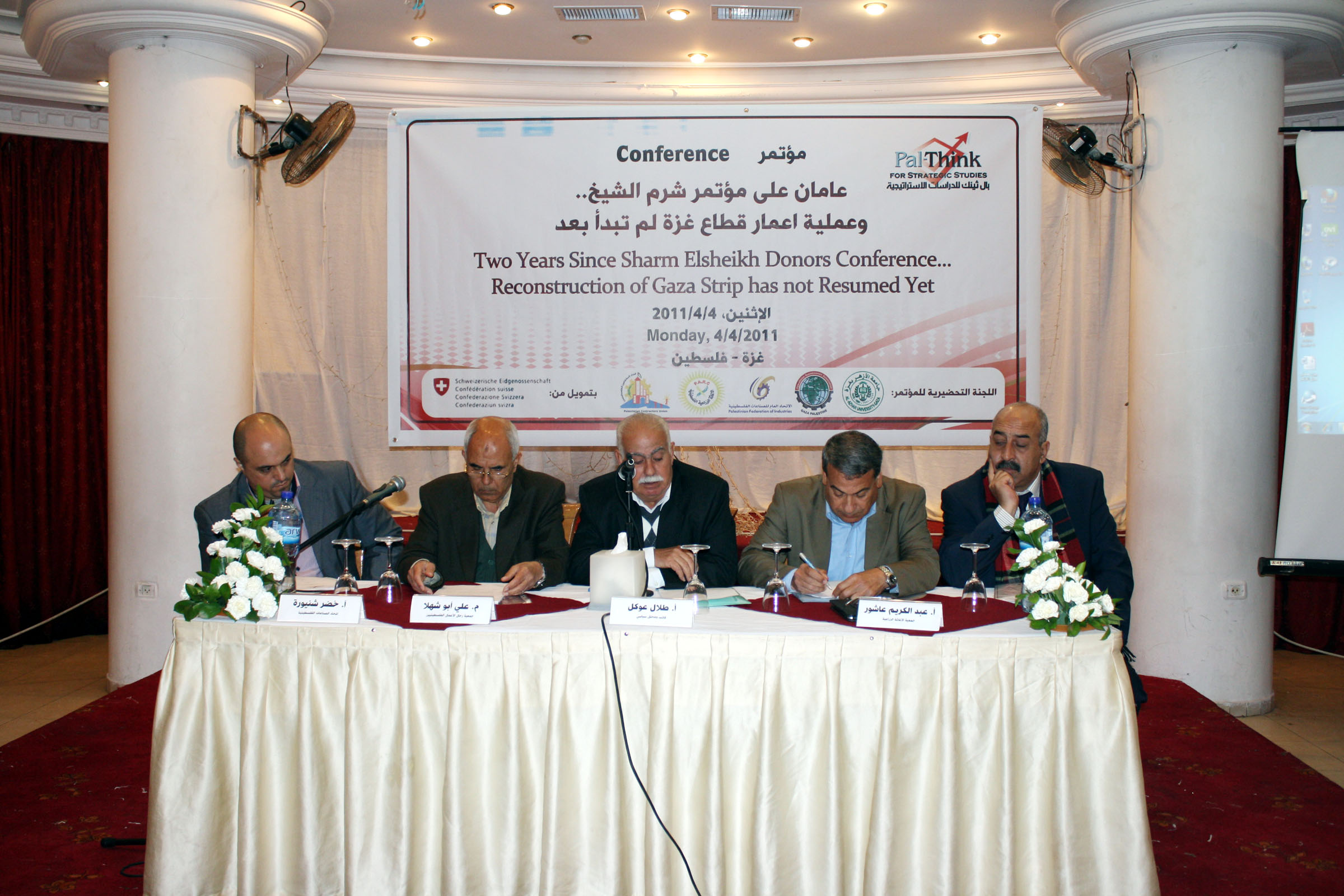
Monday – 4 April – Gaza – The rainy weather that took Gaza City by surprise yesterday, Monday, did not prevent dozens of academics, specialists and civil-society activists from taking part in the Gaza reconstruction conference organised by Pal-Think for Strategic Studies. The conference came under the title “Two years since the Sharm el-Sheikh conference.. the process of reconstructing the Gaza Strip has not yet begun” and with the aim of discussing the issue of reconstructing the Gaza Strip and the international promises relating to reconstruction.
The conference, attended by more than a hundred people from among representatives of the sectors and of civil and local institutions, comes within the project “Strengthening community partnership for national reconciliation”, funded by the Swiss government. The conference shed light on the needs of the various production sectors for reconstruction, as well as reviewing and assessing the international and local governmental and non-governmental efforts at reconstruction since they began in the wake of the Sharm el-Sheikh donors' conference held on the second of March 2009. The calls during the conference focused on not politicising the reconstruction process and on forming an independent central body to supervise it.
The conference's preparatory committee included important Palestinian bodies and institutions including al-Azhar University in Gaza, the Palestinian Businessmen's Association, the Palestinian Contractors' Union, the Agricultural Relief Association and the Federation of Palestinian Industries,
The conference was opened by Omar Shaban, director of Pal-Think for Strategic Studies, who welcomed those present and valued the efforts of the preparatory committee in preparing the working papers and organising the conference. He stressed the importance of holding this conference two years after the Sharm el-Sheikh conference for reconstruction, and stressed the necessity of following up the efforts made for reconstruction, assessing them and the extent to which the conference's recommendations have been achieved.
The first session: the needs of the various reconstruction sectors
In the conference's first session, moderated by Talal Okal, researcher and political analyst, the session dealt with the needs of the reconstruction sectors, with four working papers presented dealing with the needs of the industrial, agricultural, business, infrastructure and housing sectors.
Mr Khader Shneiwra, director of the office of the Federation of Palestinian Industries, presented the needs of the industrial sector for reconstruction and offered an analysis of the damage and its consequences for the industrial sector, and also reviewed the most important programmes implemented by the General Federation of Industries and an assessment of their performance. Shneiwra recommended giving priority to settling the debts of the industrial sector in Gaza owed by the National Authority, and the necessity of programmes to support labour in the factories, hone skills and strengthen the retention of labour within the industrial workforce, in addition to formulating and activating new economic agreements that would encourage investment and support Palestinian industry.
This was followed by a working paper dealing with the needs of the contracting sector for reconstruction, presented by Mr Ayman Juma on behalf of the head of the Palestinian Contractors' Union, in which he set out the requirements for the success of the reconstruction process, among them establishing a governmental fund or governmental sponsorship to grant soft loans to contractors without bank interest, and improving the funding conditions of the donor countries by their not making it a condition that projects be implemented by their local companies only. Juma also reviewed the Gaza governorates' needs for housing units and facilities and the investment needs for the coming ten years, in addition to success stories in housing projects.
For his part, Mr Ali Abu Shahla, secretary of the Palestinian Businessmen's Association, presented a working paper dealing with the needs of the business sector for reconstruction, in which Abu Shahla mentioned that homes and buildings cannot be reconstructed before reconstructing the factories that supply them with concrete and materials. Abu Shahla said that there are international institutions that deal with reconstruction in a partisan manner, as it recently became clear that they provide assistance to the affected residents according to their political affiliations. In the course of his remarks on the mechanism for reconstructing the destroyed homes, Abu Shahla proposed that the necessary financial support be provided to each owner of a building destroyed during the war on Gaza, leaving him free to carry out the work in accordance with plans, controls and standards set by the reconstruction authority. Abu Shahla noted that the government should not have removed the rubble of the destroyed buildings before allowing the crossings to reopen, given what this rubble represented as a genuine and real witness to the ferocity of the war on Gaza. He also noted that the process of bringing various goods in through the tunnels in Rafah contributed to easing international pressure on the Israeli government to open the crossings. In conclusion, Abu Shahla recommended the necessity of forming an independent body agreed upon in Gaza and the West Bank for the reconstruction of Gaza.
For his part, Mr Abdel Karim Ashour, deputy head of the Agricultural Relief Association, presented a working paper dealing with the needs of the agricultural sector for reconstruction, in which he referred to the direct damage inflicted on the agricultural sector as a result of the Israeli aggression on Gaza. He mentioned that the internal Palestinian situation is one of the most important obstacles impeding the reconstruction process, since the Palestinian division prevents the donor countries from pumping their funds into the sector, in addition to the fact that the agricultural sector has a special character since it is linked to two essential elements, land and water, over which there has been a dispute with Israel for years. He also noted that the agricultural sector, unlike the other sectors, has not been given funding, and called for giving attention to the subject of food security and combating poverty. Ashour recommended the necessity of forming a supreme national committee to supervise the processes of agricultural reconstruction, and of adopting a new agricultural policy in the Gaza Strip that takes into account the political, economic and social developments in addition to the other structural determinants.
The second session: international and local efforts for reconstruction
The conference's second session, moderated by Mr Marwan al-Agha, dean of the faculty of economics and administrative sciences at al-Azhar University, dealt with a summary of the Sharm el-Sheikh conference and its recommendations and two working papers reviewing the international and local reconstruction programmes.
Omar Shaban, director of Pal-Think for Strategic Studies, presented a summary of the Sharm el-Sheikh conference, its recommendations and the sums promised, and pointed out that most of the Sharm el-Sheikh funding was Arab funding and that there is a confusion between the funds earmarked to support the Palestinian people, between the Authority's budget and support for the reconstruction of Gaza. Shaban also explained that one of the errors of the Sharm el-Sheikh conference was that it did not prepare a clear mechanism for reconstruction, and he called for there to be an independent body to supervise the reconstruction process.
For his part, Mr Moin Rajab, “part-time” professor of economics at al-Azhar University, reviewed the local efforts made for building works and reconstruction in the Gaza Strip, referring to emergency plans, relief aid, and repair and maintenance works for a large number of homes and facilities. Rajab recommended giving priority to mobilising all the efforts of local institutions to participate in reconstruction with greater participation by the syndicates and professional unions, while giving great importance to an updated central information unit and giving sufficient attention to the technical human element, and striving urgently for the success of reconciliation efforts and an end to the Palestinian division.
In the same context, Mr Muhammad Miqdad, associate professor of economics at the Islamic University, spoke about the international governmental and non-governmental programmes for reconstruction, noting the conferences and summits held with the aim of organising efforts and funding the process of reconstructing Gaza and raising up its economy. He said that those efforts and promises were theoretical and have so far remained far from implementation, hostage to political conditions and considerations and hostage to Israeli acceptance, which still besieges Gaza and prevents the entry of building materials and the requirements of reconstruction. Miqdad pointed out that the Israeli decision to ease the blockade contributed to making many food goods available, but the main materials needed for reconstruction have not entered and have not been permitted so far. Miqdad recommended the necessity of reconstructing the Palestinian economy entirely and not limiting matters to the reconstruction of buildings, as well as filing legal suits against the Israeli measures that increase the scale of the crisis in the Gaza Strip.
The interventions:
Mamoun Abu Shahla, secretary of the coordinating council of private-sector institutions, said in an intervention of his that the reconstruction of Gaza will not be accomplished by collecting donors' funds only; rather what is more important is that the crossings be opened so that these funds may be made use of and employed in reconstruction. He also called for the international bodies to participate in an independent reconstruction authority, and for there to be financial bodies that provide the funds through sound legal channels.
In his remarks on the energy sector, the engineer Suhail Skaik, director general of the Gaza Governorates Electricity Distribution Company, noted that Gaza's current energy crisis has exceeded 30%, and that the Strip's need for energy in a normal situation is 280 megawatts, while Israel allows the entry of only 90 megawatts. He pointed out that there is a project to connect Gaza's electricity with Egypt and that its implementation may need two years, but that it faces political obstacles, as the Egyptian government previously made its approval of beginning the implementation of this project conditional on signing the Egyptian paper for reconciliation.
The conference's recommendations:
1) Forming an independent body that coordinates and cooperates with the funding bodies to put in place a mechanism for supervising and beginning reconstruction.
2) Establishing an independent central information unit that provides the body with precise and updated information and data.
3) Qualifying the human element and raising its competence in all sectors through training and development programmes.
4) Intensifying the efforts pushing towards ending the division and achieving national reconciliation.
5) Opening the Rafah crossing and the other crossings permanently in a way that guarantees the entry of the basic materials for reconstruction into the Strip, and reconstructing, supporting and rehabilitating the Palestinian economy.