At Pal-Think's seminar «International funding for the Palestinians — lessons learned»: funding must serve Palestinians' development and political ambition
Pal-Think held the seminar «International funding for the Palestinians: lessons learned», attended by many Palestinian intellectuals, politicians, economists and civil-society representatives, under the «Community partnership for national reconciliation» project.
- Author
- The editorial team
- Date
- 2011-11-02
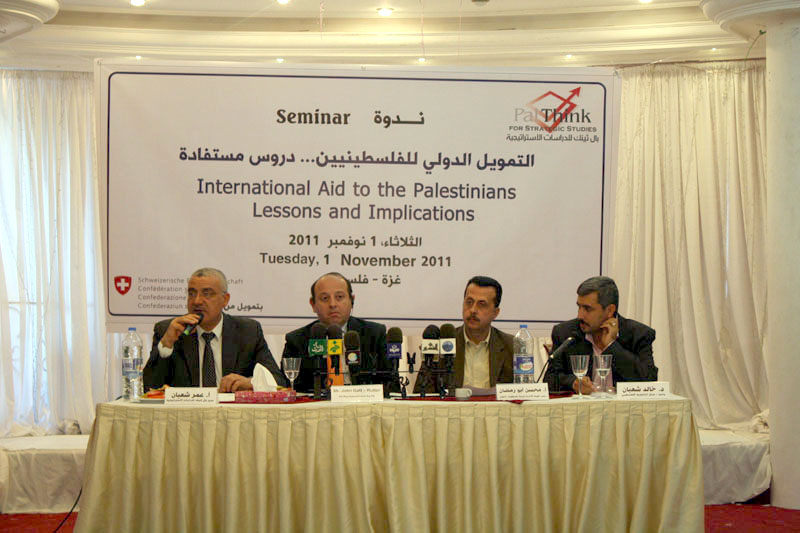
Tuesday 1 November 2011 – Gaza – Pal-Think for Strategic Studies organised a seminar entitled “International funding for the Palestinians… lessons learned”, attended by a large number of Palestinian intellectuals, politicians and economists and representatives of civil-society institutions. This seminar comes within the project “Strengthening community partnership for national reconciliation”, funded by the Swiss government.
The seminar was opened by Mr Omar Shaban, founder and director of Pal-Think for Strategic Studies, who welcomed those present and valued the participation in the seminar of representatives of some international and local institutions, of the European Union and also of the institutions department in the Gaza government. He stressed the importance of understanding and discussing the subject of international funding and its aims, especially in the Palestinian case given the multiplicity of funders and the plurality of aims and agendas, and stressed the necessity that international funding be within a defined and clear strategy and vision.
In the first session Dr Adnan Abu Amer, professor of political science, presented his paper entitled “The significance of regional support for the Gaza Strip: Turkey and Qatar as a model”. He explained that the financial support and economic assistance provided to the Gaza Strip by the regional supporters, particularly Qatar and Turkey, enjoy an ample share of total international and global assistance, showing that this means, on the one hand, that it is an essential and useful gateway for alleviating the effects of the Israeli siege, and on the other a political window for these supporters onto a geographical spot whose significance is not unknown to the eyes of decision-makers in the region.
He stressed the necessity of making room for developing and increasing this assistance in all its various fields and at all levels, in a way that achieves real development in the Gaza Strip and a serious alleviation of the consequences of the siege, pointing to the importance of directing this regional assistance towards other fields and facilities that it did not cover in previous years, so that the range of beneficiaries — whether people, structures or sectors — is broadened.
Dr Abu Amer stressed that the Palestinian economy in Gaza, like its counterpart in the West Bank, depends to a large degree on regional and Islamic assistance, which requires a serious search for ways to reduce it, not out of disdain for it but for fear of relying on it entirely. He added: “If we realise clearly that such assistance may form a prelude to falling into the trap of those who provide it, even if they declare it unconditional in most cases, and out of fear that it will not enter genuine developmental channels of investment within the framework of the Palestinian economy — which requires the decision-makers in Gaza to work to prepare the conditions for the return of emigrated capital, estimated at about 60 billion dollars, to settle it in the mother country and open up national investments”.
In an intervention by Mr Alaa al-Ghalayini, director of the NGO Development Centre in Gaza, he spoke about the centre, its establishment and its work in Palestine, explaining that the NGO Development Centre is a specialised Palestinian centre for delivering support and funding to civil institutions in Palestine. He spoke about the aims of the NGO Development Centre and pointed out that the centre provides many services in the West Bank, the Gaza Strip and Jerusalem, and gave many examples of these services, noting that his institution does not support any project and does not give any grant unless it has a developmental impact, and that it does not implement direct relief projects.
In an address by Mr Ayman Ayesh, representative of the department of institutions and associations at the Ministry of the Interior, he spoke about the reality of international institutions in the Gaza Strip before 2007, pointing out that there are 20 institutions registered with the Ministry of the Interior out of 70 institutions, which means that more than two-thirds of the institutions operate without a permit and approval from the Ministry of the Interior. He explained that after 2007 some institutions closed their doors in the Gaza Strip, and that in 2009 the war on the Gaza Strip made a great difference, as many institutions reopened their doors and with them opened institutions that had not been working before, but without registering or documenting their status, which created a state of confusion and controversy at the Ministry of the Interior.
He explained that the Ministry worked on the necessity of documenting the status of these institutions operating in the Gaza Strip in several stages, and stressed that the Ministry dealt with this issue with great flexibility and held many meetings and gatherings with many of these institutions, pointing out that by the end of January 2010 his ministry had completed the registration of these institutions.
He added that the second stage was documenting the situation of these institutions, because most of them do not submit reports to the Ministry of the Interior and the Ministry has no information about them, and therefore there must be follow-up of these institutions' affairs and work. It was indeed agreed that each institution would submit its annual and financial reports setting out its revenues and expenditures in detail, in implementation of the law and to strengthen transparency in these institutions.
He pointed out that the third stage, which faced many difficulties, is the stage of auditing, since these reports and this information must correspond to reality on the ground. He explained that since the beginning of 2011 reports showing the revenues and expenditures of those institutions have been reaching the government in Gaza, but when the government took steps towards auditing it collided with a group of institutions, foremost among them the American institutions, which led the government to give those institutions 3 months to settle their status and to grasp that they are not above the Palestinian system.
He pointed out that the Arab and Islamic institutions were more understanding of the position and more accepting, clearer and more transparent than the international institutions, adding: “We do not oppose the presence of international institutions, but they must be regulated in a way that serves the national vision with clear transparency, away from directing funding to particular programmes”.
In the second session Dr Khaled Shaban, researcher at the Palestinian Planning Centre, presented a paper entitled “Western funding for the Palestinians: data and results”, in which he stressed the necessity that funding be within a strategic framework so that there is interaction between external and also local funding, working to integrate the ordinary citizen into the activities of the civil organisations, seeking to achieve a kind of institutionalisation in the work of the civil organisations, and that work in these organisations must be according to the Palestinian interest.
Dr Khaled Shaban asked: “Funding must not be an end in itself regardless of the projects that are implemented, so is what is happening in Palestine development or the suppression of development?”, showing that there must be governmental participation so that external funding is not directed towards particular institutions but rather that most associations benefit from it, and that its geographical spread be noticeable so that there is no discrimination between the West Bank and the Gaza Strip, or between towns and villages. He stressed the necessity of making room for the civil organisations to play an important role in influencing the general policies of the Palestinian National Authority, in order to guarantee just, balanced and equitable policies that stimulate the small-business sector.
He stressed the necessity of obliging the foreign funder to align with the general policies of the Palestinian Authority so that Palestinian society is not invaded by Western ideas contrary to the Palestinian national vision, and pointed to the importance of oversight in order to safeguard the funds of the civil organisations and to make sure that the money is spent on projects and programmes. It is clear that the indicators show that the institutions that received financial support have not been subject to mechanisms of accountability and oversight, and the problem is that after all these years no studies on corruption in the Palestinian civil organisations are available.
In an intervention by Mr John Gatt-Rutter, chargé d'affaires of the European Union representative to the Palestinian National Authority, he pointed out that the European Union supports the Palestinians in many fields and that this support includes Gaza and the West Bank. He noted two important matters: the first is that the value of the European Union's contribution reaches a million euros annually despite the financial crisis in Europe; and the second is that the European Union works in partnership with the Palestinian National Authority within the neighbourhood policy between Europe and the Mediterranean countries, whereby the two sides coordinate to determine the form and methodology of the assistance provided by the European Union to the Palestinian National Authority, and therefore any project funded by the European Union is carried out in full and integrated coordination with the Palestinian National Authority. The European Union representative valued the role of Qatar and Turkey in assisting the Palestinian people and pointed out that Qatar and Turkey bear many responsibilities because the European Union cannot bear these responsibilities alone. He also affirmed that the Gaza Strip falls within the European Union's priorities, and Mr John Rutter reviewed the fields of assistance funded by the European Union, which include support for the private sector, the rule of law, infrastructure, education and youth, by way of example and not limitation.
In an address by Mr Muhsin Abu Ramadan, head of the administrative board of the network of civil organisations, he stressed that the issue of funding is linked to political circumstances and pointed to the fluctuation of funding when political relations fluctuate, which confirms the link between funding and political circumstances. He added that international funding is not linked to the priorities and needs of the local community, and that this is due to several reasons, the most important of them the absence of a comprehensive developmental vision for this issue, and the second reason that there is an internationally imposed agenda for this funding.
In his intervention Abu Ramadan referred to the Bisan 2009 report, which indicates that funding for the Authority's institutions and Palestinian society doubled by 200%, which led to an increase in the per-capita share so that the individual's share became higher than in 7 countries of the Third World. The report indicates that this doubling led to an increase in indebtedness and a rise in rates of poverty and unemployment, and did not achieve development and stability.
Recommendations:
– The necessity that international funding be within a defined and clear strategy and vision.
– The necessity that international funding serve human development and the political aspiration of the Palestinians.
– The necessity of a comprehensive developmental vision for international funding.
– The necessity of making room for developing and increasing assistance in all its various fields and at all levels.
– The importance of oversight in order to safeguard the funds of the civil organisations.
– The necessity of obliging the foreign funder to align with the general policies of Palestinian society.
– Obliging the funder to observe the priorities and needs of the local community.
– The necessity of laws that regulate the work of the organisations and facilitate and assist the funding bodies.
.jpg)

.jpg)

The seminar's working papers: https://www.palthink.org/?p=266