Conference: «The blockade on Gaza — assessing the damage and the strategies of response»
At a conference held by Pal-Think with the Heinrich Böll Foundation: the international community must work to lift the blockade of Gaza, whose effects on education, women and the private sector are devastating.
- Author
- The editorial team
- Date
- 2012-10-23
At a conference organised by Pal-Think for Strategic Studies in cooperation with the German Heinrich Böll Foundation:
The international community must work to lift the siege on the Gaza Strip, which is causing devastating effects on the education sector, on women and on the private sector.
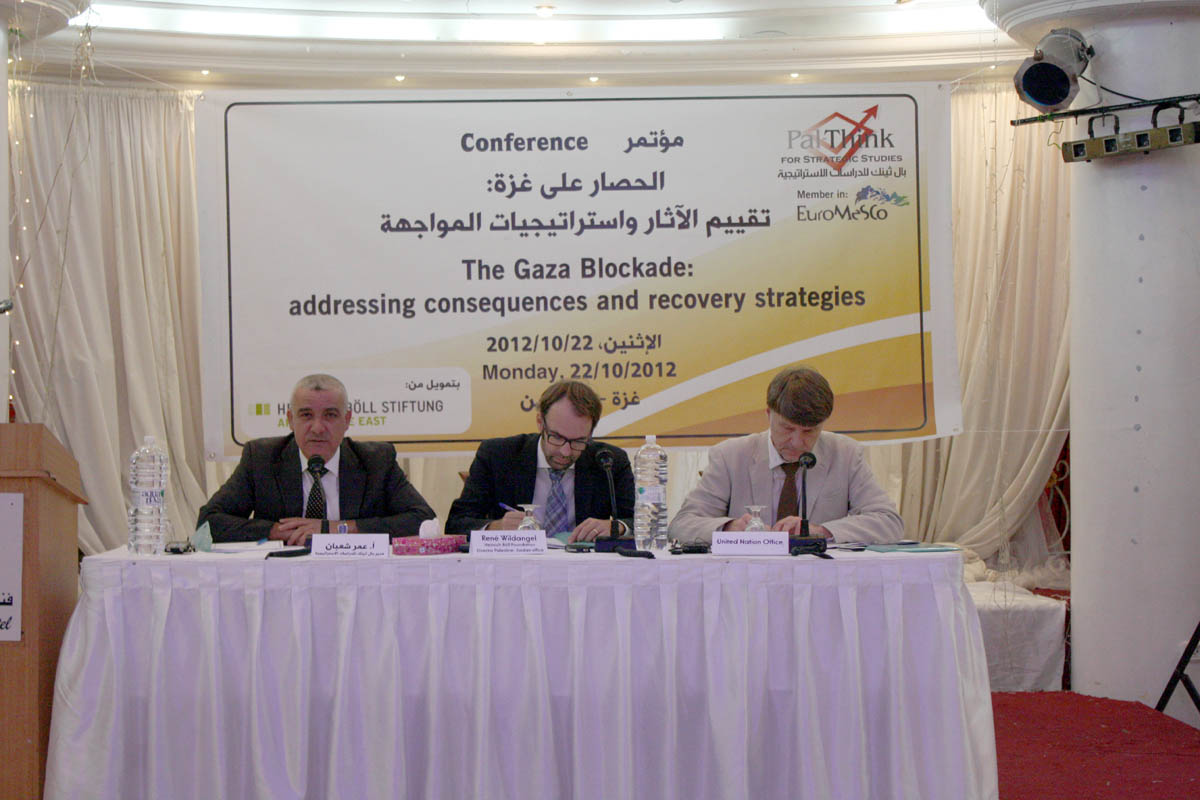
Monday 22/10/2012 – Gaza
In cooperation with the German Heinrich Böll Foundation, Pal-Think for Strategic Studies organised the conference, which was attended by a select group of representatives of civil society, analysts, journalists, academics and representatives of the relevant bodies. The conference aims to examine the future visions and the strategies that may be followed in light of the current economic and political conditions in the Gaza Strip with regard to the higher-education sector, the private sector and women's issues.
Mr Omar Shaban, director of Pal-Think for Strategic Studies, opened the conference, welcoming those present and valuing the attendance of representatives of civil-society institutions, of Mr René Wildangel, director of the German Heinrich Böll Foundation, and of Mr Alexei Maslov, director of the office of the Special Representative of the United Nations in the Palestinian territories. He stressed the importance of shedding light on the aforementioned sectors, especially after more than 6 years of the siege on the Palestinian people. Omar Shaban pointed out that this conference comes as a reminder that the Israeli siege on the Gaza Strip is still in place despite the Israeli government's claims that Gaza is no longer besieged.
Mr René Wildangel spoke about the German Heinrich Böll Foundation, which forms part of the Green political movement that has grown around the world in response to traditional socialist, liberal and conservative policies. He noted its fields of work, namely democracy, the environment, women and international policy, and said that the Middle East office handles projects and programmes in the Palestinian territories, Egypt and Jordan, and that it seeks to contribute with its modest efforts to alleviating the suffering of the Palestinian people and lifting the siege on the Gaza Strip. Mr Wildangel stressed the importance of organising such conferences in order to make the international community aware of what the siege on the Gaza Strip is causing, and of continuing to press Western governments and international institutions to undertake their work to lift the unjust siege.
This was followed by an address from Mr Alexei Maslov, director of the UNESCO office in Gaza and representing Mr Robert Serry, the Special Representative of the UN Secretary-General Ban Ki-moon. Mr Maslov focused on the recently issued United Nations report that speaks about the reality of Gaza in 2020. He pointed out that this document should be taken as a strong advocacy tool in the hands of Palestinian and international institutions to draw attention to the harms of the siege, and also noted that Mr Robert Serry, the UN Special Coordinator in the Palestinian territories, had presented this report at the last session of the Security Council and that the report's statistics and information had shocked many of the members of the Security Council. He announced that an official Arabic version of the report would be issued during the coming few weeks. Maslov pointed out that there are 13 United Nations institutions working in the Strip, including UNRWA, the largest of its institutions in the West Bank and Gaza. These institutions implement projects whose budget approaches 835 million dollars, to which 224 million dollars will soon be added. These sums indicate the enormous volume of the United Nations' work and the great burden it bears.
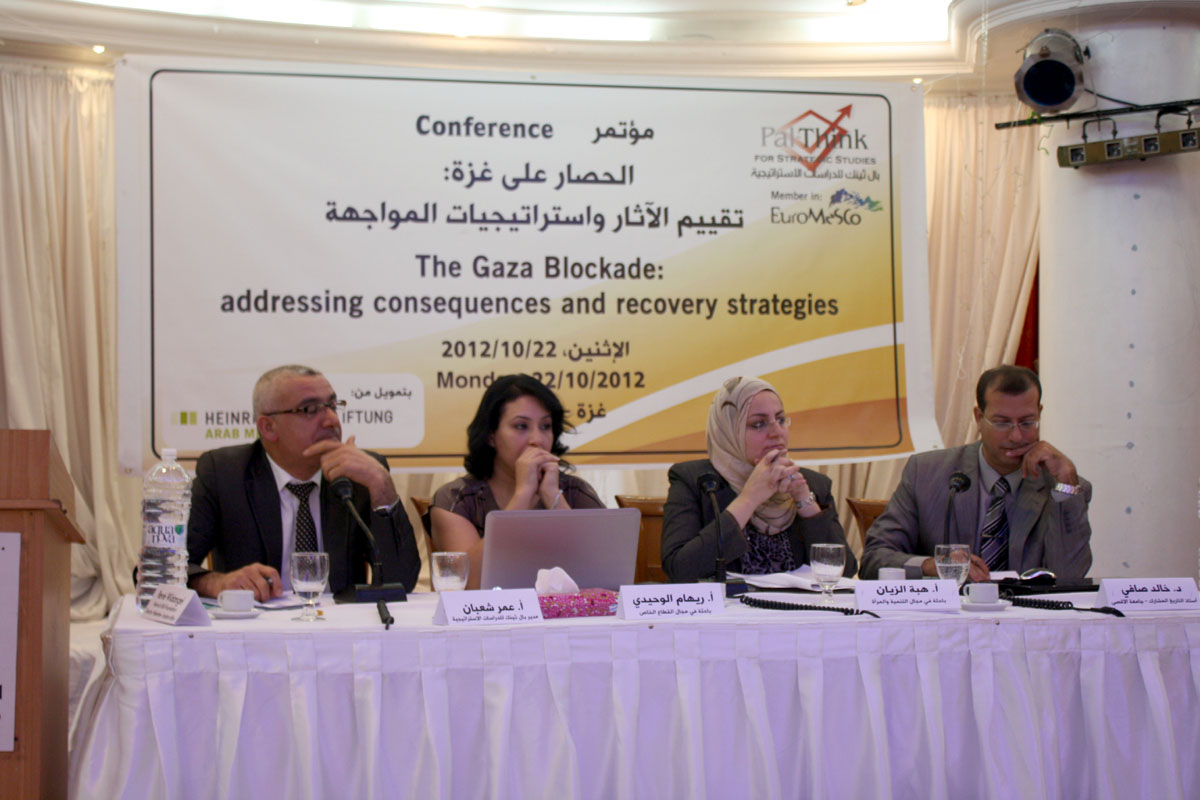
In the main session of the conference three working papers were presented, dealing with the impact of the siege on the higher-education sector, the private sector and women. Dr Khaled Safi, associate professor of history at the Islamic University, presented the effect of the siege on higher-education institutions in the Gaza Strip, speaking about the effect of the siege on the universities and community colleges and their technical readiness, and also addressing the damage they suffered in the wake of the last war on Gaza. The siege contributed to institutions supporting higher-education institutions ceasing to support infrastructure and construction projects because of the difficulty of implementing projects on the ground, which led to a major decline in the development of infrastructure and buildings at these universities. This also contributed to a decline in the universities' budgets and its reflection in the level of their assistance and services to students. He also spoke about the obstruction of the completion of postgraduate studies and of the research activity of students and academics; cultural and academic activities in the Gaza Strip have also declined, whether those carried out by the universities, cultural institutions or public libraries, because of the interruption of communication with the West Bank, Jerusalem and abroad, the scarcity of funding and the decline in general interest. Dr Khaled Safi addressed the reality of the students and the difficulty of movement and travel, the financial and economic repercussions, the weakness of the academic level and the decline of their national and value systems. Safi made several recommendations, among them: providing sufficient support to educational institutions and lifting the restrictions on funding; erecting sufficient buildings at higher-education institutions to address overcrowding in lecture halls; providing suitable infrastructure at the universities including green spaces; strengthening communication between Palestinian higher-education institutions at the national level, as well as communication with Arab, regional and international universities; providing freedom of travel to participate in scientific conferences and seminars at home and abroad; strengthening scientific research; and establishing a suitable infrastructure of traditional and electronic libraries.
Ms Reham al-Wehaidi, chair of the board of Athar International Consulting Company, spoke about the effect of the siege on the private sector in the Gaza Strip. After affirming the deterioration of the condition of the private sector because of the siege on the one hand and the division on the other, she moved to a set of conclusions and recommendations, the most important of them: the necessity of emerging from the state of siege or of political division that obstructs and increases the burden on private-sector institutions; empowering the pivotal private-sector institutions that represent it, because they are the voice that contributes to shaping the economic climate that allows the private sector to develop; as well as the necessity of reviewing employment and unemployment programmes and directing them in a way that serves the interests of the national economy. She called for a unified system that provides incentives and support to the private sector, with a focus on a set of important sectors that have high employment and with their programmes focusing on quality and sustainability. In a response to some queries she mentioned that the closure of the tunnels with Egypt in the first quarter of 2012 led to a 30% drop in the volume of imports, and that the incoming Qatari funding targets the building and construction sector primarily (254 million dollars) and that 62.2% of the tenders are concentrated on construction, and this is not a strategic matter on which sustainability programmes can be built.
Heba al-Zayyan, a researcher in the field of development and women, stressed that the crisis in the Gaza Strip is not a humanitarian one but rather a “crisis of the human being” relating to many issues (rights, freedoms, dignity, a decent life, etc.), and that the problems Gaza faces are essentially developmental problems but are pushed aside to make room for relief programmes and efforts. Al-Zayyan pointed out that women's political participation is not translated on an equal footing with their economic and social participation, and that the importance of women's political participation and their participation in decision-making results in gender equality. Looking at the reality of political participation and representation in the Legislative Council, the rate of women's participation rose from 5.6 in 1996 to 12.9 in 2006; but the women elected in 2006 did not find the framework that would allow them to press for the practice and development of women's issues, because parliamentary legislative work in Gaza stopped after 2006. Likewise, many of the committees that emerged from the stalled “reconciliation” did not include women, among them the committees on women's rights and freedoms. Ms al-Zayyan concluded with many recommendations, among them: reconciliation is an essential element in restarting the wheel of women's political empowerment; there must be a unified vision for women's frameworks and parties and support for second-rank leaderships; as well as translating the UN resolution concerning women into a Palestinian theoretical form, and restructuring the political parties in a way that supports women in a logical manner.
In her remarks on the issue of violence against women, al-Zayyan mentioned that 51% of married women in the Gaza Strip suffer from violence from their husbands, compared with the West Bank where only 29% of married women suffer from violence from their husbands, according to what the Palestinian Central Bureau of Statistics indicates. There is a research link between the high rate of violence against women and the economic and social conditions in those areas, but this is not a conditional link, for not every poor family or person is violent; likewise Gazan families have become very pliable, finding alternatives for everything, and each party, whether the man or the woman, expects the other party to take on the burdens. .04% of women go to protection and support centres and 66% keep silent. In this context al-Zayyan recommended supporting the institutions that work on the principle of sheltering and protecting women, the continuation of the efforts of civil society and educational institutions in combating violence, and starting from the basic stage (the stage of formation). She also addressed the economic empowerment of women and explained that the market in Gaza is gendered and needs women more than men, and that there is still a gap between women's economic role and their obtaining of their economic rights (access to resources and sources), and that they still lack loans and small projects. Finally she recommended the necessity of economic-empowerment programmes that take account of the woman as a human being and not of her economic situation in itself.
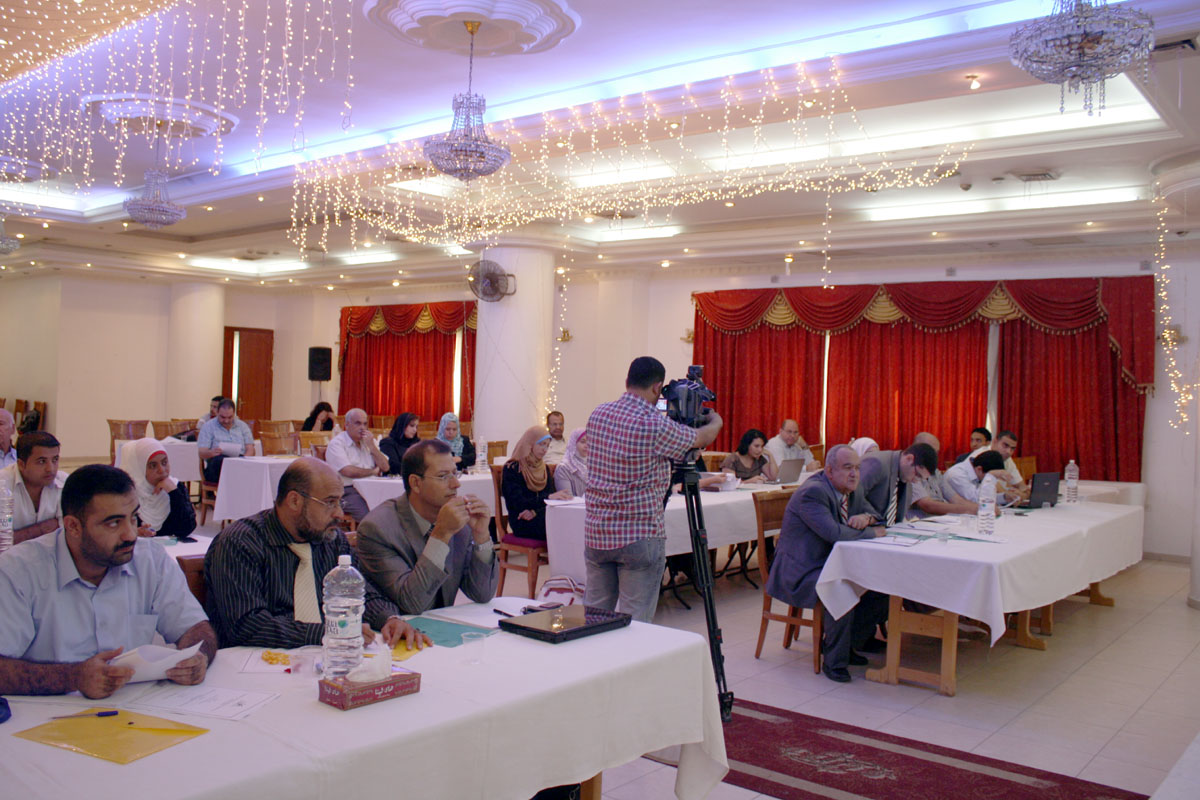
The conference witnessed a heavy attendance of representatives of civil society, academia, the business sector and the media, and valuable interventions and comments were made by the audience.
It is worth mentioning that Pal-Think for Strategic Studies is a Palestinian intellectual institution registered in Gaza in March 2007, working in the field of promoting scientific discussion and systematic thinking on strategic issues of concern to Palestinian and regional affairs.
To view the summaries of the working papers: https://www.palthink.org/?p=248
To view the English version: https://www.palthink.org/en/?p=745