Backed by Likud, the right dominates the Israeli political scene
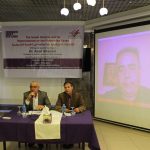
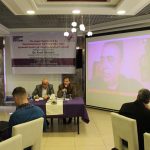
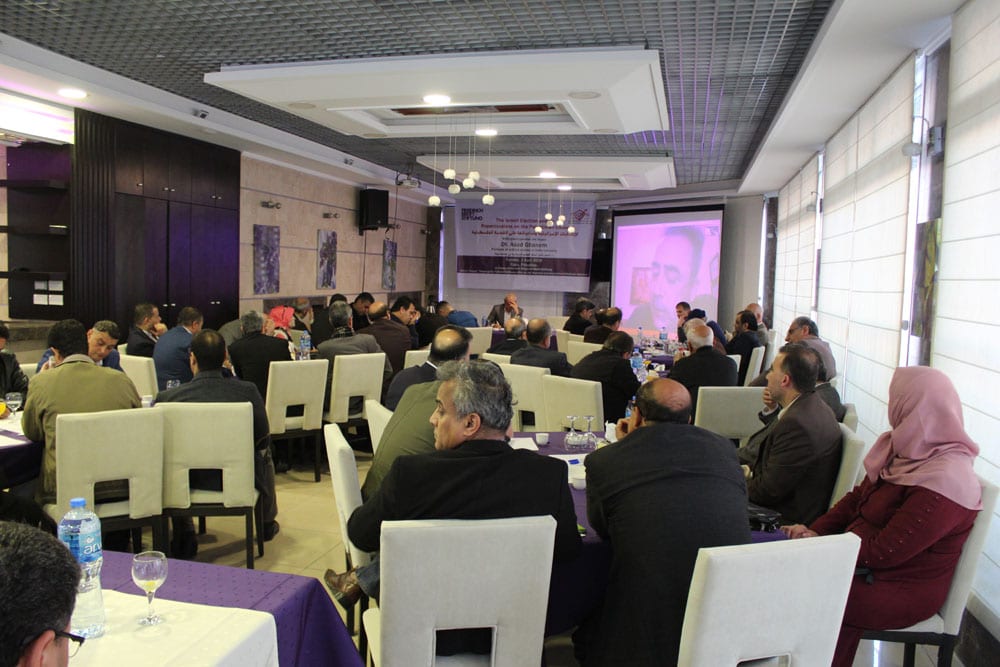
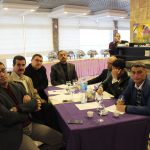
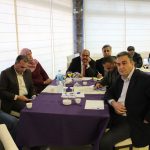
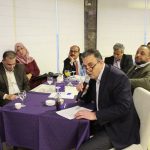
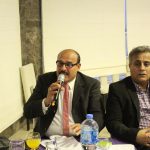
Pal-Think held the Skype dialogue «The Israeli elections and their consequences for the Palestinian question» with Dr. As'ad Ghanem, head of government and political thought at the University of Haifa.
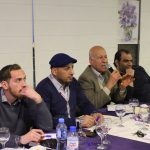
Gaza — The Pal-Think for Strategic Studies institution organised a dialogue session titled “The Israeli elections and their repercussions on the Palestinian cause” via Skype with Dr Asad Ghanem, lecturer in the political-science department and head of the department of government and political thought at the University of Haifa, in cooperation with the German Friedrich Ebert Foundation within the project “Keeping the Palestinian cause on the regional and international political agenda”.
Mr Omar Shaban, director of Pal-Think for Strategic Studies, welcomed the attendees from among the political activists and the academics, and affirmed the Pal-Think institution's continuing pursuit of holding such workshops to enrich and stimulate thought in Palestinian society. Shaban likewise noted that the session is a completion of a series of meetings Pal-Think holds in partnership with the German Friedrich Ebert Foundation, with the goal of strengthening Palestinian awareness and overcoming the intellectual blockade imposed on the Palestinians in Gaza, to form a scientific and deep understanding of the Palestinian cause. Shaban pointed to Dr Asad Ghanem's activity at the communal level and not only the academic.
In his turn, Dr Osama Antar, “programmes director of the German Friedrich Ebert Foundation”, welcomed the attendees and noted the effectiveness of the partnership with Pal-Think and the importance of cooperation for the success of such projects — pointing out that the Israeli policies are what determine what the Palestinians eat at their dining table tomorrow; Israeli politics influences us as Palestinians and not the reverse. What predominates in Israel is the extreme nationalist right-wing character, and there is no centre in Israel. We hope through such sessions to understand well the political environment surrounding and influencing us.
For his part, Dr Asad Ghanem affirmed that the question under way is not only an internal Israeli political question; rather we as Palestinians have been living, since 1967, the results of what happens in Israel. He spoke of two important keys as relates to the elections question. The first is: are we before a critical political condition, meaning revolutionary elections? In reality we are in the stage of the existence of Benjamin Netanyahu, who tries to impose an equation on the Palestinians, namely the acceptance of a settlement and historic reconciliation and the acquiescence in Israel's existence — including the acceptance of a limited Palestinian state, the continuation of the settlements' expansion, Jerusalem as a unified capital of Israel, the demand that the Palestinians recognise the historic right of the Jews in Palestine, and the Palestinians' renunciation of the right of return; and this opinion has been strengthened through the existence of a dominant blocking right-wing bloc, especially with the right under the Likud's control. The second is the existence of the idea of the dominant bloc or party, which is the extreme right, and the attempt to obtain the largest number of votes and the pursuit of hegemony to build the agenda particular to all the state's sectors. The Likud party since 2009 has not reached the degree of the dominant party; but since Sharon's departure the party of the right is what controls Israeli politics, and it seems the right-wing bloc will succeed in the coming elections and form its government. In reality the Likud is what imposes the political agenda, and the Israeli right tries to change the Israeli scene in all the sectors, not only with respect to the Palestinian cause, but the cultural, social, economic scene — trying to control by imposing its policy on all the sectors. The party that represents the people in Israel is the Likud, for it obtains the voters' votes from all the sectors of the Israeli people, and consequently obtains parallel votes from all the classes.
There are many reasons that led to the hegemony and rise of the right in the Israeli political arena: fundamentally the approach of ethnic politics in Israel; for since Oslo voting in the elections transformed onto an ethnic basis — the Arabs vote for the Arabs and the Russians for the Russians and so on — which led to the deepening of ethnic identity in Israel and consequently to the rise of the political currents that were previously in the opposition, and this is considered a deep social change in Israel and its politics. Also the show of a lightening of the intensity of the Israeli–Palestinian conflict in the last 20 years — and this is practically incorrect; rather the conflict has deepened more with the rise of the right and the role of the Palestine Liberation Organization, and the increase of Hamas's strength in Gaza. In addition to that, the pursuit of policies of fear-mongering about the minorities in Israel, including the migrants and the Arabs, and the alarming of the Israeli people about the Palestinians, and the use of Islam to frighten Israel — and this resembles the methodology of the extreme populist right in Europe. Add to that the absence of the Israeli left from the political arena, especially after the departure of personalities like Shimon Peres and Rabin, and consequently the ending of the left in Israel to a great extent.
The participants put many valuable questions, including: what is the future of the '67 state in light of the circumstances? What influences Israeli public opinion? The Israeli government does not recognise the Arab bloc in Israel — are Israeli blocs that defend the Palestinians more effective than them? What is the future of the relationship with Gaza after the rise of the right and the generals? In light of this reality, the continuation of the government of the right, is the policy toward the Palestinian condition an alternative one? Does the rapprochement between Israel and the Arab states influence the elections, meaning their support for Netanyahu? Will the current extreme, reckless policies lead to a radical change in Israeli behaviour? What are the dangers consequent for the two-state solution if a new unified government is formed? What are the repercussions of Netanyahu's ignoring of the Palestinian Authority?
The existing situation in Israel can be summed up: that the political system is a system of blocs in Israel; there is a pragmatic end of the parties — the parties in Israel seek to form coalitions with the right and have become unable to manoeuvre. And the Likud is the decision-holder in Israel. Netanyahu's government was the most right-wing in Israel's history, and the coming government, whatever it be, will be more right-wing. Even if the left rose to rule it would not seek to establish a neighbouring Palestinian state — we have surpassed the matter of the two-state solution in the first place! The one-state solution is the project that must be thought about at present, especially in light of the absence of the Palestinian political project from the arena — there is no Palestinian policy or role inside or outside, and the Palestinians' loss of trust in the capacity of the political leadership, whether inside, outside, or in the Arab world, and the world as a whole, to accomplish any solution to the conflict justly. There remains the question we must all ask of the Palestinian leadership in the '48 lands: how can they lead the Palestinians in light of this deteriorating situation, especially as there is much speculation and it seems the right is the controlling bloc that will dominate later?
Finally, it is necessary to rebuild the Palestinian leadership in the Bank, Gaza, and the '48 lands. As for the party of the right, it exists, and the Likud is hegemonic and controlling, and it does not seem there will be radical changes in Israeli politics in the coming years. As for Gaza, the most beautiful thing for Israel is the Palestinian division — it is the biggest gift for the Israeli right, and this is the ideal situation. As for the deal of the century, the Palestinians are the ones who decide their fate themselves, and not the leaderships.