Young Creations: the role of women's guidance committees during the COVID-19 crisis
Researchers Dina Ismail and Nashwa Rizq discussed their paper on the «Isnad» women's guidance committees' support of local emergency committees against COVID-19 in Palestine's northern governorates.
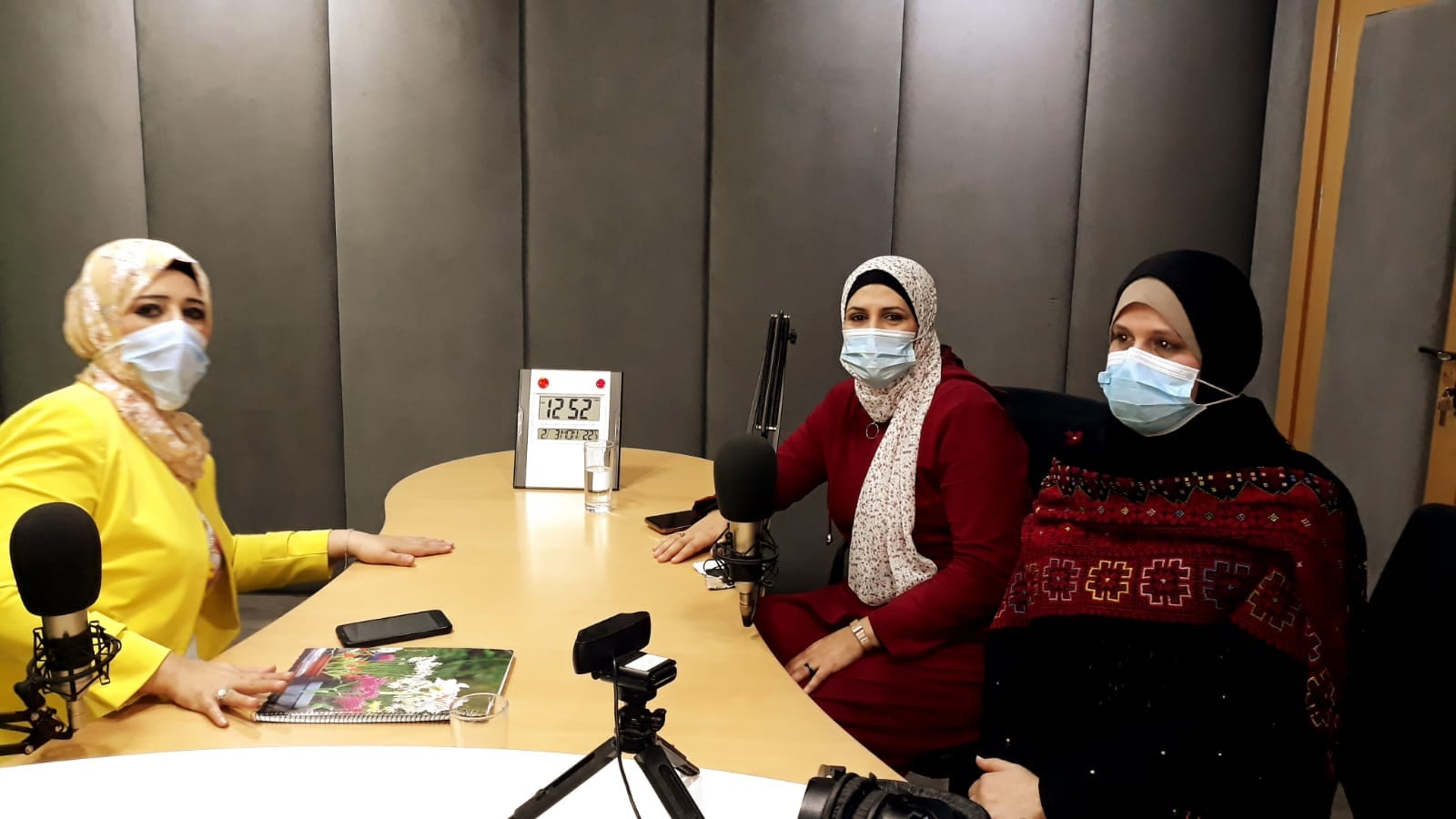
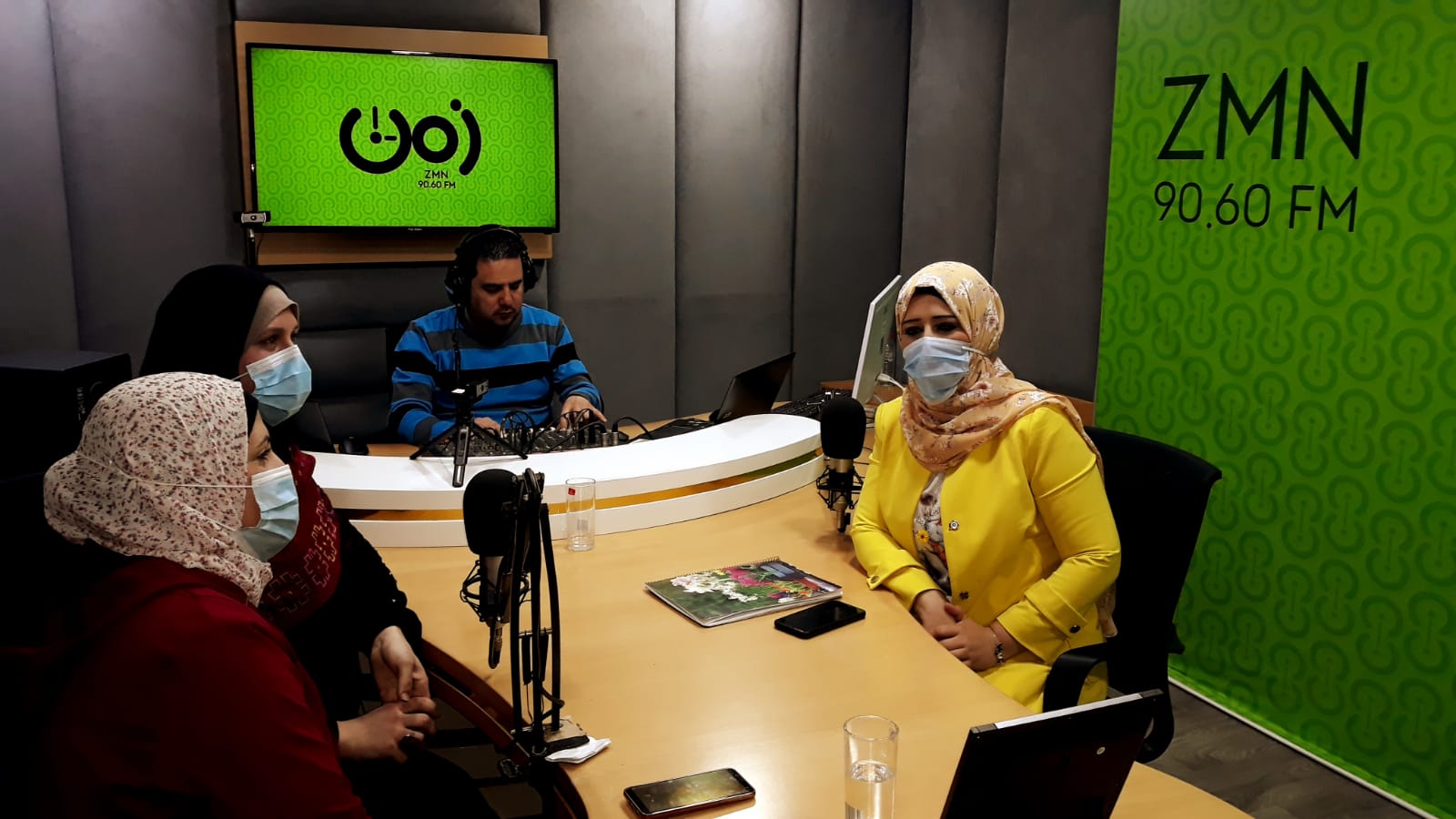
The researchers Dina Ismail and Nashwa Rizq discussed a research paper titled “The role of the women's counselling and guidance committees 'Isnad' in backing the local emergency committees in facing the coronavirus pandemic in the northern governorates in Palestine”, during the second radio episode of the programme “Youth Creations” on Zaman radio in the Gaza Strip, with the participation of the director of Pal-Think for Strategic Studies, Omar Shaban, and the director-general of the Council of Ministers unit at the Ministry of Women's Affairs, Yousef Odeh — within the project “Research writing in gender and feminism”, implemented by “Pal-Think” with funding from the Government of Canada.
The institution's director, Mr Omar Shaban, said in his intervention: “Pal-Think is an independent Palestinian institution that works with the whole of the Palestinian collective, and works with the universities and with 57 civil institutions in the West Bank, Jerusalem, and the Gaza Strip — because we believe in the national partnership and in the importance of preserving the Palestinian social fabric.”
He added: “The Palestinian woman has a fundamental role in the Palestinian struggle and in the social, health, and educational field. There are wonderful models of Palestinian women who assumed great positions and obtained international prizes in multiple fields. Despite that, there is insufficient appreciation from society for women, and sometimes the man wrongs the woman without knowing it — and one of the causes of that is that the voice of most of them is unheard.”
Shaban continued: “Women cannot obtain their rights without conviction from the man himself. Accordingly, raising men's awareness is important. From here came this quality project, to develop the research concepts in gender among male and female researchers. At the project's end these papers will be published in a booklet to become a reference for the Palestinian library, and workshops will be organised for the participants to present their research papers.”
He concluded by saying: “This project is a continuous activity of Pal-Think, which always believes in sustainability.”
For his part, Mr Yousef Odeh spoke of the importance of the training programmes that aim to spread awareness and limit gender-based violence against women.
He said in his intervention: “The idea of forming the guidance committees (Isnad) crystallised during the coronavirus pandemic in the month of March, for the necessity of integrating women into the government committees given their distinguished role since old times; so it was agreed upon with the Ministry of Local Government.”
Odeh reviewed the committee's goals, the most important of them: carrying out women's works in all the villages and cities, working to empower them, and creating a feminist leadership able to change the stereotyped image of women in society through qualifying and training women.
As for the obstacles, he pointed out that the greatest obstacle is the Israeli occupation, then the non-acceptance of the idea by some heads of the municipal councils.
For her part, the researcher Dina Ismail made clear that the goal of forming the committees is benefiting from women's role at the level of the local committees in all the areas, with the goal of strengthening their empowerment in all fields, especially in the circumstances of the coronavirus pandemic.
She said: “Among the most important goals of (Isnad) are creating a condition of integration between the government and civil society institutions, and forming a feminist popular base of a high measure of training, qualification, and awareness — to be one of the levers of social, economic, political, health, and cultural development; and the exchange of experience between the generations through granting the opportunity to integrate the young generation. In addition to strengthening voluntary work and initiatives, to form a communal incubator for that, and creating trust, spreading awareness, and breaking the barrier of fear.”
In the same context, the researcher Nashwa Rizq reviewed the committees' works in the West Bank, among them:
Holding awareness sessions on the effect of the coronavirus and distributing sterilisation tools; distributing some parcels to the quarantined families; holding awareness sessions on Resolution 1325 and its domestication in Palestine; holding awareness sessions on property rights and on the importance of passing the family-protection law; and distributing winter clothing to persons with disability.
The two researchers arrived at recommendations, namely: generalising the experience of the counselling and guidance committees — Isnad — in the southern governorates; working to activate women's role in the local emergency committees; building the capacities of young feminist leaderships to be the nucleus of “Isnad”; the necessity of integrating persons with disability, they being an important stratum in society; working to widen the committees' field of work to comprise new scopes and fields; and finally, taking the necessary measures to preserve the continuity and permanence of “Isnad's” work.