On «Dialogue with Youth»: how to entrench democratic values and human rights in Palestinian society
Continuing its youth-empowerment work, Pal-Think delivered the fourth episode of «Dialogue with Youth» on Zaman FM: «Mechanisms for strengthening democratic values and human rights in Palestinian society».
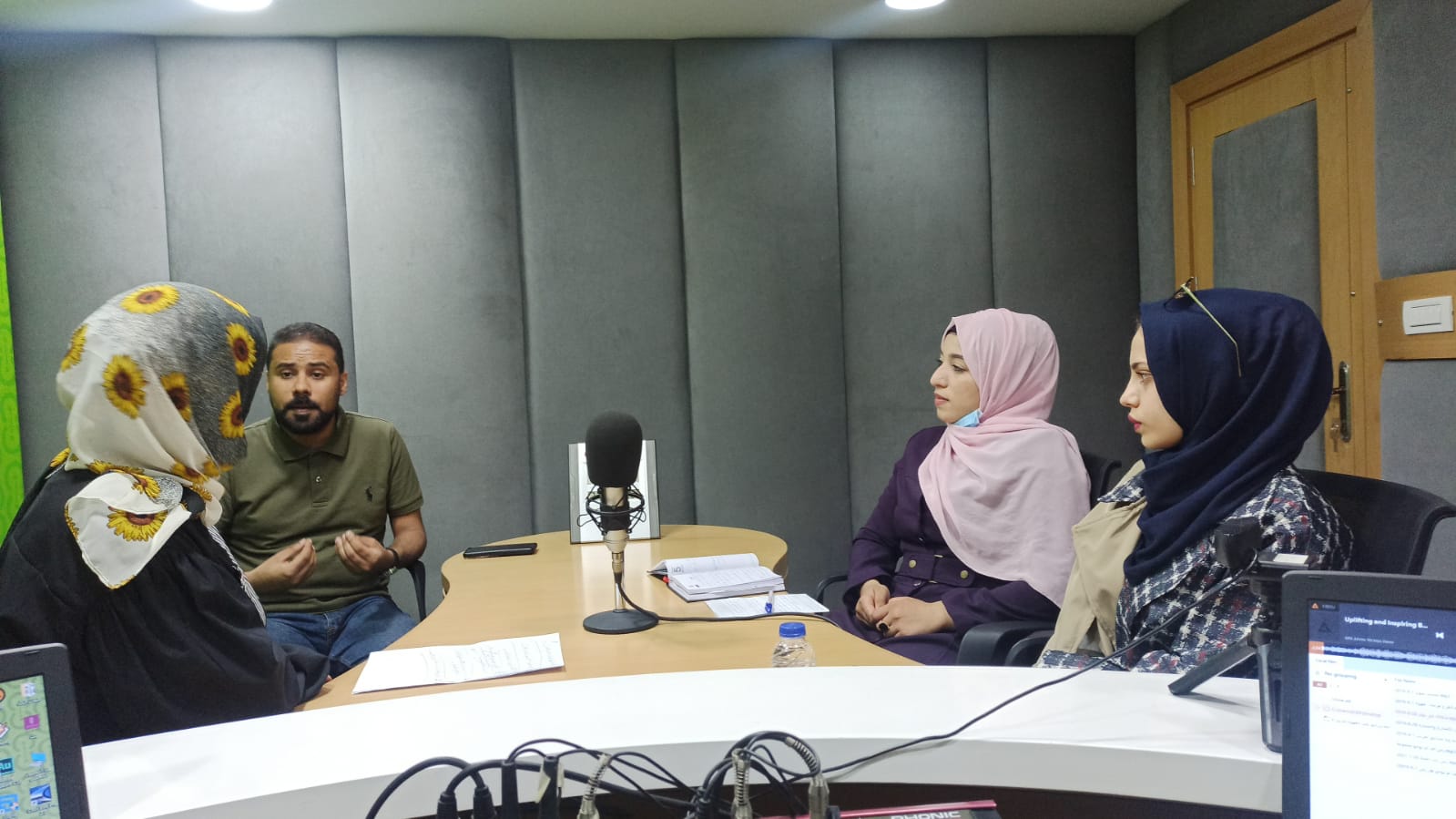
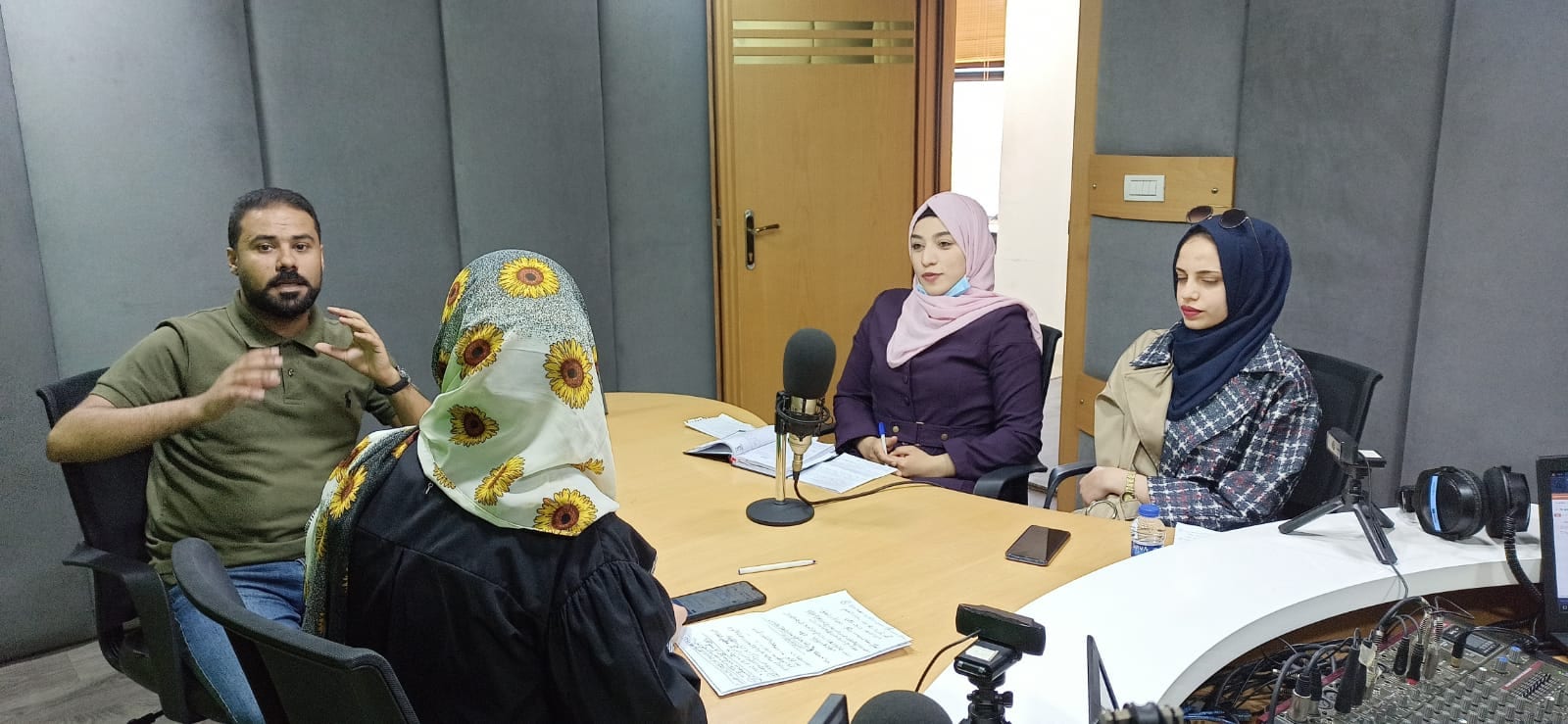
Completing its efforts in empowering youth since its founding, Pal-Think for Strategic Studies carried out the fourth radio episode, titled “Mechanisms of strengthening democratic values and human rights in Palestinian society”, of the programme “Dialogue with Youth”, broadcast on the local Zaman radio every Sunday at noon — within the project “Civic Education”, funded by the National Endowment for Democracy (NED), which aims to strengthen democratic values and human rights among university students.
The episode's guests were: the lawyer and legal researcher Abdallah Sharshara, and the two members of the civic-education body at “Pal-Think” Haneen Lulu and Aya Abu Hatab, who opened her talk about the nature of the body.
She said: “At the beginning we submitted applications to join the civic-education body at Pal-Think, and we went through personal interviews, and 25 young men and women were chosen. Then we received intensive trainings on democracy, human rights, governance, and good governance, at the hands of experts.”
She pointed out that the project had benefited her greatly, as among its outputs was holding a series of workshops in the universities and some institutions, “and it was the first time I educated my peers on the topics of democracy and the subjects we were trained on”.
On how to advance human rights in Palestine, Abu Hatab said: “We must create a belief in individuals in the importance of human rights. Unfortunately, if we asked many of them we would find they do not believe in the work of human rights institutions — so we must correct people's beliefs about human rights, and create a new intellectual system that works to respect the individual and their rights and prevent assault on their rights in any form; and that the political and economic frame of reference for all be human at its base; and that we work to train youth to take part in political life, and bring them out of blind obedience to the cultural heritage.”
She added: “Youth are the category counted upon for change — all the movements of change in history were led by youth. Their first role is an awareness role, and acquiring knowledge of rights and duties, then they pass their knowledge and the concepts of human rights to others.”
Abu Hatab made clear that among the most prominent impediments to applying human rights is the scarcity of awareness and the lack of belief in the principles of human rights, in addition to the cultural heritage in society and the effect of class differences.
For her part, the body member Haneen Lulu opened her talk by thanking “Pal-Think” for granting youth this opportunity to express themselves without restriction or condition. She said: “Among the best things I felt was the spirit of working as a team, alongside the students' turnout — we saw a thirst for knowledge among the students, because the meetings are not based on dictation but on exchanging information.”
She added: “The fundamental goal of strengthening human rights among citizens is forming a good citizen who takes part in a system of government with all its conditions and elements — and this is through training youth in conscious participation and rational conduct, and through institutions training youth on human rights issues to spread the values of citizenship and loyalty to the homeland.”
Lulu pointed out that youth's role in spreading human rights is through training, teaching, media, and passing on knowledge and skills.
For his part, the lawyer Abdallah Sharshara said that human rights, simply, are all the things any human being feels are theirs by right innately; their development is related to the development of humanity and the world, and they are the product of the catastrophes human beings lived through, such as the world wars, disasters, and other things — pointing out that depriving human beings of their rights leads to destructive wars.
He made clear that the principles of human rights are the principles that teach the world that they are fundamental rights everyone must enjoy.
“Human rights in Palestine are deteriorating”
He added: “The condition of human rights in Palestine is extremely deteriorated, and human rights are connected and integrated — for example, our deprivation of the right to vote means we are deprived of many rights. Also, the condition of human rights internally is bad, and among its causes is the deterioration of the economic situation, which throws its weight upon human rights. It is necessary to mention that there is no people that is poor and takes its rights. The violations we live are compound, and we are among the peoples most subjected to compound, concentrated pressure and violations of human rights.”
Sharshara pointed out that there are three principal determinants that determine the situation of human rights in Palestine: first, the political situation in Palestine, where the division exists; second, the economic situation — unemployment and poverty are high, and this means the right to adequate living and the right to work are missing; third, the occupation, which affects several fields and levels, among them human rights.
Ways of change
The lawyer said: “If we wanted to change the reality, we must grasp the reality — most youth and others are unaware of their rights. For example, the right to work: less than 4 per cent of workers have work contracts; even the educated categories such as journalists, most of them work without work contracts and are subjected to employment violations. If we looked only at health insurance, we would find that most of the population lives on government insurance that provides simple government services. If we looked, for example, at the right to education, we would find in the past two years a great turning-away of students from university registration because of the deterioration of economic conditions, and especially because of the Authority's policy of reducing the budget toward the Gaza Strip. Most of society does not grasp that what is happening is a violation of its rights.”
He affirmed that the human being must demand their rights through civilised means once they grasp them. And this is what the civic-education body at “Pal-Think” does: entrenching knowledge about their rights.
Sharshara made clear that among what the Palestinian is owed by the government bodies is free education, the right to social security, health, and life, non-arrest outside the scope of the law, the right to choice and political participation, and children's right to an environment free of internal violence.
Youth are the most harmed
The lawyer affirmed that youth are the category most harmed by the absence of human rights in Palestinian society, it being a young society — in addition to the absence of the alternation of generations in Palestine for a long time, which stopped completely since the beginning of the division.
He pointed out that human rights are the most important guarantee against the repetition of the tragedies that occurred in the Second World War. Whenever the human rights system does not work, the chances of wars and suffering renewing are great.
Sharshara concluded by saying: “Among the most important impediments to human rights is the division, which produced a political and security system that deals with human rights organisations in many cases in an adversarial relationship that impedes any change. In addition, the ideological and intellectual leanings of the ruling regimes may conflict with some rights.