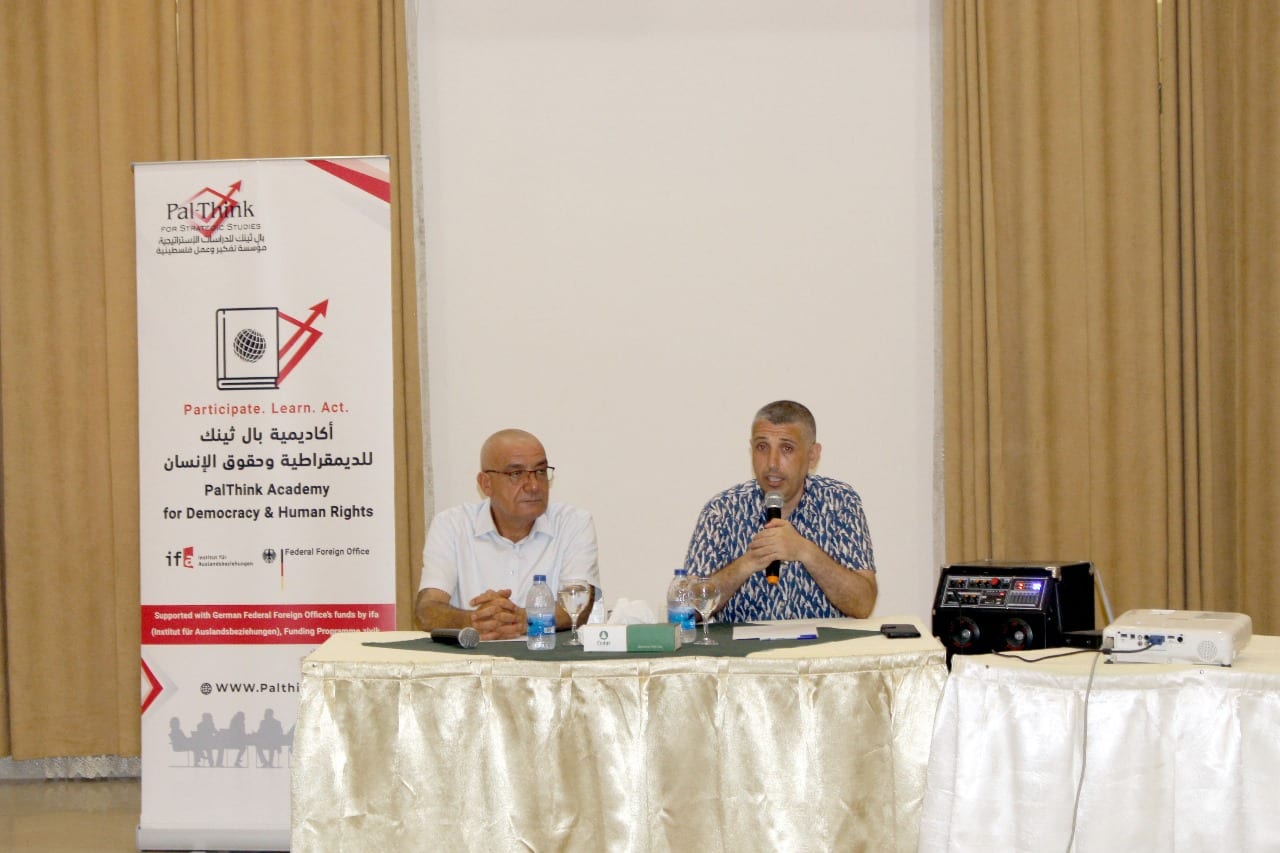
Pal-Think's Academy hosts Dr. Yasser Al-Ashqar on studying and working in Europe
Pal-Think hosted Dr. Yasser Al-Ashqar, professor of law and international relations at Dublin University, speaking with young people about studying and working in Europe, under the Pal-Think Academy for Democracy and Human Rights (phase two).
Gaza — Pal-Think for Strategic Studies hosted Dr Yaser Alashqar, professor of law and international relations at the University of Dublin, to speak with young people about the experience of study and work in Europe — within the activities of the project “Pal-Think Academy for Democracy and Human Rights (second phase)”, implemented by the institution in partnership with the German Institute for Foreign Relations (ifa).
The meeting was opened by Pal-Think's director, Omar Shaban, who welcomed the audience and the guest and affirmed “the highly important role Pal-Think plays in raising young people's awareness by enabling them to meet high-level figures they would not usually be able to meet.”
For his part, Dr Alashqar expressed his delight at the meeting that brought him together with the youth, thanked Pal-Think for organising it, then spoke of his journey — beginning with his upbringing in the Nuseirat camp in the Gaza Strip, then study at Al-Azhar University, then volunteering with an international organisation in Ireland, then a master's in political science in England, then a doctorate in international law in Ireland, then work as professor of law and international relations at the University of Dublin.
He spoke of his interest in the English language in his youth, which played a part in his personal success — enabling him to correspond with many institutions and universities in Europe, which opened opportunities for work and study — and he called on the youth to walk the same path.
Dr Alashqar touched on the challenges facing those wishing to study and work in Europe, among them obtaining opportunities; he therefore called on young people to define their goals and begin early in researching, contacting institutions and universities, networking, and forming relationships.
He said one of the most important challenges young people may face when travelling is the cultural and social shock, calling on them to develop the skills of communication, negotiation, and acceptance of the other so they can adapt and adjust to new environments — by making certain concessions, but without a person abandoning their identity, and by focusing on the principle of participation rather than assimilation.
He noted that among the most important things requiring young people's focus is identifying their experience and their capacities, building on them, and developing them — stressing the West's focus on experience over certificates (don't tell me what you hold; tell me what you can offer).
The young people, for their part, offered a number of interventions and put a number of questions to the guest, centring on learning English, how to contact Western universities, and the initiatives aimed at strengthening dialogue and tolerance in Ireland through coexistence among the different parties.
The doctor concluded by taking up various issues including freedoms in the West, the attacks by Israeli lobbies on Palestinian academics, the importance of holding to professionalism in work and using logic in argument and persuasion; he also spoke of racism toward Arabs and Muslims in the West, noting that it goes no further than individual behaviours and does not reflect Western societies as a whole.