Pal-Think continues the Future Foresight project in Palestine — third session, in partnership with 15 community organisations
A group of civil-society organisations — ACT for Studies and Conflict Resolution, Amjad, the Palestinian Working Woman's Association, Al-Ataa, the South Media Women's Forum and Al-Majd — held a special meeting on 9 March.
A group of civil-society organisations — ACT for Studies and Conflict Resolution, the Amjad Association for Creativity and Community Development, the Palestinian Working Woman Society for Development, the Al-Ataa Association, the Southern Women Journalists Forum, and the Al-Majd Association for Community Development — held a special meeting on Monday 9 March 2025 to discuss and present three policy papers under the project “Strengthening Palestinian civil society's contribution to shaping Palestine's future”, supervised by Pal-Think for Strategic Studies as part of its drive to strengthen Palestinian civil society's role in drawing the policies of the future.
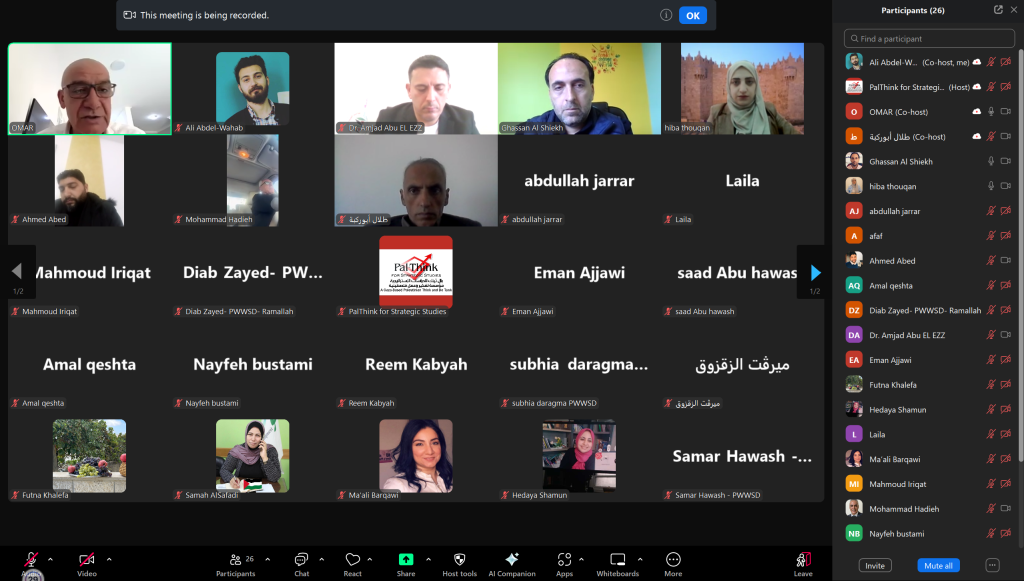
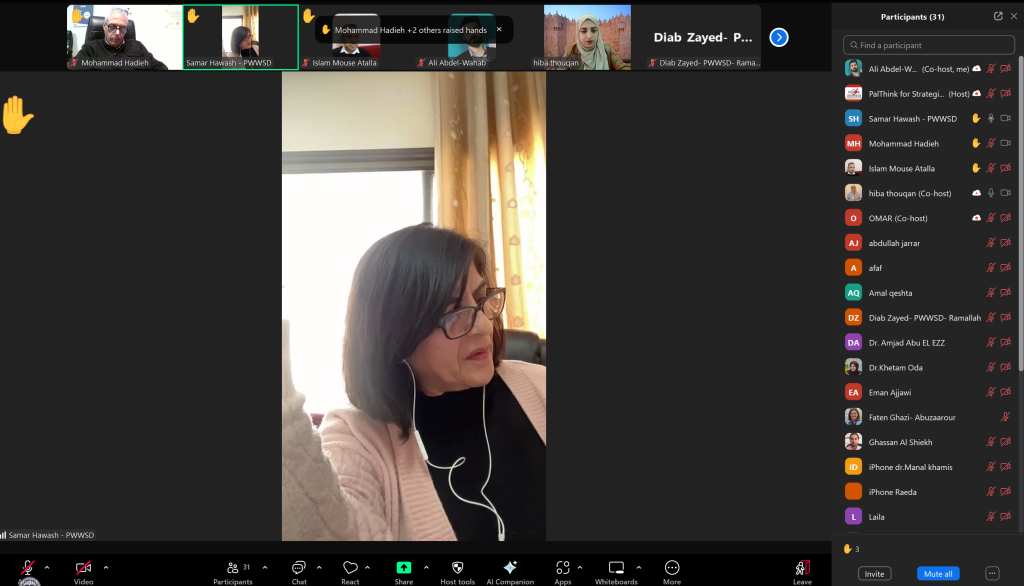
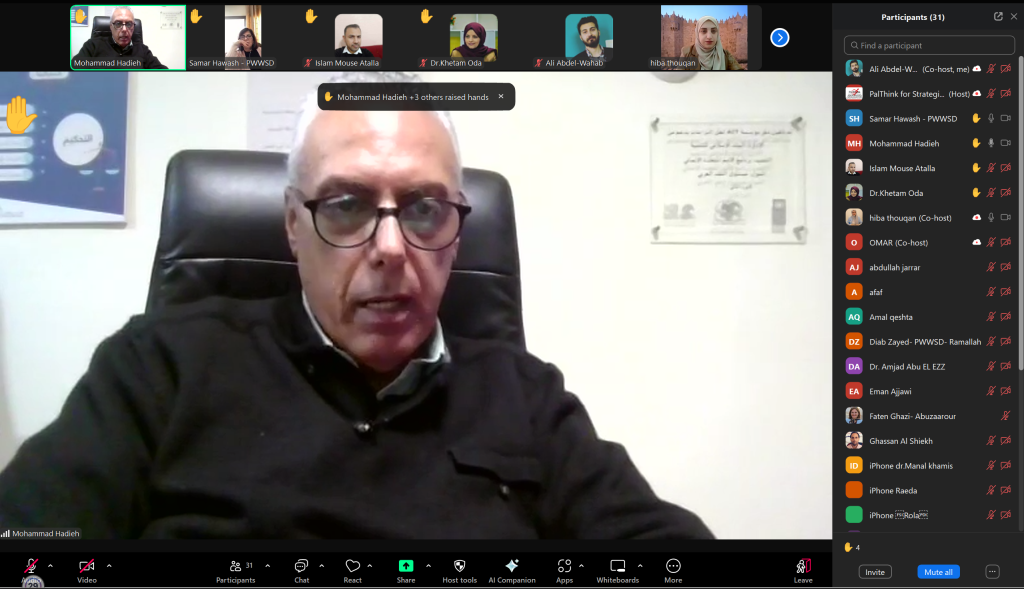
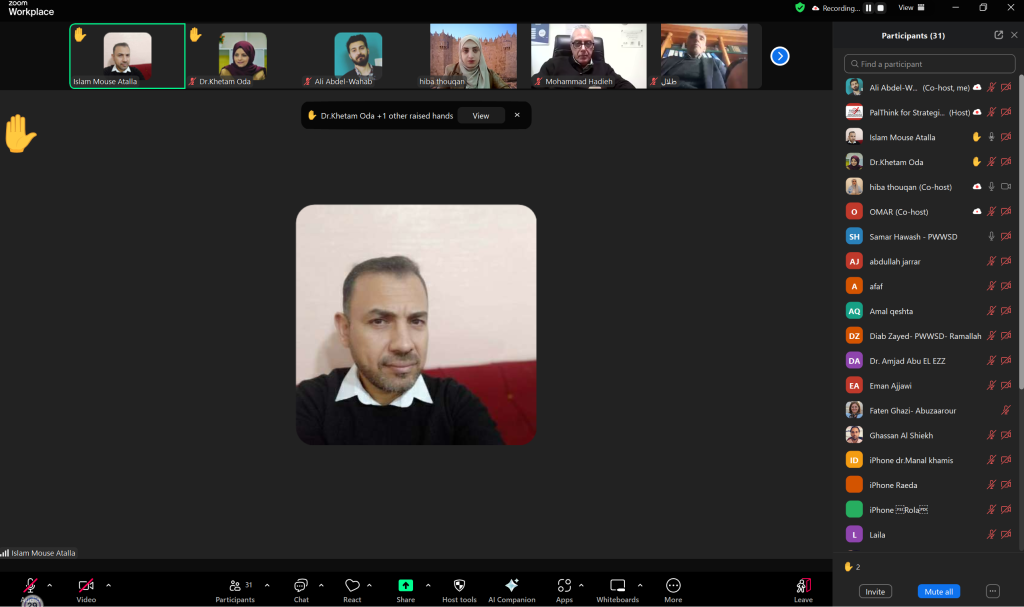
The meeting was attended by an elite of the researchers who prepared the policy papers, alongside a group of academics, experts, and civil-society representatives, in addition to a number of figures concerned with Palestinian affairs from inside Palestine and the Arab world — 37 people in all.
The meeting opened with a word of welcome from the director of Pal-Think for Strategic Studies, Mr Omar Shaban, affirming the importance of policy papers in supporting decision-making and civil society's role in contributing effectively to shaping Palestine's future, especially amid the current political and social changes.
The first paper, titled “Toward practical strategies for overcoming the crisis of identity and thinking among Palestinian youth after the seventh of October”, prepared by the researchers Amal Qishta and Amjad Abu al-Ezz, addressed the challenges Palestinian youth face amid the current crisis, especially after the events of the seventh of October, and the effect of these changes on their national identity and critical thinking. The paper also surveyed a number of proposed strategies for strengthening youth resilience and steering them toward positive, effective roles in society.
The second paper, titled “The future of Jerusalem amid the political and regional changes: a forward-looking reading”, prepared by the researchers Rami Murad and Mahmoud Erekat, focused on the political and regional developments and their effect on the future of the city of Jerusalem, addressing the probable scenarios for the holy city's political situation in light of the regional and international changes, in addition to surveying the challenges Palestinians face in preserving Jerusalem's identity and the policy alternatives for its future.
The third and final paper, titled “Palestinian women between the steadfastness of wars and their role in building a post-conflict society in Gaza”, prepared by the researchers Mervat al-Zaqzouq and Diab Zayed, discussed the role of Palestinian women in facing the repercussions of wars and conflicts and the extent to which the repeated conflicts affect their social and economic life. The paper also addressed the challenges obstructing the empowerment of Palestinian women in the post-conflict phase, and the possible mechanisms for strengthening their role in building a more stable and prosperous society.
After the three papers were presented, the floor was opened for discussion and engagement between the researchers and the audience. Many questions and recommendations were raised by the participants, who affirmed the importance of such meetings in shedding light on the fateful issues affecting Palestine's future. They also stressed the need to activate the research papers' outputs and to circulate the recommendations to decision-makers and the relevant institutions, to guarantee maximum benefit from these studies in drawing development policies that improve the reality of Palestinian society and strengthen its resilience before the current challenges.
This event flows from the importance of the aforementioned project in strengthening Palestinian civil society's role in policy-making by building a coalition of Palestinian community organisations and organising round-table sessions that discuss vital political and social issues. Through these activities, research papers will be produced that contribute practical solutions to the challenges facing Palestine. The project will also help deliver the policy recommendations decision-makers need, strengthening the chances of achieving the required reforms across the different aspects of Palestinian life.